Bioethics
Здесь есть возможность читать онлайн «Bioethics» — ознакомительный отрывок электронной книги совершенно бесплатно, а после прочтения отрывка купить полную версию. В некоторых случаях можно слушать аудио, скачать через торрент в формате fb2 и присутствует краткое содержание. Жанр: unrecognised, на английском языке. Описание произведения, (предисловие) а так же отзывы посетителей доступны на портале библиотеки ЛибКат.
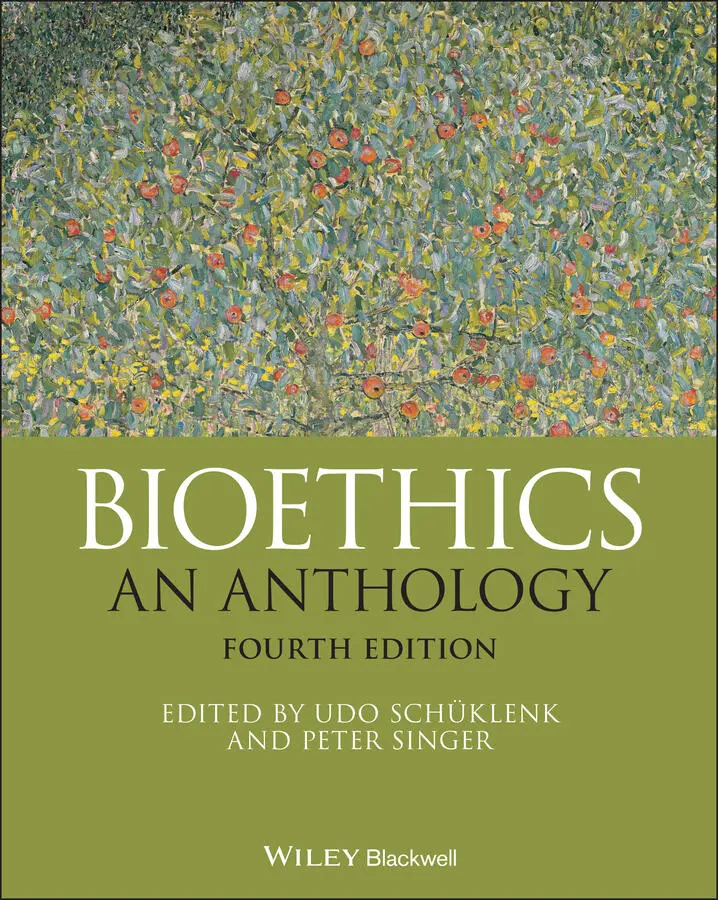
- Название:Bioethics
- Автор:
- Жанр:
- Год:неизвестен
- ISBN:нет данных
- Рейтинг книги:4 / 5. Голосов: 1
-
Избранное:Добавить в избранное
- Отзывы:
-
Ваша оценка:
Bioethics: краткое содержание, описание и аннотация
Предлагаем к чтению аннотацию, описание, краткое содержание или предисловие (зависит от того, что написал сам автор книги «Bioethics»). Если вы не нашли необходимую информацию о книге — напишите в комментариях, мы постараемся отыскать её.
For more than two decades,
has been widely regarded as the definitive single-volume compendium of seminal readings on both traditional and cutting-edge ethical issues in biology and medicine. Acclaimed for its scope and depth of coverage, this landmark work brings together compelling writings by internationally-renowned bioethicist to help readers develop a thorough understanding of the central ideas, critical issues, and current debate in the field.
Now fully revised and updated, the fourth edition contains a wealth of new content on ethical questions and controversies related to the COVID-19 pandemic, advances in CRISPR gene editing technology, physician-assisted death, public health and vaccinations, transgender children, medical aid in dying, the morality of ending the lives of newborns, and much more. Throughout the new edition, carefully selected essays explore a wide range of topics and offer diverse perspectives that underscore the interdisciplinary nature of bioethical study. Edited by two of the field’s most respected scholars, Covers an unparalleled range of thematically-organized topics in a single volume Discusses recent high-profile cases, debates, and ethical issues Features three brand-new sections: Conscientious Objection, Academic Freedom and Research, and Disability Contains new essays on topics such as brain death, life and death decisions for the critically ill, experiments on humans and animals, neuroethics, and the use of drugs to ease the pain of unrequited love Includes a detailed index that allows the reader to easily find terms and topics of interest
remains a must-have resource for all students, lecturers, and researchers studying the ethical implications of the health-related life sciences, and an invaluable reference for doctors, nurses, and other professionals working in health care and the biomedical sciences.
Bioethics — читать онлайн ознакомительный отрывок
Ниже представлен текст книги, разбитый по страницам. Система сохранения места последней прочитанной страницы, позволяет с удобством читать онлайн бесплатно книгу «Bioethics», без необходимости каждый раз заново искать на чём Вы остановились. Поставьте закладку, и сможете в любой момент перейти на страницу, на которой закончили чтение.
Интервал:
Закладка:
The objection to playing God has a much wider appeal than to those who literally believe in a divine plan. But, outside such a context, it is unclear what the objection comes to. If we have a Darwinian view, according to which features of our nature have been selected for their contribution to gene survival, it is not blasphemous, or obviously disastrous, to start to control the process in the light of our own values. We may value other qualities in people, in preference to those which have been most conducive to gene survival.
The prohibition on playing God is obscure. If it tells us not to interfere with natural selection at all, this rules out medicine, and most other environmental and social changes. If it only forbids interference with natural selection by the direct alteration of genes, this rules out negative as well as positive genetic engineering. If these interpretations are too restrictive, the ban on positive engineering seems to need some explanation. If we can make positive changes at the environmental level, and negative changes at the genetic level, why should we not make positive changes at the genetic level? What makes this policy, but not the others, objectionably God‐like?
Perhaps the most plausible reply to these questions rests on a general objection to any group of people trying to plan too closely what human life should be like. Even if it is hard to distinguish in principle between the use of genetic and environmental means, genetic changes are likely to differ in degree from most environmental ones. Genetic alterations may be more drastic or less reversible, and so they can be seen as the extreme case of an objectionably God‐like policy by which some people set out to plan the lives of others.
This objection can be reinforced by imagining the possible results of a programme of positive engineering, where the decisions about the desired improvements were taken by scientists. Judging by the literature written by scientists on this topic, great prominence would be given to intelligence. But can we be sure that enough weight would be given to other desirable qualities? And do things seem better if for scientists we substitute doctors, politicians or civil servants? Or some committee containing businessmen, trade unionists, academics, lawyers and a clergyman?
What seems worrying here is the circumscribing of potential human development. The present genetic lottery throws up a vast range of characteristics, good and bad, in all sorts of combinations. The group of people controlling a positive engineering policy would inevitably have limited horizons, and we are right to worry that the limitations of their outlook might become the boundaries of human variety. The drawbacks would be like those of town‐planning or dog‐breeding, but with more important consequences.
When the objection to playing God is separated from the idea that intervening in this aspect of the natural world is a kind of blasphemy, it is a protest against a particular group of people, necessarily fallible and limited, taking decisions so important to our future. This protest may be on grounds of the bad consequences, such as loss of variety of people, that would come from the imaginative limits of those taking the decisions. Or it may be an expression of opposition to such concentration of power, perhaps with the thought: ‘What right have they to decide what kinds of people there should be?’ Can these problems be side‐stepped?
The Genetic Supermarket
Robert Nozick is critical of the assumption that positive engineering has to involve any centralized decision about desirable qualities: ‘Many biologists tend to think the problem is one of design , of specifying the best types of persons so that biologists can proceed to produce them. Thus they worry over what sort(s) of person there is to be and who will control this process. They do not tend to think, perhaps because it diminishes the importance of their role, of a system in which they run a “genetic supermarket”, meeting the individual specifications (within certain moral limits) of prospective parents. Nor do they think of seeing what limited number of types of persons people’s choices would converge upon, if indeed there would be any such convergence. This supermarket system has the great virtue that it involves no centralized decision fixing the future human type(s).’ 7
This idea of letting parents choose their children’s characteristics is in many ways an improvement on decisions being taken by some centralized body. It seems less likely to reduce human variety, and could even increase it, if genetic engineering makes new combinations of characteristics available. (But we should be cautious here. Parental choice is not a guarantee of genetic variety, as the influence of fashion or of shared values might make for a small number of types on which choices would converge.)
To those sympathetic to one kind of liberalism, Nozick’s proposal will seem more attractive than centralized decisions. On this approach to politics, it is wrong for the authorities to institutionalize any religious or other outlook as the official one of the society. To a liberal of this kind, a good society is one which tolerates and encourages a wide diversity of ideals of the good life. Anyone with these sympathies will be suspicious of centralized decisons about what sort of people should form the next generation. But some parental decisons would be disturbing. If parents chose characteristics likely to make their children unhappy, or likely to reduce their abilities, we might feel that the children should be protected against this. (Imagine parents belonging to some extreme religious sect, who wanted their children to have a religious symbol as a physical mark on their face, and who wanted them to be unable to read, as a protection against their faith being corrupted.) Those of us who support restrictions protecting children from parental harm after birth (laws against cruelty, and compulsion on parents to allow their children to be educated and to have necessary medical treatment) are likely to support protecting children from being harmed by their parents’ genetic choices.
No doubt the boundaries here will be difficult to draw. We already find it difficult to strike a satisfactory balance between protection of children and parental freedom to choose the kind of upbringing their children should have. But it is hard to accept that society should set no limits to the genetic choices parents can make for their children. Nozick recognizes this when he says the genetic supermarket should meet the specifications of parents ‘within certain moral limits’. So, if the supermarket came into existence, some centralized policy, even if only the restrictive one of ruling out certain choices harmful to the children, should exist. It would be a political decision where the limits should be set.
There may also be a case for other centralized restrictions on parental choice, as well as those aimed at preventing harm to the individual people being designed. The genetic supermarket might have more oblique bad effects. An imbalance in the ratio between the sexes could result. Or parents might think their children would be more successful if they were more thrusting, competitive and selfish. If enough parents acted on this thought, other parents with different values might feel forced into making similar choices to prevent their own children being too greatly disadvantaged. Unregulated individual decisions could lead to shifts of this kind, with outcomes unwanted by most of those who contribute to them. If a majority favour a roughly equal ratio between the sexes, or a population of relatively uncompetitive people, they may feel justified in supporting restrictions on what parents can choose. (This is an application to the case of genetic engineering of a point familiar in other contexts, that unrestricted individual choices can add up to a total outcome which most people think worse than what would result from some regulation.)
Читать дальшеИнтервал:
Закладка:
Похожие книги на «Bioethics»
Представляем Вашему вниманию похожие книги на «Bioethics» списком для выбора. Мы отобрали схожую по названию и смыслу литературу в надежде предоставить читателям больше вариантов отыскать новые, интересные, ещё непрочитанные произведения.

Обсуждение, отзывы о книге «Bioethics» и просто собственные мнения читателей. Оставьте ваши комментарии, напишите, что Вы думаете о произведении, его смысле или главных героях. Укажите что конкретно понравилось, а что нет, и почему Вы так считаете.