Creative Lives
Здесь есть возможность читать онлайн «Creative Lives» — ознакомительный отрывок электронной книги совершенно бесплатно, а после прочтения отрывка купить полную версию. В некоторых случаях можно слушать аудио, скачать через торрент в формате fb2 и присутствует краткое содержание. Жанр: unrecognised, на английском языке. Описание произведения, (предисловие) а так же отзывы посетителей доступны на портале библиотеки ЛибКат.
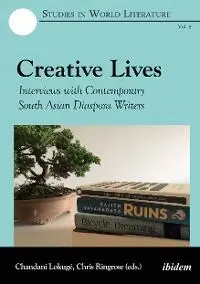
- Название:Creative Lives
- Автор:
- Жанр:
- Год:неизвестен
- ISBN:нет данных
- Рейтинг книги:5 / 5. Голосов: 1
-
Избранное:Добавить в избранное
- Отзывы:
-
Ваша оценка:
Creative Lives: краткое содержание, описание и аннотация
Предлагаем к чтению аннотацию, описание, краткое содержание или предисловие (зависит от того, что написал сам автор книги «Creative Lives»). Если вы не нашли необходимую информацию о книге — напишите в комментариях, мы постараемся отыскать её.
The interviewers and interviewees are: Alexandra Watkins, Michelle de Kretser, Homi Bhabha, Klaus Stierstorfer, Amit Chaudhuri, Pavan Malreddy, Rukhsana Ahmad, Maryam Mirza, Shankari Chandran, Birte Heidemann, Neel Mukherjee, Anjali Joseph, Chris Ringrose, Michelle Cahill, Rajith Savanadasa, Mariam Pirbhai, Maryam Mirza, Mridula Koshy, Sehba Sarwar, Dr Angela Savage, Sulari Gentill.
Creative Lives — читать онлайн ознакомительный отрывок
Ниже представлен текст книги, разбитый по страницам. Система сохранения места последней прочитанной страницы, позволяет с удобством читать онлайн бесплатно книгу «Creative Lives», без необходимости каждый раз заново искать на чём Вы остановились. Поставьте закладку, и сможете в любой момент перейти на страницу, на которой закончили чтение.
Интервал:
Закладка:
Contents
Foreword by Janet Wilson
Introduction
The Act of Inter-viewing: A Network of Creative Lives in the South Asian Diaspora
Genres, Languages, Voices: Rukhsana Ahmad in Conversation with Maryam Mirza
The Aesthetics of Fragmentation: Michelle Cahill in Conversation with Chris Ringrose
Writing One Reality, Returning to Another: Shankari Chandran in Conversation with Birte Heidemann
In a State of Indifference: Amit Chaudhuri in Conversation with Pavan Kumar Malreddy
Poetry as Radical Resistance: R. Cheran in Conversation with Aparna Halpé
An Infinity of Traces: Suneeta Peres da Costa in Conversation with Reshmi Lahiri-Roy
The Delicious Indulgences of Writing: Sulari Gentill in Conversation with Angela Savage
“An Island is a World”: Romesh Gunesekera in Conversation with Susheila Nasta
A Highbrow “Hijra”: Kaiser Haq in Conversation with Mohammad A. Quayum
Nomadic Thinking: Tabish Khair in Conversation with Pavan Kumar Malreddy
Reading, Writing and the Contours of Power: Mridula Koshy in Conversation with Maryam Mirza
“To want to know the world, to look outward”: Neel Mukherjee in Conversation with Anjali Joseph
Before the Battle: Karthika Naïr in Conversation with Laetitia Zecchini
Remapping Canada: Mariam Pirbhai in Conversation with Maryam Mirza
“I Ground Myself in Multiple Spaces”: Sehba Sarwar in Conversation with Maryam Mirza
The Processes of Fiction, Theatre and Life: Rajith Savanadasa in Conversation with Alexandra Watkins
Where Politics and Climate Meet: Sungchuk Kyi in Conversation with Ruth Gamble
Places and Proximities: Samrat Upadhyay in Conversation with Prakash Subedi
About the Editors
ibidem-Press, Stuttgart
Foreword
Janet Wilson
The pleasure of reading these fascinating interviews with writers and artists cannot be underestimated. The interview is a way to hear their voices in dialogue with empathetic, discerning readers and interpreters of their work. It offers a snapshot of the writers’ world view as it has determined their writing and life moves, and the particular choices they have made. Such motivations towards developing a hybrid narrative voice on the part of the 18 South Asian diasporic writers who appear in this volume hinge on their decision to migrate from their homelands. Since they are exiles and migrants, their journeys are constitutive of the multidirectional trajectories comprising the many South Asian diasporas that extend across the globe: collectively the world’s largest diaspora today.
This collection represents a shop-front for the work of the South Asian Diaspora Researchers’ Network (SADIRN) established at Monash University, Australia in 2016. It stems from an ongoing project that involved network members and affiliates in discussion with transnational, global writers, both in Australia and beyond, and reflects the oversight and commitment of its Director Chandani Lokuge, and her co-editor of this volume, Chris Ringrose. Its range of interviews reflects SADIRN’s international relations with European research groups such as that run by Frank Schulze-Engler at the University of Frankfurt and the European Association for Australian Studies (EASA). There is also its fruitful liaison with the journal Wasafiri, through its founding-editor Susheila Nasta, which over the last 35 years has pioneered landmark interviews with writers from “other” cultures.
Creative Lives is an illustrious extension of Wasafiri’s tradition of fostering these literatures: it features writers who have relocated in diverse European, Australian and US centres yet retain ties with their homelands in Bangladesh, India, Nepal, Pakistan, Sri Lanka and Tibet. Alongside interviews with writers shortlisted for the Man Booker Prize are conversations with writers who are national and international prize-winners, or have been shortlisted for prestigious grants and awards.
In their excellent, wide-ranging introduction, Lokuge and Ringrose, who like many of the interviewees are creative writers as well as essayists, critics and scholars, draw attention to the liminality implicit in the act of interviewing. The interviews themselves demonstrate the contrapuntal diasporic subjectivity that arises from living in two or more cultures, which is refracted in narrative practices of hybrid, transcultural, transnational writing, and the shaping discourses of movement and resettlement. The dual focus on movement to new countries like Australia, Canada, France, the UK and USA, alongside the ongoing pull of homeland issues and cultures, suggests their work may be read according to some mix of postcolonial and world literature writing categories, as proposed by Stephan Helgesson (2014), insofar as they are concerned with “local conflictual histories” and their transcultural production belongs to a “circulational phenomenon that moves across languages and literary fields” (484).
The challenges faced by these writers converge on the crux for all migrants, whether voluntary, exiled, refugee or asylum seeker: national borders, visas, entry permits, and policies of exclusion, as well as the related question of whether cultures’ “others” are perceived as located within the nation or as aliens threatening from outside. As a liminal act each one of these 18 interviews is constructed from the writer’s re-experience and recreation in words of a material reality—the vicissitudes of migration and dislocation due to political and cultural pressures, and the struggle between familial, national ties and affiliative urges—and each depends for its animation and direction on the synchronicities and affinities between interviewer and interviewee.
Creative Lives reinforces the special value of the interview at a time of devastation wrought by the COVID-19 pandemic, and by political upheavals across the globe. In this era of fake news, shrinking borders, and global uncertainty, our minds are being rewired, our antennae of curiosity and enquiry activated differently. Such reconfiguring processes and increased connectivity between people due to mobile technology— video teleconferencing services like Zoom, TV and video streaming services, and social media networking—have been reinforced by social isolation and national lockdowns. The interview format contributes to this greatly enhanced access to information that enables us, as readers, consumers, and co-producers of knowledge, to choose how to think more critically.
Bibliography
Helgesson, Stephan. 2014. “Postcolonialism and World Literature: Rethinking the Boundaries.” Interventions 16 (4): 483–500.
Introduction
The Act of Inter-viewing: A Network of Creative Lives in the South Asian Diaspora
Chandani Lokuge and Chris Ringrose
What is more important in a network than the interstitial relations? What Hannah Arendt called human “inter-est”, that which is between people and brings them together. (Bhabha 2015)
An “interview” is a pragmatic way into new knowledge but is also suggestive of subtle undertones and interpretations of what is already known and familiar. On the one hand, it is an interrogation or conversation that brings together one individual, the interviewee, and an other, the interviewer, who shares their world. In the act of the interview, the individual sees themselves in relation to and separate from the other—who represents the public beyond their own world. When split with a hyphen, as we have chosen to do here, “inter-view” suggests something more introspective and liminal: looking inward or in-between. The effect then could be of something unpredicted, a frisson, perhaps, created between what is said and not said, what is felt and not thought—an inward reaction that resists articulation but is important to our notions of who we are in our continual negotiations with the world.
Читать дальшеИнтервал:
Закладка:
Похожие книги на «Creative Lives»
Представляем Вашему вниманию похожие книги на «Creative Lives» списком для выбора. Мы отобрали схожую по названию и смыслу литературу в надежде предоставить читателям больше вариантов отыскать новые, интересные, ещё непрочитанные произведения.





Обсуждение, отзывы о книге «Creative Lives» и просто собственные мнения читателей. Оставьте ваши комментарии, напишите, что Вы думаете о произведении, его смысле или главных героях. Укажите что конкретно понравилось, а что нет, и почему Вы так считаете.