Cordula Glass - Collocations, Creativity and Constructions
Здесь есть возможность читать онлайн «Cordula Glass - Collocations, Creativity and Constructions» — ознакомительный отрывок электронной книги совершенно бесплатно, а после прочтения отрывка купить полную версию. В некоторых случаях можно слушать аудио, скачать через торрент в формате fb2 и присутствует краткое содержание. Жанр: unrecognised, на английском языке. Описание произведения, (предисловие) а так же отзывы посетителей доступны на портале библиотеки ЛибКат.
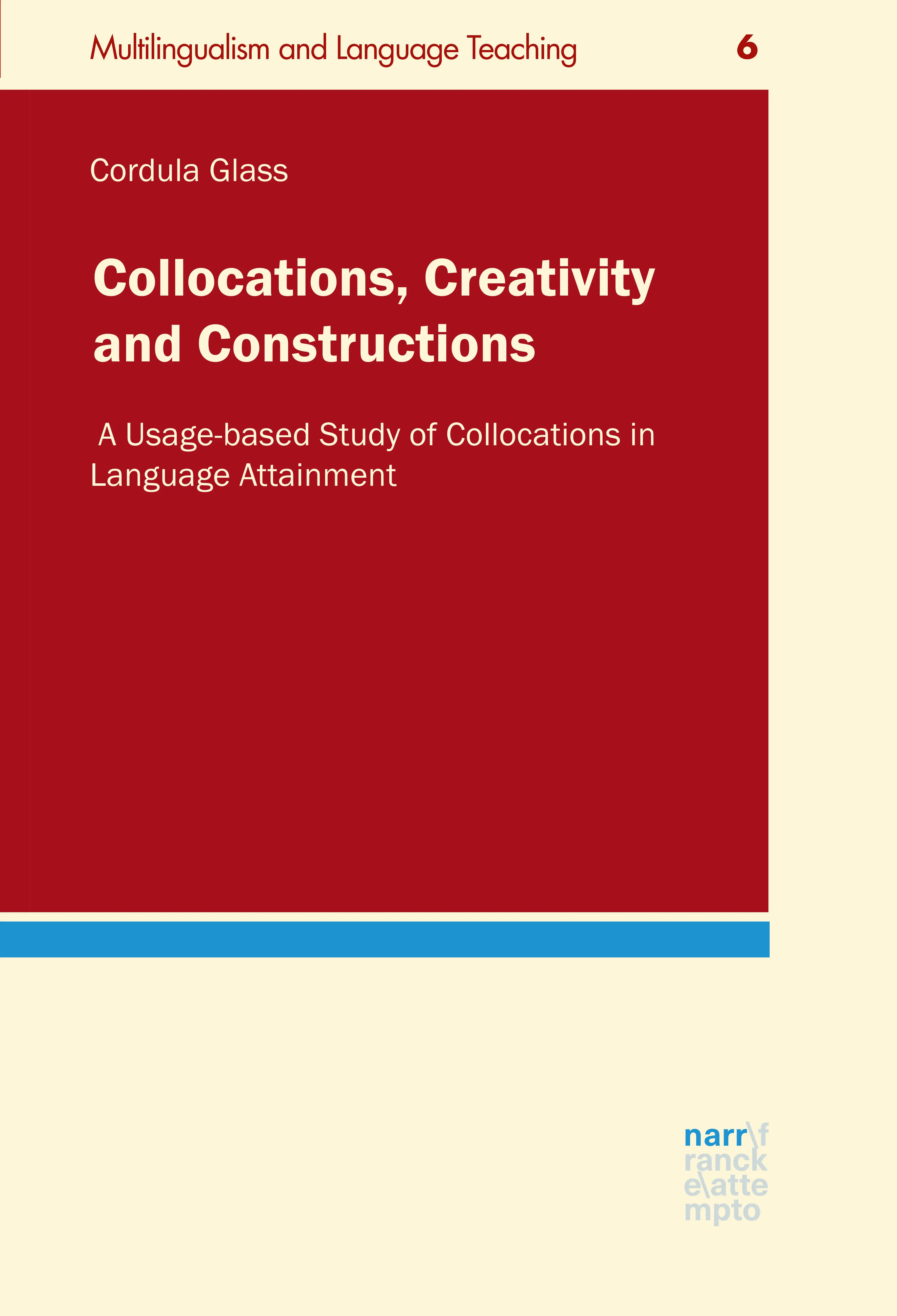
- Название:Collocations, Creativity and Constructions
- Автор:
- Жанр:
- Год:неизвестен
- ISBN:нет данных
- Рейтинг книги:3 / 5. Голосов: 1
-
Избранное:Добавить в избранное
- Отзывы:
-
Ваша оценка:
Collocations, Creativity and Constructions: краткое содержание, описание и аннотация
Предлагаем к чтению аннотацию, описание, краткое содержание или предисловие (зависит от того, что написал сам автор книги «Collocations, Creativity and Constructions»). Если вы не нашли необходимую информацию о книге — напишите в комментариях, мы постараемся отыскать её.
Collocations, Creativity and Constructions — читать онлайн ознакомительный отрывок
Ниже представлен текст книги, разбитый по страницам. Система сохранения места последней прочитанной страницы, позволяет с удобством читать онлайн бесплатно книгу «Collocations, Creativity and Constructions», без необходимости каждый раз заново искать на чём Вы остановились. Поставьте закладку, и сможете в любой момент перейти на страницу, на которой закончили чтение.
Интервал:
Закладка:
Of course, some of these examples sketch a very rare use of bachelor or man . But any description of linguistic processes needs to be able to account for less frequent or creative applications as well. At the same time, this is why an analysis of collocations and their more creative alternations not only has the potential to gain insight into the creative process at work but can also explain aspects of a speaker’s language processing in general. Admittedly, Katz and Fodor explicitly stress that what they introduce is a “characterization” rather than a “semantic theory of a natural language” (Katz/Fodor 1963: 170). Nevertheless, in their framework too, the idea of a contextual setting is already an important variable for the semantic interpretation of sentences (Katz/Fodor 1963: 176–181), even if it struggles to explain the interpretation of creative or even partly contradictory readings, as demonstrated above. Nonetheless, the question of the origin of meaning in general and creative readings in particular should be central to any semantic theory, irrespective of whether it is trying to explain naturally occurring utterances or a stylized linguistic system. Together with Postal, Katz also developed a theory which argues that meaning remains constant across generative transformations (Katz/Postal 1964). According to the Katz-Postal Hypothesis , semantic representations are allocated in a sentence’s deep structure 1, while actual sentences are a result of transformations and represent different surface structures, all of which share the same deep structure. Therefore, Katz and Postal (1963) also suggest treating sentences with an idiomatic reading, like to kick the bucket , as one possible surface structure which shares the same deep structure as the more literal to die (Prinz 1983). Similar2 to the concept of Interpretive Semantics, this Generative Semantic approach also presupposes that potential semantic representations are already part of the deep structure, which makes it difficult to account for spontaneous, creative alternations and readings within this theory.
4.1.2 Conceptual Semantics and Parallel Architecture
Ray Jackendoff (2002, 1990), one of Chomsky’s students, takes a different approach to semantic structures within a Universal Grammar framework. Unlike Katz and Fodor’s advance in Interpretive Semantics, his Conceptual Semantics does not assume that aspects of meaning are derived from syntactic structures. Rather, he presupposes that there is a network of semantic primitives which form the components of semantic structures. As a result, semantic structures exist as a generative entity alongside syntactic structures; both are correlated through interface rules. With this perspective, he moves away from the traditional Universalist perspective that syntax is primary to all other aspects of language but retains the Chomskyan spirit when he summarises the aim of his research as follows:
My purpose – the characterization of the mental resources that make possible human knowledge and experience in the world – is conceived as an extension of Chomsky’s goals. Accordingly, an important boundary condition on my enterprise is that it be in all respects compatible with the world view of generative linguistics. In particular, it is crucial to choose I-concepts rather than E-concepts as the focus for a compatible theory of knowledge. (Jackendoff 1990: 8)
Nevertheless, Jackendoff also acknowledges that he shares his pursuit for internal “mental resources” with researchers from fields like Cognitive Grammar or Cognitive Semantics , but stresses that, unlike Cognitive Grammar approaches, Conceptual Semantics is “committed to an autonomous level of syntactic representation rather than to its abandonment” as well as “to rigorous formalism” (Jackendoff 1990: 16). At the same time, he is also keen to find potential relations between perceptual psychology, language acquisition, and his new approach. Hoping to find “the possibility of a strong, innate, formal basis for concept acquisition” (Jackendoff 1990: 16), Jackendoff then sets out to analyse various words and phenomena. Among these is the way -construction as in (24)
| (24) | Babe Ruth homered his way into the hearts of America. (Jackendoff 1990: 211) |
Later, Jackendoff flags the analysis of this construction as one of the main reasons why he started to consider constructionist approaches as a potential explanation for the restricted, yet productive nature of a construction like “V X’s way PP” (Jackendoff 2013: 77). This observation led Jackendoff to the Parallel Architecture model which, in many respects, is very similar to most modern construction grammar approaches (> 4.3.1) in that it assumes that language is ultimately produced by the combination of more or less abstract lexical items. These lexical items again are in their prototypical form very much defined as constructions, namely as a pairing of phonological, syntactical and conceptual structures. Furthermore, Parallel Architecture also allows for lexical items which lack one of the three columns, like predominantly structural items without a concrete phonological representation1 but which are still seen as a unit as long as they are stored in the long-term memory. (Jackendoff 2002: 152–195)
Still very much rooted in a generative framework is Jackendoff’s focus on the presumably unlimited productivity of language in general and lexical items in particular, which, of course, makes his approach relevant for the analysis of creativity and creative alternations of established items. Since his defining feature is storage in long-term memory, the cognitive make-up of language, according to Parallel Architecture, very much depends on which items are needed to produce the potentially infinite amount of utterances. Here, Jackendoff suggests two mechanisms, full productivity , and semi-productivity , to account for lexical items which can be extended without many limitations and more restricted entries on the other side of the spectrum. For items with full productivity, Jackendoff postulates that only a more abstract, rather prototypical entry is enough, even though he admits that it might be likely that, especially in the early stages of language acquisition, some exemplar instances remain (Jackendoff 2002: 339–343). This, for example, might be the case for general structural relations like V+N. In semiproductive items, regular behaviour can be observed as well, however, as Jackendoff points out “acceptable instances must be learned and stored individually” (Jackendoff 2013: 84). As a consequence, semi-productive items cannot be fully predicted as far as their potential variations and extensions are concerned, yet there might be sub-constructions, which can behave in a fully productive, open way. Analysis of collocations and their creative alternations according to Jackendoff could work in a similar way. While pretty or commit might not form accepted combinations with any noun, a construction like [ pretty +N ] or [ commit +N ] could form an unlimited number of word pairs. The aspect of an additional reading, which Jackendoff assumes to be contextually decodable, is referred to as enriched composition in Parallel Architecture (Jackendoff 2002: 387–394).
Therefore, even though Jackendoff’s research started out as an exclusively generativistic undertaking, the last few paragraphs have shown that it gradually developed into a framework which, in conceptualisation and layout, resembles most construction grammar approaches. The fact that Jackendoff himself acknowledges that generativist linguistics is not comprehensive enough, since it is not able to explain phenomena like the way -construction, shows that, despite the central role which Generative Grammar assigns to creativity, it can be only applied to a quite limited set of creative language2. Thus, other approaches, which also take actual language and language use into account, are needed to design a useful framework for any type of creative language. Jackendoff’s advances contain some interesting thoughts, yet, they are still mostly based on introspective consideration. Therefore, the next chapter will present a family of approaches which, from the very beginning, were dedicated to basing their theories on more usage-based grounds.
Читать дальшеИнтервал:
Закладка:
Похожие книги на «Collocations, Creativity and Constructions»
Представляем Вашему вниманию похожие книги на «Collocations, Creativity and Constructions» списком для выбора. Мы отобрали схожую по названию и смыслу литературу в надежде предоставить читателям больше вариантов отыскать новые, интересные, ещё непрочитанные произведения.



![Chade-Meng Tan - Search Inside Yourself - Increase Productivity, Creativity and Happiness [ePub edition]](/books/703803/chade-thumb.webp)


Обсуждение, отзывы о книге «Collocations, Creativity and Constructions» и просто собственные мнения читателей. Оставьте ваши комментарии, напишите, что Вы думаете о произведении, его смысле или главных героях. Укажите что конкретно понравилось, а что нет, и почему Вы так считаете.