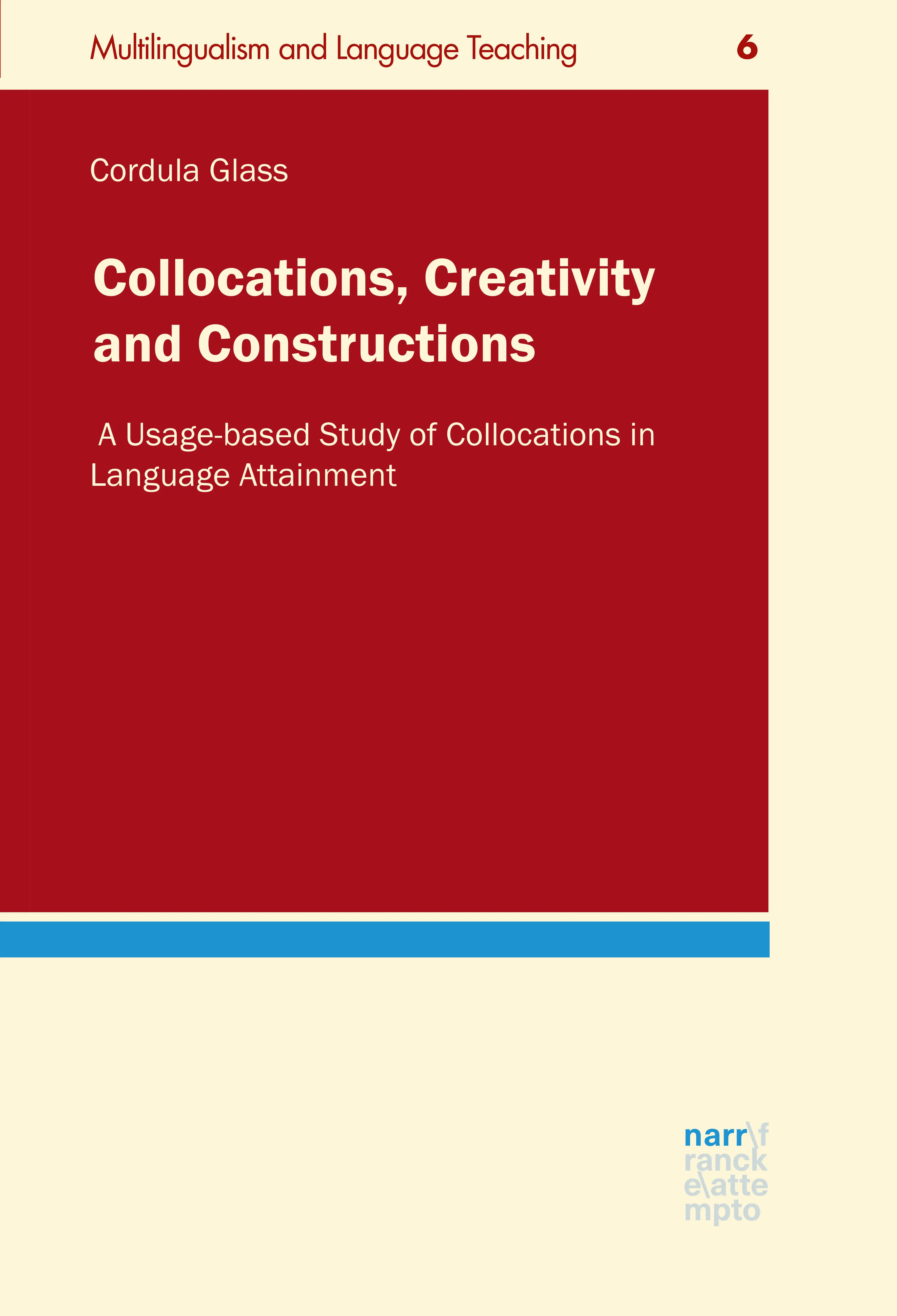
Cordula Glass - Collocations, Creativity and Constructions
Здесь есть возможность читать онлайн «Cordula Glass - Collocations, Creativity and Constructions» — ознакомительный отрывок электронной книги совершенно бесплатно, а после прочтения отрывка купить полную версию. В некоторых случаях можно слушать аудио, скачать через торрент в формате fb2 и присутствует краткое содержание. Жанр: unrecognised, на английском языке. Описание произведения, (предисловие) а так же отзывы посетителей доступны на портале библиотеки ЛибКат.
- Название:Collocations, Creativity and Constructions
- Автор:
- Жанр:
- Год:неизвестен
- ISBN:нет данных
- Рейтинг книги:3 / 5. Голосов: 1
-
Избранное:Добавить в избранное
- Отзывы:
-
Ваша оценка:
Collocations, Creativity and Constructions: краткое содержание, описание и аннотация
Предлагаем к чтению аннотацию, описание, краткое содержание или предисловие (зависит от того, что написал сам автор книги «Collocations, Creativity and Constructions»). Если вы не нашли необходимую информацию о книге — напишите в комментариях, мы постараемся отыскать её.
Collocations, Creativity and Constructions — читать онлайн ознакомительный отрывок
Ниже представлен текст книги, разбитый по страницам. Система сохранения места последней прочитанной страницы, позволяет с удобством читать онлайн бесплатно книгу «Collocations, Creativity and Constructions», без необходимости каждый раз заново искать на чём Вы остановились. Поставьте закладку, и сможете в любой момент перейти на страницу, на которой закончили чтение.
Интервал:
Закладка:
Investigating linguistic creative alternation against a language acquisition background, however, has two major implications: it shifts the focus from big C and ProC to little c or even mini c creativity , and it assumes that linguistic creativity is part of every individual’s linguistic system. As has been discussed before, both assumptions are supported by research into cognitive processes of creativity in general (> 3.2). As Boden (2013: 95–98) has outlined, creative thinking is based on combining and testing familiar concepts with a new level of application or interpretation. In language acquisition, this is essentially done from a very early stage, namely, when familiar concepts like hunger or desire are cognitively combined with new forms of articulation, like more cookies or gimmi . Since the basis of creative alternations of collocations also seems to be the acquisition of a new functional-semantic conception, this chapter will examine the most prominent approaches towards first language acquisition and discuss their perspective on the development of meaningful concepts and creativity. In the context of first language acquisition, there are often three major approaches which serve as a framework for most theories and models: Behaviourism , Nativism and Constructionism 1.
Behaviourism, however, would not seem to be a suitable approach for a study which is partly concerned with creativity and creative alternations, since it suggests that language, like any other acquired behaviour, is learnt through operant conditioning. In principle, this means that as soon as an individual shows a required behaviour, s/he is rewarded – either positively, through receiving a treat, or negatively, by making a negative situation easier or more bearable. According to behaviouristic belief, this then motivates a participant or subject to repeat whatever s/he did to deserve a reward. This reinforcement can be used to train required behaviour as well as to break somebody of unwanted habits (Skinner 1957). As a consequence, behaviourist approaches can only account for the acquisition of controlled and conditioned input, which makes operand conditioning as the sole process of language acquisition unsuitable for any take on creativity and change (Chomsky 1959). Thus, chapter 4.1 starts with a review of selected nativist approaches which suppose that language is a uniquely human, partly inborn faculty, while 4.2 presents constructionist perspectives which take language as a usage-based, predominantly emergent phenomenon. In 4.3, selected models will be discussed in order to propose a model (> 4.4) which will then be used as a theoretical basis for the results in chapters 6 and 7. A summary of the major implications and consequences which can be drawn from this chapter will be provided in 4.5.
4.1 Nativist Approaches
Despite their inability to account for linguistic creativity, behaviouristic approaches can indirectly take credit for being one of the foundations of modern, nativist approaches, since it was the lack of any discussion of creativity within language that, amongst other factors inspired Noam Chomsky (1959) to write his ardent review of Skinner’s Verbal Behavior (1957) and thus lay the foundations for generative linguistics1. Therefore, it comes as no surprise that generative linguists such as Noam Chomsky advocate the importance of analysis of creative language. In his 1964 publication Current Issues in Linguistic Theory , Chomsky even states the need to explain the source of novel, creative utterances as being one of the main objectives of modern linguistics:
The central fact to which any significant linguistic theory must address itself is this: a mature speaker can produce a new sentence of his language on the appropriate occasion, and other speakers can understand it immediately, though it is equally new to them. Most of our linguistic experience, both as speakers and hearers, is with new sentences; once we have mastered a language, the class of sentences with which we can operate fluently and without difficulty or hesitation is so vast that for all practical purposes […] we can regard it as infinite. (Chomsky 1964: 7)
According to Chomsky, any theory which attempts to draw a comprehensive picture of language needs to address the fact that, despite certain structural constraints, speakers of a language are able to produce novel yet generally accepted sequences of words by filling and recombining a limited set of words with a limited set of sequential structures (Chomsky 1972: 5–7, Chomsky 1965: 15). However, by referring to “new sentences”, it becomes clear that, in the beginning, Chomsky’s emphasis lay on syntactic structures. These, he claims, are part of an inborn linguistic capacity, which then allows the native speaker to produce novel sentences by filling syntactical slots with a finite set of lexical items. Later this model was altered and redefined from the initial idea of a Generative Transformational Grammar (Chomsky 1964, 1957) to a more refined concept in the shape of the Minimalist Program (Chomsky 1995). The basic assumptions regarding the process of language acquisition remain throughout these developments: the faculty of language is a uniquely human ability, and sentences are derived from a deeper, inborn linguistic universal grammar. This observation leads Chomsky to conclude that “[…] there is only one human language, apart from the lexicon, and language acquisition is, in essence, a matter of determining lexical idiosyncrasies.” (Chomsky 1992: 55) At first glance, this statement gives the impression that, at a later stage, Chomsky puts lexical items and even phraseological phenomena at the very centre of his theory; yet, quite the opposite is the case. Within a nativist framework, a linguist’s attention revolves around the uniquely human and absolutely universal structures which are regarded as the basis of human language. Lexical items, on the other hand, are to be regarded as secondary. Thus, a strict separation of lexicon and grammar seems to be the logical consequence of Universal Grammar. Against this background, creativity is first and foremost to be regarded as novel lexical sequences which have neither been heard nor uttered before by a speaker of the respective language. This is, of course, directly aimed at Skinner’s assumption that language, like other mental faculties, can be trained and learnt by operand conditioning. But while this conception might explain sufficiently well why a sentence like colorless green ideas sleep furiously (Chomsky 1957: 15), despite its initial novelty, would not be disregarded as “not English”, it does not help to understand why pretty man carries a certain connotation, nor why this combination is remarkable. This is a question of how word meaning is shaped and created in the first place; a problem which Chomsky avoids by focusing on structural language universals which he regards as the core of language while dismissing idiosyncrasies or irregularities of any kind, like collocations or irregular verb forms, as periphery (1995: 19–20). There are, however, approaches within the nativist tradition which try to approach word meaning from a generativist point of view. One of them is the structuralistically inspired field of Interpretive Semantics (> 4.1.1) and the almost constructionist perspective of Conceptual Semantics (> 4.1.2).
4.1.1 Interpretive Semantics
While Chomsky himself in his earlier works focuses on syntactic structures and their interrelation, Katz and Fodor consider a semantic branch for generative grammar. Their idea for Interpretive Semantics is quite similar to Plato’s early conception. Picking up on the idea of an inborn linguistic faculty, Katz and Fodor (1963) married platonic, universalist thinking with a concept from structural semantics: componential analysis (Leech 1974: 95–125; Palmer 21981: 108–107) attempts to break lexical items into their smallest meaningful units, thus formulating the basic semantic components of a word. Katz and Fodor took these structures and established them as the mentally stored cornerstone of their Interpretive Semantics. They assume that, through a system of projection rules, these formal dictionary entries are transformed to fit into a given context. As a consequence, every meaning of a lexical entry needs to be accounted for in the first place to make a transformation and ultimately understanding as such possible. Katz and Fodor give the example of bachelor which, according to the authors, has four different readings: 1) a human male who has never married, 2) a young human male knight serving under the standard of another king, 3) a human who has the first or lowest-level academic degree and 4) a young male fur seal (animal) without a mate during the breeding season. The adequate interpretation of bachelor in a sentence like The old bachelor finally died. would then be disambiguated by the premodification old , since reading 1) is not blocked by the marker young and can, therefore, be used in connection with old without any interpretative clashes (Katz/Fodor 1963: 189–190). Unfortunately, Katz and Fodor do not comment on the reason why option 3), a person with a certain kind of academic degree, might not be possible either. There are cases where even reading 4) might be constructed, for example in a conversation between two zoo keepers. Furthermore, the actual age of the bachelor might also depend on the context. Prototypically, this sentence of course triggers the image of rather advanced age, maybe a gentleman in his nineties comes to mind, yet it might also be used in a situation where people are talking about the death of a generally unpleasant and ardently detested acquaintance who was single for most of his life and died after some years of illness at the age of 40. Here, old would hardly be regarded as ‘old age’ and would probably refer to the fact that this person had been a bachelor for most of his life. Nevertheless, this sentence within this slightly unusual context would presumably be both acceptable and interpretable if it were encountered within the right setting, for example as an ironic remark in a book. In order to provide for all potential readings of man , the potential interpretations would even be more diverse, reaching from the more prototypical adult, male human, to a very broad understanding along the line of ‘all human beings’, up to the somewhat seemingly contradictory reading of ‘male human, but with female characteristic’ as in the example of pretty man . Furthermore, like most approaches within the framework of Universal Grammar before it, Interpretive Semantics presupposes an ideal speaker-hearer who has total command of the whole of the English language. Especially in a meaning-related context, this seems to be a rather unrealistic conception, since not only does the size of a speaker’s vocabulary vary from individual to individual (Clark 1995, 1993; Anglin 1993), but the different readings of a lexical entry might also be only partially available to him/her, even for native speakers of a language. So, it could well be that not every adult native speaker of English is aware of the fact that bachelor could, amongst others, refer to a ‘knight’ or a ‘fur seal’.
Читать дальшеИнтервал:
Закладка:
Похожие книги на «Collocations, Creativity and Constructions»
Представляем Вашему вниманию похожие книги на «Collocations, Creativity and Constructions» списком для выбора. Мы отобрали схожую по названию и смыслу литературу в надежде предоставить читателям больше вариантов отыскать новые, интересные, ещё непрочитанные произведения.



![Chade-Meng Tan - Search Inside Yourself - Increase Productivity, Creativity and Happiness [ePub edition]](/books/703803/chade-thumb.webp)



Обсуждение, отзывы о книге «Collocations, Creativity and Constructions» и просто собственные мнения читателей. Оставьте ваши комментарии, напишите, что Вы думаете о произведении, его смысле или главных героях. Укажите что конкретно понравилось, а что нет, и почему Вы так считаете.