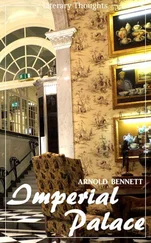
Arnold Bennett - Imperial Palace
Здесь есть возможность читать онлайн «Arnold Bennett - Imperial Palace» — ознакомительный отрывок электронной книги совершенно бесплатно, а после прочтения отрывка купить полную версию. В некоторых случаях можно слушать аудио, скачать через торрент в формате fb2 и присутствует краткое содержание. Жанр: unrecognised, на английском языке. Описание произведения, (предисловие) а так же отзывы посетителей доступны на портале библиотеки ЛибКат.

- Название:Imperial Palace
- Автор:
- Жанр:
- Год:неизвестен
- ISBN:нет данных
- Рейтинг книги:4 / 5. Голосов: 1
-
Избранное:Добавить в избранное
- Отзывы:
-
Ваша оценка:
Imperial Palace: краткое содержание, описание и аннотация
Предлагаем к чтению аннотацию, описание, краткое содержание или предисловие (зависит от того, что написал сам автор книги «Imperial Palace»). Если вы не нашли необходимую информацию о книге — напишите в комментариях, мы постараемся отыскать её.
Imperial Palace — читать онлайн ознакомительный отрывок
Ниже представлен текст книги, разбитый по страницам. Система сохранения места последней прочитанной страницы, позволяет с удобством читать онлайн бесплатно книгу «Imperial Palace», без необходимости каждый раз заново искать на чём Вы остановились. Поставьте закладку, и сможете в любой момент перейти на страницу, на которой закончили чтение.
Интервал:
Закладка:
The orchestra, after threatening never to cease, most startlingly ceased. But at once it burst vivaciously and majestically into “God Save the King.” The three males stood to attention; the women stood still. Then the three guests sat down again at their table, and Evelyn could hear the murmurs of their talk; he could hear also the movements of the departing band. The professional dancers had vanished. The waiters waited. At length the trio of guests left the sick scene of revelry, and came up the steps into the foyer. Evelyn turned his back on them. In a moment the table was emptied. In three more moments every cloth had been snatched off the rows of tables, and every table changed from white to dark green. The two male guests continued to talk in the gentlemen’s cloak-room. The woman had disappeared into the ladies’ cloak-room apparently for ever. But she came forth. The trio renewed conversation. Never would they go. They went, slowly, reluctantly, up the stairs into the great hall. The restaurant and the foyer were dark now, save for one light in each. The head-attendant of the vestiaire was manipulating switches. The entrance to the ladies’ cloak-room was black.
“Ludovico!” Evelyn called to the last black-coated man haunting the gloom of the restaurant. Ludovico span round, espied, and came hastening.
“Sir?”
“Did Volivia perform first or second in the second cabaret?”
“First, sir. The other turn—clown, I forget his name, sir—refused to appear first.”
“Why?”
Ludovico raised his shoulders.
“All right, thanks. Good night.”
And Ludovico ran down the steps again, and he too vanished. The gentlemen’s cloak-room was black and empty. The great hall was silent, the foyer deserted except by Evelyn. The public night-life of the Imperial Palace had finished. But not the private night-life.
Refusing the lift, with a wave of the hand to the liftman, Evelyn began to climb the stairs; but he was arrested by the sight of the gigolo (coat-collar turned up, and a grey muffler wrapped thickly round his neck) and the girl-dancer (with a thin cloak hanging loosely over her frail evening frock). The pair were walking about two yards apart, the woman a little in front of the man: bored, fatigued, weary. For the purpose of symbolising the graceful joy of life he had held her in his arm a dozen times during the long spell of work; but now each displayed candidly a complete indifference to the other; each had had a surfeit of the other. They passed through the melancholy gloom of the foyer, up into the great hall, and at the revolving doors thereof Long Sam negligently saluted them—too negligently, thought captious Evelyn. He followed, aimless, but feeling a sickly interest in them.
Approaching the doors, he acknowledged Long Sam’s impressive salute with rather more than the negligence which Long Sam had dispensed to the working dancers—just to punish him! Through the glass Evelyn saw the pair standing under the gigantic marquise, reputed to weigh several tons. They exchanged infrequent monosyllables. The gigolo shivered; not the girl. Then a taxi drove up, with a porter perched on the driver’s step. The gigolo opened the taxi and the girl got in. Bang! The taxi curved away and was lost in the darkness. The gigolo departed on foot. His feet traced a path as devious as a field-path. Fatigue? And he also receded into invisibility. Where did he live? Why did he not drive home, like the girl? What was his private life? And what the girl’s? After all, they were not dancing marionettes; they were human beings, with ties of sentiment or duty. What was the old age of a gigolo? There was something desolate in that slow, listless, meandering departure.
II
“Morbid is the word for me to-night,” thought Evelyn, as he turned towards the hall and nodded amiably to Reyer, the Night-manager, who stood behind the Reception-counter as listless as the dancers. His mind was not specially engaged with Gracie; he was afflicted by the conception of all mankind, of the whole mournful earthly adventure. He began a second time to climb the stairs. It was his practice to make at intervals a nocturnal tour of inspection of the hotel; so that the night-staff saw nothing very unusual in his presence and movements.
He walked eastwards the length of the first-floor main corridor all lighted and silent, and observed nothing that was abnormal. Then up one flight of the east staircase, and westwards the length of the second-floor main corridor. At the end of it, he looked into the waiters’ service-room. It was lighted but empty. By day it would be manned by two waiters. From midnight till 8 a.m. only two waiters with one valet and one chambermaid were on duty for all the hotel, and they ranged from floor to floor according to demand. Among them they contrived to make good the quiet boast of the Palace that hot and cold dishes and cold and hot drinks could be served in any apartment at any hour of the night; for the grill-room kitchens, unlike the restaurant kitchens, were open all night as well as all day. The sole difference between night and day on the Floors was that in the night, instead of ringing for a waiter, guests had to telephone their orders to the central telephone office, which transmitted them.
Evelyn minutely inspected and tested the impeccably tidy service-room: the telephone to the central switchboard, the telephone direct to the bill-office, the gravity-tubes which carried order-checks to the kitchen and bills and cash to the bill-office, the geyser, the double lift with a hot shelf and a cold shelf, the books of bill-forms and order-checks, the ice, the machine for shaving ice to put round oysters, the dry tea, the milk, the mineral waters, the fruit, the bread, the biscuits, the condiments, the crockery, the cocktail jugs, the iced-water jugs, the silver and cutlery all stamped with the number of the floor, the stock-lists hung on the wall, and the electrically controlled clock which also hung on the yellow wall. Nothing wrong. (Once he had memorably discovered fourth-floor silver in the fifth-floor service-room: mystery which disconcerted all the floor-waiters, and which was never solved!) Everything waiting as in a trance for a life-giving summons. He went out of the room content with the organisation every main detail of which he had invented or co-ordinated years ago, and which he was continually watchful to improve.
Back again along the corridor, up another flight of stairs to the third-floor corridor lighted and silent. Room No. 359. Rooms Nos. 360-1. Rooms Nos. 362-3-4. Rooms Nos. 365-6-7-8. Not a sound through that door: which was hardly surprising, in view of another quiet boast of the Palace that no noise from a corridor could be heard in a room, and no noise from a room in a corridor. Was she asleep, and in what kind of a nightdress—or would it be pyjamas? Or was her party still drinking, chattering, laughing, smoking, card-playing?
Then in the distance of the interminable corridor he descried two white tables drawn apart from the herd of tables that stood at the door of every service-room. And then both night-waiters emerged from the service-room with dishes, bottles and glasses which they began to dispose on the two tables. Evelyn turned swiftly back, and concealed himself in the bay of a linen-closet. After a few moments he heard the trundling of indiarubber-tyred castors on the carpet of the corridor, the fitting of a pass-key into a door, the opening of a door, more trundling. Then he looked forth. Corridor empty. Door of Nos. 365-6-7-8 half open. Both waiters were doubtless within the suite. He came out of the bay, and walked steadily down the corridor. Blaze of light in the lobby of the suite. Hats and coats on the hatstand. Animated murmur of voices through the open door between the lobby and the drawing-room. Impossible to distinguish her voice. He went on, and into the service-room, which was in all the disorder of use. The pink order-check book lay on the little desk near the telephone. He examined the last two carbons in it. Suite 365. Time, 1.51. Two bottles 43. (He knew that 43 was Bollinger 1917.) One Mattoni. One China tea. One kummel. One consommé. Six haddock Côte d’Azur. Quite a little banquet before dawn: stirrup cups, no doubt! What a crew of wastrels! What untriumphant, repentant mornings they must have! But he felt excluded by his own act from paradise. He gazed and gazed. A telephone tinkled. He took up the receiver.
Читать дальшеИнтервал:
Закладка:
Похожие книги на «Imperial Palace»
Представляем Вашему вниманию похожие книги на «Imperial Palace» списком для выбора. Мы отобрали схожую по названию и смыслу литературу в надежде предоставить читателям больше вариантов отыскать новые, интересные, ещё непрочитанные произведения.








Обсуждение, отзывы о книге «Imperial Palace» и просто собственные мнения читателей. Оставьте ваши комментарии, напишите, что Вы думаете о произведении, его смысле или главных героях. Укажите что конкретно понравилось, а что нет, и почему Вы так считаете.