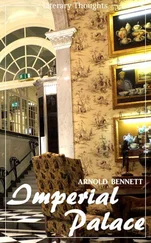
Arnold Bennett - Imperial Palace
Здесь есть возможность читать онлайн «Arnold Bennett - Imperial Palace» — ознакомительный отрывок электронной книги совершенно бесплатно, а после прочтения отрывка купить полную версию. В некоторых случаях можно слушать аудио, скачать через торрент в формате fb2 и присутствует краткое содержание. Жанр: unrecognised, на английском языке. Описание произведения, (предисловие) а так же отзывы посетителей доступны на портале библиотеки ЛибКат.

- Название:Imperial Palace
- Автор:
- Жанр:
- Год:неизвестен
- ISBN:нет данных
- Рейтинг книги:4 / 5. Голосов: 1
-
Избранное:Добавить в избранное
- Отзывы:
-
Ваша оценка:
Imperial Palace: краткое содержание, описание и аннотация
Предлагаем к чтению аннотацию, описание, краткое содержание или предисловие (зависит от того, что написал сам автор книги «Imperial Palace»). Если вы не нашли необходимую информацию о книге — напишите в комментариях, мы постараемся отыскать её.
Imperial Palace — читать онлайн ознакомительный отрывок
Ниже представлен текст книги, разбитый по страницам. Система сохранения места последней прочитанной страницы, позволяет с удобством читать онлайн бесплатно книгу «Imperial Palace», без необходимости каждый раз заново искать на чём Вы остановились. Поставьте закладку, и сможете в любой момент перейти на страницу, на которой закончили чтение.
Интервал:
Закладка:
The shock of the introduction into the Dantesque Latin microcosm, of the transition from indolent luxury to feverish labour, was shown in Gracie’s features.
“You’ll soon get used to it,” said Evelyn, thinking with admiration how sensitive was the puzzling creature. “See here!” He examined a board studded with hooks, near the entrance, and pulled from one of them an oblong of flimsy pink paper. “See?” He pointed to the scrawled word ‘soufflé.’ “ ‘37.’ That’s your table.”
“And what’s that?” asked Gracie, putting her finger on certain perforated figures.
“ ‘10.12.’ That’s the time of the order. We stamp it. There’s the machine that does it.”
“Good! Good!” ejaculated Sir Henry, tersely.
Evelyn restored the paper to its hook.
“Oh!” cried Gracie, suddenly childlike. “Do let’s see the soufflé made.”
“We will!” answered Evelyn eagerly, also childlike in sympathy. But he thought: “Has she come here because she is really interested, or because she wants to persuade me that she is interested?” His mind was peopled with sinister suspicions which, previously squatting in dark corners, had on a sudden sprung upright and into the open. “But what a marvellous figure she makes here in her finery!” he thought.
“Oh!” Gracie cried again, perceiving a tank into which fresh water was spurting. “What’s this?”
A cook sprang forward and, seizing a long handle with a net at the end, plunged it into the water and lifted out the net full of struggling fish.
“Des truites,” said he proudly.
“They little know the recent fate of three of their brothers!” said Sir Henry with gaiety.
“How horrible! How can you, father? Put them back, please do.” Gracie had laid a protesting hand on Sir Henry’s arm.
The trout were dropped into the water.
Two waiters at the delivery-counter snatched up two loaded trays which had mysteriously been placed there, and hastened off into the other world.
“You’re pretty busy here!” said Sir Henry, surveying the noisy scene.
“This is nothing,” Evelyn replied negligently. “You should see the place at a quarter to two when everyone wants lunch at the same moment, and watch the battle at that counter. There’d be sixty cooks here then. This is comparatively a slack time.”
Then approached down the vista a youngish, plump, jolly man, not to be distinguished by his attire from anybody else. He had heard by the inexplicable telegraph which functions in workshops that the Director was in the kitchen, with guests; and he was hurrying.
“Ah!” said Evelyn. “Here’s Planquet, the chef of chefs.”
The man arrived, bowing.
“Let me introduce Maître Planquet,” Evelyn began the ceremonial of presentation.
The master-cook protected himself against the hazards of contact with the extraneous world by a triple system of defence. Outermost came the cushion of his amiable jollity. Next, a cushion of punctilious decorum—obeisances, deferential smiles, handshakings, which expressed his formal sense of a great honour received; for he needed no one to tell him that only visitors of the highest importance would be introduced by the Director himself. Third, and innermost, a steel breastplate forged from the tremendous conviction that the kitchens of the Imperial Palace restaurant were the finest kitchens in the universe, and that he Planquet, a Frenchman, was the head of the finest kitchens in the universe, and therefore the head of his ancient profession.
When he genially admitted, in response to a suggestion in French from alert Gracie, that he was a Frenchman from the South of France, his tone had in it a note of interrogation, implying: “Surely you did not imagine that any but a Frenchman of the Midi could possibly be the head of my profession?” His tone also indicated a full appreciation of the fact that Gracie was an exceeding pretty woman. Behind the steel breastplate dwelt unseen the inviolable vital spark of that fragment of the divine which was the master’s soul.
While Sir Henry vouchsafed to him in the way of preliminary small-talk that he and his daughter and Mr. Orcham were in the middle of dinner in the restaurant, his unregarding, twinkling gaze seemed negligently to recognise that a restaurant, and perhaps many floors of a hotel, might conceivably be existing somewhere beyond the frontier of the kitchens, and that these phenomena were a corollary of the kitchens—but merely a corollary.
“Ah!” said Gracie, over a dishful of many uncooked cutlets, meek and uniform among various dishfuls of the raw material of art. “They have not yet acquired their individualities.”
The master gave her a sudden surprised glance of sympathetic approbation; and Evelyn knew that the master was saying to himself, as Evelyn was saying to himself: “She is no ordinary woman, this!” And for an instant the Director felt jealous of the master, as though none but the Director had the right to perceive that Gracie was no ordinary woman. The master’s demeanour changed, and henceforth he spoke to Gracie as to one to whom God had granted understanding. He escorted her to the enormous open fire of wood in front of which a row of once-feathered vertebrates were slowly revolving on a horizontal rod.
“We return always to the old methods, mademoiselle,” said he. “Here in this kitchen we cook by electricity, by gas, by everything you wish, but for the volaille we return always to the old methods. Wood fire.”
The intense heat halted Gracie. The master, however, august showman, walked right into it, seized an iron spoon fit for supping with the devil, and, having scooped up an immense spoonful of the fat which had dripped drop by drop from the roasting birds, poured it tenderly over them, and so again and again. Then he came back with his jolly smile to Gracie, as cool as an explorer returning from the Arctic zone.
“Nothing else is worth the old methods,” said he, and made a polite indifferent remark to Sir Henry.
But the next minute he was displaying, further up the vista, a modern machine for whipping cream. And later, ice-making by hand.
“The good method of a hundred years since.” Then, further, far from the frontier, in the very hinterland of the kitchens, was heard a roar of orders. Two loud-speakers suspended from a ceiling over a table!
“Yes,” the master admitted to Gracie’s questioning, ironic look. “It is bizarre, it is a little bizarre, this mixture. But what would you, mademoiselle?”
Two shabby young men were working like beavers beneath the loud-speakers and round about, occasionally bawling acknowledgments of receipt of orders to colleagues in some distant county of the master’s kingdom.
The party went in and out of rooms hot and rooms cold, rooms large and rooms small, rooms crowded with industry and rooms where one man toiled delicately alone. And the master explained his cuisine to Gracie, as one artist explains an art to another artist who is ignorant but who has instinctive comprehension. Down by a spiral staircase into the bakery and the cakery. Up into an office with intent clerks and typewriters. And everywhere white employees raised eyes for a second to the Director and his wandering charges and the master, and dropped them again to their tasks.
II
Evelyn, with Sir Henry, was behind the other two. He watched the changing expressions on Gracie’s face as she turned, and tried to read them, and could not. Then Sir Henry left him and with an authoritative query drew the master from Gracie’s side. Evelyn joined her. They had mysteriously got back to the kitchen of the wood fire and the revolving game—but not the same game was revolving. Gracie approached the huge hearth, beckoning, and he stood close to her.
Читать дальшеИнтервал:
Закладка:
Похожие книги на «Imperial Palace»
Представляем Вашему вниманию похожие книги на «Imperial Palace» списком для выбора. Мы отобрали схожую по названию и смыслу литературу в надежде предоставить читателям больше вариантов отыскать новые, интересные, ещё непрочитанные произведения.









Обсуждение, отзывы о книге «Imperial Palace» и просто собственные мнения читателей. Оставьте ваши комментарии, напишите, что Вы думаете о произведении, его смысле или главных героях. Укажите что конкретно понравилось, а что нет, и почему Вы так считаете.