Core Microbiome
Здесь есть возможность читать онлайн «Core Microbiome» — ознакомительный отрывок электронной книги совершенно бесплатно, а после прочтения отрывка купить полную версию. В некоторых случаях можно слушать аудио, скачать через торрент в формате fb2 и присутствует краткое содержание. Жанр: unrecognised, на английском языке. Описание произведения, (предисловие) а так же отзывы посетителей доступны на портале библиотеки ЛибКат.
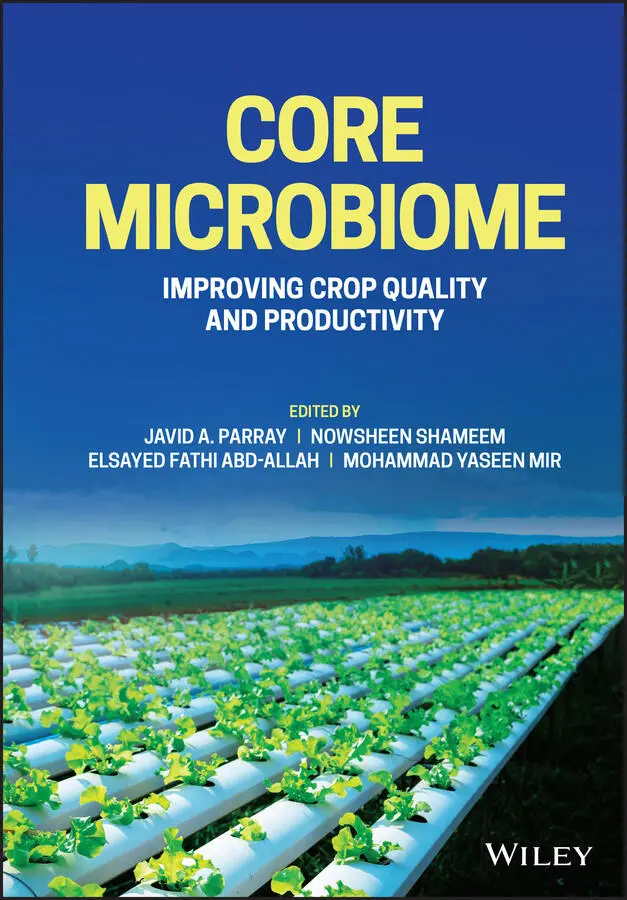
- Название:Core Microbiome
- Автор:
- Жанр:
- Год:неизвестен
- ISBN:нет данных
- Рейтинг книги:3 / 5. Голосов: 1
-
Избранное:Добавить в избранное
- Отзывы:
-
Ваша оценка:
Core Microbiome: краткое содержание, описание и аннотация
Предлагаем к чтению аннотацию, описание, краткое содержание или предисловие (зависит от того, что написал сам автор книги «Core Microbiome»). Если вы не нашли необходимую информацию о книге — напишите в комментариях, мы постараемся отыскать её.
Core Microbiome: Improving Crop Quality and Productivity Core Microbiome Descriptions of the basic structure of core microbiomes and their functions across various habitats New and cutting-edge trends and technological innovations highlighted that use core microbiomes to harness plant microbiome interaction The structure, classification, and biotechnological applications of aquatic core microbiomes, in addition to the material on plant microbiomes As a broad introduction to the interaction of core microbiome and plant productivity,
is ideal for researchers and scientists working in the field of environmental science, environmental microbiology, and waste management. Similarly, undergraduate and graduate students in these fields, as well as in agriculture, biotechnology, biosciences, and life and environmental sciences will also benefit from this work.
Core Microbiome — читать онлайн ознакомительный отрывок
Ниже представлен текст книги, разбитый по страницам. Система сохранения места последней прочитанной страницы, позволяет с удобством читать онлайн бесплатно книгу «Core Microbiome», без необходимости каждый раз заново искать на чём Вы остановились. Поставьте закладку, и сможете в любой момент перейти на страницу, на которой закончили чтение.
Интервал:
Закладка:
21 21Tsuge, K., Akiyama, T., and Shoda, M. (2001). Cloning, sequencing, and characterization of the iturin A operon. Journal of Bacteriology Nov 1 183 (21): 6265–6273.
22 22Steller, S., Vollenbroich, D., Leenders, F., Stein, T., Conrad, B., Hofemeister, J., Jacques, P., Thonart, P., and Vater, J. (1999). Structural and functional organization of the fengycin synthetase multienzyme system from Bacillus subtilis b213 and A1/3. Chemistry & Biology Jan 1 6 (1): 31–41.
23 23Raaijmakers, J.M., Paulitz, T.C., Steinberg, C., Alabouvette, C., and Moënne-Loccoz, Y. (2009). The rhizosphere: A playground and battlefield for soilborne pathogens and beneficial microorganisms. Plant and Soil Aug 321 (1): 341–361.
24 24Asaka, O. and Shoda, M. (1996). Biocontrol of Rhizoctonia solani damping-off of tomato with Bacillus subtilis RB14. Applied and Environmental Microbiology Nov 1 62 (11): 4081–4085.
25 25Couillerot, O., Prigent-Combaret, C., Caballero-Mellado, J., and Moënne-Loccoz, Y. (2009). Pseudomonas fluorescens and closely-related fluorescent Pseudomonads as biocontrol agents of soilborne phytopathogens. Letters in Applied Microbiology May 48 (5): 505–512.
26 26Guo, Q., Shi, M., Chen, L., Zhou, J., Zhang, L., Li, Y., Xue, Q., and Lai, H. (2020). The biocontrol agent Streptomyces pactum increases Pseudomonas koreensis populations in the rhizosphere by enhancing chemotaxis and biofilm formation. Soil Biology & Biochemistry May 1 144: 107755.
27 27Rezzonico, F., Binder, C., Défago, G., and Moënne-Loccoz, Y. (2005). The type III secretion system of biocontrol Pseudomonas fluorescens KD targets the phytopathogenic Chromista Pythium ultimum and promotes cucumber protection. Molecular Plant–Microbe Interactions Sep 18 (9): 991–1001.
28 28Vacheron, J., Moënne-Loccoz, Y., Dubost, A., Gonçalves-Martins, M., Müller, D., and Fluorescent, P.-C.-C. (2016). Pseudomonas strains with only few plant-beneficial properties are favored in the maize rhizosphere. Frontiers in Plant Science Aug 25 7: 1212.
29 29Pieterse, C.M., Zamioudis, C., Berendsen, R.L., Weller, D.M., Van Wees, S.C., and Bakker, P.A. (2014). Induced systemic resistance by beneficial microbes. Annual Review of Phytopathology Aug 4 52.
30 30Pascale, A., Proietti, S., Pantelides, I.S., and Stringlis, I.A. (2020). Modulation of the root microbiome by plant molecules: The basis for targeted disease suppression and plant growth promotion. Frontiers in Plant Science Jan 24 (10): 1741.
31 31Harman, G.E., Björkman, T., Ondik, K., and Shoresh, M. (2008). Changing paradigms on the mode of action and uses of Trichoderma spp. for biocontrol. Outlooks on Pest Management Feb 1 19 (1): 24.
32 32Weller, D.M., Raaijmakers, J.M., Gardener, B.B., and Thomashow, L.S. (2002). Microbial populations responsible for specific soil suppressiveness to plant pathogens. Annual Review of Phytopathology Sep 40 (1): 309–348.
33 33Kwak, M.J., Kong, H.G., Choi, K., Kwon, S.K., Song, J.Y., Lee, J., Lee, P.A., Choi, S.Y., Seo, M., Lee, H.J., and Jung, E.J. (2018). Author correction: Rhizosphere microbiome structure alters to enable wilt resistance in tomato (Nat. Biotechnology 36 (11): (1100–1116). 10.1038/nbt. 4232). Nature Biotechnology 2018 Nov 9 36 (11): 1117.
34 34Shi, W., Li, M., Wei, G., Tian, R., Li, C., Wang, B., Lin, R., Shi, C., Chi, X., Zhou, B., and Gao, Z. (2019). The occurrence of potato common scab correlates with the community composition and function of the geocaulosphere soil microbiome. Microbiome Dec 7 (1): 1–8.
35 35Minuto, A., Spadaro, D., Garibaldi, A., and Gullino, M.L. (2006). Control of soilborne pathogens of tomato using a commercial formulation of Streptomyces griseoviridis and solarization. Crop Protection May 1 25 (5): 468–475.
36 36Sindhu, S.S., Rakshiya, Y.S., and Sahu, G. (2009). Biological control of soilborne plant pathogens with rhizosphere bacteria. Pest Technology 3 (1): 10–21.
37 37Palmieri, D., Vitullo, D., De Curtis, F., and Lima, G. (2017). A microbial consortium in the rhizosphere as a new biocontrol approach against fusarium decline of chickpea. Plant and Soil Mar 1 412 (1-2): 425–439.
38 38Wu, H., Lin, M., Rensing, C., Qin, X., Zhang, S., Chen, J., Wu, L., Zhao, Y., Lin, S., and Lin, W. (2020). Plant-mediated rhizospheric interactions in intraspecific intercropping alleviate the replanting disease of Radix pseudostellariae. Plant and Soil Sep 454 (1): 411–430.
39 39Li, X., De Boer, W., Ding, C., Zhang, T., and Wang, X. (2018). Suppression of soilborne Fusarium pathogens of peanut by intercropping with the medicinal herb Atractylodes lancea. Soil Biology & Biochemistry Jan 1 116: 120–130.
40 40Ren, L., Su, S., Yang, X., Xu, Y., Huang, Q., and Shen, Q. (2008). Intercropping with aerobic rice suppressed Fusarium wilt in watermelon. Soil Biology & Biochemistry Mar 1 40 (3): 834–844.
41 41Zhang, H., Yang, Y., Mei, X., Li, Y., Wu, J., Li, Y., Wang, H., Huang, H., Yang, M., He, X., and Zhu, S. (2020). Phenolic acids released in maize rhizosphere during maize-soybean intercropping inhibit Phytophthora blight of soybean. Frontiers in Plant Science Jul 28 (11): 886.
42 42Bailey, K.L. and Lazarovits, G. (2003). Suppressing soilborne diseases with residue management and organic amendments. Soil and Tillage Research Aug 1 72 (2): 169–180.
43 43Pane, C., Spadaccini, R., Piccolo, A., Scala, F., and Bonanomi, G. (2011). Compost amendments enhance peat suppressiveness to Pythium ultimum, Rhizoctonia solani and Sclerotinia minor. Biological Control Feb 1 56 (2): 115–124.
44 44Hardoim, P.R., van Overbeek, L.S., and van Elsas, J.D. (2008). Properties of bacterial endophytes and their proposed role in plant growth. Trends in Microbiology Oct 1 16 (10): 463–471.
45 45Compant, S., Clément, C., and Sessitsch, A. (2010). Plant growth-promoting bacteria in the rhizo-and endosphere of plants: Their role, colonization, mechanisms involved and prospects for utilization. Soil Biology & Biochemistry May 1 42 (5): 669–678.
46 46Compant, S., Duffy, B., Nowak, J., Clément, C., and Barka, E.A. (2005). Use of plant growth-promoting bacteria for biocontrol of plant diseases: Principles, mechanisms of action, and future prospects. Applied and Environmental Microbiology Sep 1 71 (9): 4951–4959.
47 47Sapers, G.M., Gorny, J.R., and Yousef, A.E., (editors). (2005). Microbiology of Fruits and Vegetables. CRC Press. Aug 29.
48 48Santoyo, G., Moreno-Hagelsieb, G., del Carmen Orozco-mosqueda, M., and Glick, B.R. (2016). Plant growth-promoting bacterial endophytes. Microbiological Research Feb 1 183: 92–99.
49 49Reinhold-Hurek, B. and Hurek, T. (2011). Living inside plants: Bacterial endophytes. Current Opinion in Plant Biology Aug 1 14 (4): 435–443.
50 50Chaturvedi, H., Singh, V., and Gupta, G. (2016). Potential of bacterial endophytes as plant growth-promoting factors. Journal of Plant Pathology and Microbiology 7 (9): 1–6.
51 51Anjum, R., Afzal, M., Baber, R., Khan, M.A., Kanwal, W., Sajid, W., and Raheel, A. (2019). Endophytes: As potential biocontrol agent—review and future prospects. The Journal of Agricultural Science 11: 113.
52 52Sheoran, N., Nadakkakath, A.V., Munjal, V., Kundu, A., Venugopal, V., Rajamma, S., Eapen, S.J., and Kumar, A. (2015). Genetic analysis of plant endophytic Pseudomonas putida BP25 and chemo-profiling of its antimicrobial volatile organic compounds. Microbiological Research Apr 173: 66–78.
53 53Sessitsch, A., Reiter, B., and Berg, G. (2004). Endophytic bacterial communities of field-grown potato plants and their plant-growth-promoting and antagonistic abilities. Canadian Journal of Microbiology May 50: 239–249.
54 54Lodewyckx, C., Vangronsveld, J., Porteous, F., Moore, E.R.B., Taghavi, S., Mezgeay, M., and Lelie, D.V.D. (2002). Endophytic bacteria and their potential applications. Critical Reviews in Plant Sciences Nov 21 (6): 583–606.
Читать дальшеИнтервал:
Закладка:
Похожие книги на «Core Microbiome»
Представляем Вашему вниманию похожие книги на «Core Microbiome» списком для выбора. Мы отобрали схожую по названию и смыслу литературу в надежде предоставить читателям больше вариантов отыскать новые, интересные, ещё непрочитанные произведения.








Обсуждение, отзывы о книге «Core Microbiome» и просто собственные мнения читателей. Оставьте ваши комментарии, напишите, что Вы думаете о произведении, его смысле или главных героях. Укажите что конкретно понравилось, а что нет, и почему Вы так считаете.