Vadim Birstein - The Perversion of Knowledge
Здесь есть возможность читать онлайн «Vadim Birstein - The Perversion of Knowledge» весь текст электронной книги совершенно бесплатно (целиком полную версию без сокращений). В некоторых случаях можно слушать аудио, скачать через торрент в формате fb2 и присутствует краткое содержание. Город: Cambridge, MA, Год выпуска: 2004, ISBN: 2004, Издательство: Westview Press, Жанр: История, Публицистика, dissident, на английском языке. Описание произведения, (предисловие) а так же отзывы посетителей доступны на портале библиотеки ЛибКат.
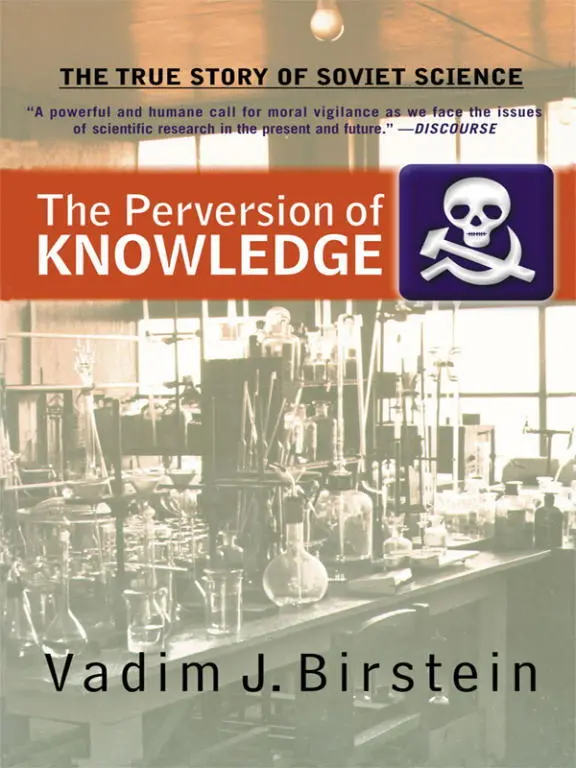
- Название:The Perversion of Knowledge
- Автор:
- Издательство:Westview Press
- Жанр:
- Год:2004
- Город:Cambridge, MA
- ISBN:978-0-8133-4280-1
- Рейтинг книги:3 / 5. Голосов: 1
-
Избранное:Добавить в избранное
- Отзывы:
-
Ваша оценка:
The Perversion of Knowledge: краткое содержание, описание и аннотация
Предлагаем к чтению аннотацию, описание, краткое содержание или предисловие (зависит от того, что написал сам автор книги «The Perversion of Knowledge»). Если вы не нашли необходимую информацию о книге — напишите в комментариях, мы постараемся отыскать её.
, a history of Soviet science that focuses on its control by the KGB and the Communist Party, reveals the dark side of this glittering achievement.
Based on the author’s firsthand experience as a Soviet scientist, and drawing on extensive Russian language sources not easily available to the Western reader, the book includes shocking new information on biomedical experimentation on humans as well as an examination of the pernicious effects of Trofim Lysenko’s pseudo-biology. Also included are many poignant case histories of those who collaborated and those who managed to resist, focusing on the moral choices and consequences. The text is accompanied by the author’s own translations of key archival materials, making this work an essential resource for all those with a serious interest in Russian history.
[Contain tables.]
The Perversion of Knowledge — читать онлайн бесплатно полную книгу (весь текст) целиком
Ниже представлен текст книги, разбитый по страницам. Система сохранения места последней прочитанной страницы, позволяет с удобством читать онлайн бесплатно книгу «The Perversion of Knowledge», без необходимости каждый раз заново искать на чём Вы остановились. Поставьте закладку, и сможете в любой момент перейти на страницу, на которой закончили чтение.
Интервал:
Закладка:
This demonstrates the approach of the Soviet/Russian military prosecutors. It is true that all former VCheKa/MGB officials who were not rehabilitated were involved in the creation of falsified materials of the cases. This was the basic difference between the Nazi and Soviet secret services. The Gestapo tortured its detainees because it wanted to know the truth, whereas the VCheKa/MGB tortured victims to force them to sign falsified testimonies. Aleksandr Solzhenitsyn gives an example of a person, Yevgenii Divnich, who was tortured by both the Gestapo and MGB:
The Gestapo accused him of Communist activities among Russian workers in Germany, and the MGB charged him with having ties to the international bourgeoisie…. The Gestapo was nonetheless trying to get at the truth, and when the accusation did not hold it, Divnich was released. The MGB wasn’t interested in the truth and had no intention of letting anyone out of its grip once he or she was arrested. 8
The Soviet security services had three goals: first, to create an impression that foreign and inner “enemies” threatened the existence of the country; second, to control the Soviet population through the myth that the organs knew everything; and third, to turn its helpless victims into slaves who could be used in all branches of the Soviet economy. But still, Sudoplatov and Eitingon were serial killers. Evidently, the Russian military prosecutors in charge of rehabilitation did not consider the assassination of innocent victims in the name of the Soviet Union and on the order of the Politburo to be crimes. The FSB/SVR officers also consider Sudoplatov to be a hero, not a killer. When on December 23, 1993, Sudoplatov appeared at the meeting of the SVR in Moscow, all the officers stood up and applauded. 9
The idea that military prosecutors are in some way superior to civilian prosecutors goes back to Stalin’s time, when the Military Court tried many political cases. In the current Russia, only the Chief Military Prosecutor’s Office has access to the files of such persons as Beria, Abakumov, and other former high-ranking members of the MGB staff. Only military prosecutors decide whether the rehabilitation of these persons is possible or not. This is why only military prosecutor Bobryonev, and not civilian and independent researchers, had an opportunity to investigate Mairanovsky’s MGB/KGB file.
Some activities of the secret services, such as Mairanovsky’s experiments with poisons, were similar in both Nazi Germany and the Soviet Union. However, one needs to keep in mind that experimentation was not the only usage of persons condemned to death (rasstrel’niki) in the Soviet Union. According to the former Soviet military intelligence officer Viktor Suvorov, physically strong rasstrel’niki were used for training in hand-to-hand fighting. 10In the VCheKa, these persons were called “gladiators”; in the NKVD, “volunteers”; in SMERSH, “Robinsons”; and in the Special Troops (Spetsnaz) of the 1990s, “dolls” (kukly) .
Mairanovsky’s experiments on POWs and political prisoners in the unsuccessful search for “truth drugs” bring to mind secret and similarly unsuccessful studies conducted by the CIA during the late 1940–1950s. 11At least the American guinea pigs were not POWs or political prisoners but, usually, volunteers. Experiments with radioactive substances were also conducted on volunteer convicts and servicemen, as well as on cancer patients. 12The British secret experiments with nerve gases from the 1940s–1960s were performed on volunteer military personnel. 13The point is: Uncontrolled secret research performed by secret services or the military tends to end up with experiments on humans, no matter what country is involved.
During the last decade, the attitude of the Russian population to the history of the VCheKa/KGB and to the current secret services has turned from negative to positive. On December 4, 1998, the lower house of the Russian parliament, the Duma, voted in favor of restoring the statue of the creator of the first Soviet political police (VCheKa), “Iron Felix” Dzerzhinsky. 14This statue was dismantled on August 21, 1991, when large crowds of Muscovites protested against CheKa/NKVD/MGB/KGB repression. But by late 1998 and early 1999, the attitude of many officials and Muscovites to Dzerzhinsky and the CheKa/KGB had changed. On February 23, 1999, the official day of the Red (Soviet) Army, Moscow witnessed a demonstration of radical Communists and nationalists with slogans “Stalin, Beria, Gulag.” 15The ominous ghosts of the past are rather popular again in Russia. During the Duma election in 1999, one of the political parties was named the “Stalin Bloc.” It was led by the arch-leftist Viktor Anpilov and included Stalin’s grandson Yevgenii Dzhugashvili. 16According to a poll conducted in December 1999, 66 percent of Russians considered Stalin’s rule more good than bad or equally good and bad. 17
Beginning in 1997, many key positions in the Russian government, including that of prime minister (Yevgenii Primakov, Sergei Stepashin, and then Vladimir Putin), were taken by former high-ranking KGB functionaries. The list of these people is rather long, 18but perhaps the most unusual was the meteoric career of the former FSB head and current president, Vladimir Putin. In July 1998, President Boris Yeltsin appointed the former KGB officer Putin to the offices of FSB head and secretary of the policymaking Security Council of Russia. On August 9, 1999, Yeltsin suddenly promoted him to prime minister. 19
Putin joined the KGB in 1975, and until 1984, he and his FSB first deputy Viktor Cherkesov (formerly head of the St. Petersburg branch of the FSB) served in the notorious Fifth Main Directorate of the KGB Leningrad branch, which targeted dissidents and human rights activists. 20After spending years in Germany (Putin had been transferred to the KGB First Main Directorate), in 1990 he returned to Leningrad and worked under the cover of the St. Petersburg University International Department. At the university, Putin participated in meetings on external economic politics. 21That same year, Putin left the KGB and joined the staff of the reformist mayor of Leningrad, Anatoly Sobchak. In 1994, he became first deputy head of St. Petersburg’s city government, and in 1996, he moved to Moscow as deputy to Pavel Borodin, manager of the office that administered the property of President Yeltsin’s administration. 22Later, as acting president, Putin sacked Borodin, evidently because of allegations of corruption and international money laundering. 23
As the FSB Head, Putin became well known to Russian and international environmentalists. Before the trial of the environmentalist Aleksandr Nikitin, 24charged by the FSB with treason and leaking state secrets to the Norwegian environmentalist group Bellona, even began, Putin declared in a press interview that Nikitin would be convicted, but the punishment would be softened due to international attention. 25Putin also claimed that foreign intelligence services largely use various environmental organizations for their work and therefore these organizations would remain under the strict control of the FSB. On April 17, 2000, the Russian Supreme Court finally acquitted Nikitin. 26On September 13, 2000, the Supreme Court rejected a bid by prosecutors to reopen the case. 27
In November 1997, Nikitin’s arrest was followed by the arrest of another environmentalist, the military journalist Grigory Pasko, in the Russian Far East. The reason was the same—the disclosure of information on nuclear waste pollution. Pasko was amnestied on July 20, 1999, but he continued to claim that he was innocent. 28In 2000, he published a book in Russian entitled Case No. 10: Grigory Pasko Against the FSB. 29Pasko maintains that the FSB and other secret services used his trial to create a “spy mania” to justify their inflated numbers. He also accused President Putin of putting the rights of the state above the rights of citizens. On November 22, 2000, the Military Tribunal of the Russian Supreme Court sent Pasko’s case back to another military court for a new trial. Pasko called this decision “a death sentence” for him. Longtime Russian human rights activist Sergei Grigoryants commented: “It is not just that the human rights situation is drastically deteriorating in Russia…. War has been officially declared on civil society in Russia.” 30
Читать дальшеИнтервал:
Закладка:
Похожие книги на «The Perversion of Knowledge»
Представляем Вашему вниманию похожие книги на «The Perversion of Knowledge» списком для выбора. Мы отобрали схожую по названию и смыслу литературу в надежде предоставить читателям больше вариантов отыскать новые, интересные, ещё непрочитанные произведения.










Обсуждение, отзывы о книге «The Perversion of Knowledge» и просто собственные мнения читателей. Оставьте ваши комментарии, напишите, что Вы думаете о произведении, его смысле или главных героях. Укажите что конкретно понравилось, а что нет, и почему Вы так считаете.