Jasmine Guillory - The Proposal
Здесь есть возможность читать онлайн «Jasmine Guillory - The Proposal» весь текст электронной книги совершенно бесплатно (целиком полную версию без сокращений). В некоторых случаях можно слушать аудио, скачать через торрент в формате fb2 и присутствует краткое содержание. Год выпуска: 2018, Издательство: Penguin Publishing Group, Жанр: roman, на английском языке. Описание произведения, (предисловие) а так же отзывы посетителей доступны на портале библиотеки ЛибКат.
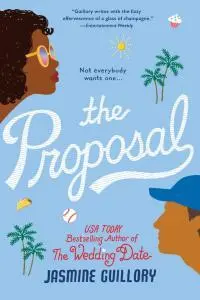
- Название:The Proposal
- Автор:
- Издательство:Penguin Publishing Group
- Жанр:
- Год:2018
- ISBN:нет данных
- Рейтинг книги:5 / 5. Голосов: 1
-
Избранное:Добавить в избранное
- Отзывы:
-
Ваша оценка:
The Proposal: краткое содержание, описание и аннотация
Предлагаем к чтению аннотацию, описание, краткое содержание или предисловие (зависит от того, что написал сам автор книги «The Proposal»). Если вы не нашли необходимую информацию о книге — напишите в комментариях, мы постараемся отыскать её.
**When someone asks you to spend your life with him, it shouldn't come as a surprise --or happen in front of 45,000 people.**
When freelance writer Nikole Paterson goes to a Dodgers game with her actor boyfriend, his man bun, and his bros, the last thing she expects is a scoreboard proposal. Saying no isn't the hard part--they've only been dating for five months, and he can't even spell her name correctly. The hard part is having to face a stadium full of disappointed fans...
At the game with his sister, Carlos Ibarra comes to Nik's rescue and rushes her away from a camera crew. He's even there for her when the video goes viral and Nik's social media blows up--in a bad way. Nik knows that in the wilds of LA, a handsome doctor like Carlos can't be looking...
The Proposal — читать онлайн бесплатно полную книгу (весь текст) целиком
Ниже представлен текст книги, разбитый по страницам. Система сохранения места последней прочитанной страницы, позволяет с удобством читать онлайн бесплатно книгу «The Proposal», без необходимости каждый раз заново искать на чём Вы остановились. Поставьте закладку, и сможете в любой момент перейти на страницу, на которой закончили чтение.
Интервал:
Закладка:
She didn’t break eye contact. He’d thought that maybe she’d get distracted by the food on her plate, but she’d clearly listened to every word he’d said.
“And who . . . dates the whitest of white guys? Is that what you were going to say?”
Well, yeah, but he’d caught himself at the last second.
“I was, but I thought the better of it!” Shit, she was going to get mad at him for this, wasn’t she? She had every right to.
She laughed and reached for another chip.
“Don’t judge me by Fisher, come on now. I’m not going to claim that he’s the only white guy that I’ve dated, but he’s definitely one of the worst.”
He’d take her word for it. She seemed more relaxed about the Fisher thing than she had the last time they’d talked about it. Maybe it was her self-defense class making the difference.
“How’s your self-defense class going? Are you kicking some ass?”
She put up her fists.
“I sure as hell am,” she said, before putting her fists down. “I didn’t really expect to enjoy the class; I think I expected it to be some empowerment bullshit, but I feel like I’m learning a lot, and it’s actually really fun. The instructor is the owner of the gym, and she’s pretty fantastic.”
He’d kind of expected her class to be some empowerment bullshit, too. His dad had made Angela take a self-defense class when she went off to college, and Angie had complained about it the whole time. She’d said it was just talking about your feelings and beating up a dude covered in padding, but that she hadn’t really learned how to defend herself. He’d had to take her into the backyard and show her how to throw a punch to feel comfortable with her leaving.
“Oh man, I’d love to hear more about that. That’s the kind of place I’d love to silently pass their brochure to some of my patients. And their moms, though I bet it’s outside their price range.”
She shook her head.
“Probably not—that’s one of the interesting things about it. She has a sliding scale for membership and all of the classes. Pretty great.”
“Wow.” As he well knew, it was hard for low- or even moderate-income people in L.A. to access a lot of the stuff that hipster L.A. took for granted. “Are you planning to write about it? I read that Anna Gardiner thing you told me you wrote for Vogue ; it was great.”
“You read it?” If he had known she would look so flattered when he told her that, he would have told her days ago. “Thanks, I’m glad you liked it. I actually hadn’t even thought about writing about Natalie’s Gym, but that’s an idea.” She shrugged. “We’ll see.”
“What other kinds of writing do you do? Is it all freelance, or are you on staff somewhere?”
“All freelance. After college, I got a job at the New York Times , which was overwhelming and amazing. I learned a ton about writing and researching there, especially about investigative reporting, just from listening to some of the reporters there and asking them a lot of questions.” She made a face. “And asking for feedback on my own work, which was horrible at the time but ultimately very valuable.”
He grinned at the look on her face.
“They were very blunt, huh?”
She dropped her head into her hands.
“You have no idea. God, I still get humiliated sometimes when I think about the draft of a story I gave one guy. Oh, it was so bad, and he told me, in lots of detail, why it was so bad. But you know, that one terrible conversation was probably worth at least an entire class of journalism school.” She took a sip of her water. “Then I came back here to be an editor for the L.A. Times entertainment section. It was such a different job, but I learned a ton about the ins and outs of the industry here in L.A.”
Hers was a very different part of L.A. than the one he’d grown up in. The part with the movie stars and the rich people that he’d always known existed, but it seemed so foreign compared to his life that it could have very well been across the country.
“This was a long way to answer your question about what kind of writing I do. I left the L.A. Times about a year and a half ago. There was a big buyout, but I was ready to go. I was getting tired of only doing celebrity stuff, as entertaining as it can be. Now I do a good combination of writing: some celebrity profiles, especially women of color. But also some investigative journalism, and other short fun pieces when I have time for them. It’s been a little scary, but also fun to craft my career in this way.”
He nodded. He’d known some of that from when he’d Googled her to find that Anna Gardiner story, but not all of it.
“What kind of investigative journalism? Who pays for stuff like that these days, other than like, the New Yorker ?”
She grinned.
“I had a piece in the New Yorker last week, actually. My second piece there.”
He’d walked right into that one, hadn’t he?
“Holy shit, that’s awesome! What was the story about?”
“Thanks. This one was a celebrity piece; it was a profile of a screenwriter who has two movies coming out this summer. I was really glad to get to write about her.” Her grin lost a little of its sparkle. “I was really excited to see it in print, but I just realized I didn’t even open the magazine. It came the same day as the Dodgers game, see.”
He suddenly hated that Fisher guy. What a way to ruin the joy of her accomplishment.
He looked at their table: plates of half-eaten tacos lined up neatly, the beans and rice basically untouched on both of their plates, their drinks all empty.
“Do you want to get dessert?” he asked.
She laughed, and the sad look disappeared from her face.
“Oh my God, no, are you kidding me? I’m way too full to even think about dessert. I can’t remember the last time I said that.”
They waved good-bye to the staff as they walked out and got in his car. A few blocks down the road, she cleared her throat.
“I might be accused of being bougie by asking this, but I’m going to do it anyway: do you ever worry about your car, parking it in neighborhoods like this?”
He nodded.
“Nah, that’s just common sense. At first I barely drove it anywhere but to work and home. I was so paranoid about break-ins, or accidents, or other cars parking too close to me. I never did valet, which in L.A., as you know, made everything more difficult.”
He flicked his blinker on to turn onto the freeway, and thought about those first months after. A lot of it he barely even remembered. He only knew certain things had happened because friends had mentioned them later. Sometimes he’d searched through his emails for something unrelated and come across emails he’d sent friends, thanking them for their card or the food they’d sent or for coming to the funeral, and he had no memory not only of sending the emails but of receiving their card or food or seeing them at the funeral. It had been such a terrible time; he was glad that there was a fog over his memory of a lot of it. The car probably wasn’t the only reason he’d barely gone anywhere but to work and his mom’s house for months.
“What made you change?” she asked.
He shrugged and started to give her a bullshit answer. But the only answer he could think of was the truth.
“My friends, really. Especially my friend Drew. Some of it . . . a lot of it, probably, wasn’t about the car at all, but was about my dad.” He’d tried not to let anyone figure out what a hard time he was having with his dad’s death. He especially didn’t want his family to know. He knew he had to be there for his mom and for Angie, to be the rock they needed.
“One day at work, we were talking about a new case that had come in the day before. It was a middle-aged man who died suddenly of a heart attack, the same as my dad. When they described what happened and started asking questions for us to answer, I had to leave the room. I didn’t think anyone noticed me leave. But that night, Drew asked if I wanted to get a beer when we both got off. We didn’t talk about it, at all, but . . . it helped. And then the following week, he convinced me to join a basketball rec league. I knew he was doing it to force me out of the house for something other than work, but I did it anyway. And it helped.”
Читать дальшеИнтервал:
Закладка:
Похожие книги на «The Proposal»
Представляем Вашему вниманию похожие книги на «The Proposal» списком для выбора. Мы отобрали схожую по названию и смыслу литературу в надежде предоставить читателям больше вариантов отыскать новые, интересные, ещё непрочитанные произведения.









Обсуждение, отзывы о книге «The Proposal» и просто собственные мнения читателей. Оставьте ваши комментарии, напишите, что Вы думаете о произведении, его смысле или главных героях. Укажите что конкретно понравилось, а что нет, и почему Вы так считаете.