John Crisp - Introduction to Microprocessors and Microcontrollers
Здесь есть возможность читать онлайн «John Crisp - Introduction to Microprocessors and Microcontrollers» весь текст электронной книги совершенно бесплатно (целиком полную версию без сокращений). В некоторых случаях можно слушать аудио, скачать через торрент в формате fb2 и присутствует краткое содержание. Год выпуска: 2004, ISBN: 2004, Издательство: Elsevier, Жанр: Компьютерное железо, на английском языке. Описание произведения, (предисловие) а так же отзывы посетителей доступны на портале библиотеки ЛибКат.
- Название:Introduction to Microprocessors and Microcontrollers
- Автор:
- Издательство:Elsevier
- Жанр:
- Год:2004
- ISBN:0-7506-5989-0
- Рейтинг книги:3 / 5. Голосов: 1
-
Избранное:Добавить в избранное
- Отзывы:
-
Ваша оценка:
Introduction to Microprocessors and Microcontrollers: краткое содержание, описание и аннотация
Предлагаем к чтению аннотацию, описание, краткое содержание или предисловие (зависит от того, что написал сам автор книги «Introduction to Microprocessors and Microcontrollers»). Если вы не нашли необходимую информацию о книге — напишите в комментариях, мы постараемся отыскать её.
Introduction to Microprocessors and Microcontrollers — читать онлайн бесплатно полную книгу (весь текст) целиком
Ниже представлен текст книги, разбитый по страницам. Система сохранения места последней прочитанной страницы, позволяет с удобством читать онлайн бесплатно книгу «Introduction to Microprocessors and Microcontrollers», без необходимости каждый раз заново искать на чём Вы остановились. Поставьте закладку, и сможете в любой момент перейти на страницу, на которой закончили чтение.
Интервал:
Закладка:
The letters APL stand, reasonably enough, for ‘A Programming Language’. This is another interpreted language developed by IBM around 1962 and is only used for numerical data. It is a curious mixture of Lisp and Fortran. It combines the function orientation of Lisp with the terse procedural mathematics of Fortran (see Figure 10.12). It allows user-defined functions and has a large library of solutions to common problems. Most people would agree that given a choice, APL is not the language to learn if you are in a hurry. For example, the four basic functions of add, subtract, multiply and divide are present but even here, life is not easy. What would you expect the result of 2*3 to be? Well, it’s not 6. This would be written as 3×2 and 2*3 is actually 2³ or 8. The statement: Value←4– –2 four take away minus two giving an answer of plus six. Notice the different symbols for minus and a negative number. Other mathematical functions like sin, cos and tan are replaced by special symbols that do not appear on standard keyboards.
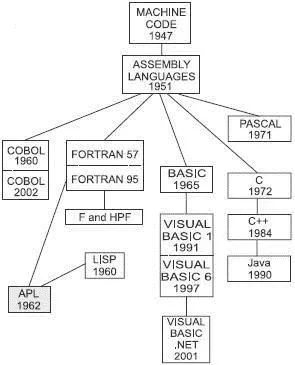
Figure 10.12 A programming language
Easy, it is not. The good news is that, once mastered, it provides fast compact programs but the many cryptic statements would need to include many comments to help another person to understand your program.
Prolog is called a ‘declarative’ language in which the program designer does not need to know exactly what the output will be when starting the design of the program. It was first developed in France in 1972 with a view to its use in the development of artificial intelligence. Prolog stands for PROgramming by LOGic. Other versions were developed, such as DEC10, IC Prolog, which were produced in the UK and other versions from the US (see Figure 10.13).
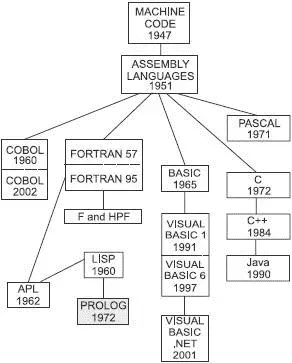
Figure 10.13 A logic-based language
Prolog is another non-procedural language in that it is not a route to a goal but a set of information and a method from which the result can be deduced. Basically the idea is to feed in some facts and ask the program to produce some conclusions. You will remember the little logic puzzles like ‘Graham is married to Anne, Kirk is the son of Peter and the brother of Matt … Is Kirk the brother of …’ You know the sort of thing – more and more interconnected pieces of information until your head hurts. Just the job for Prolog.
The program includes facts and rules then we can ask questions. Here is a really simple example.
Facts:
coins (franc, france)
coins (centime, france)
coins (dollar, usa)
coins (cent, usa)
Rules:
french(x):–coins (x,france)
american(x):–coins (x,american)
Now we ask some questions:
?french (centime)
answer: Yes
?french (dollar)
answer: No
OK so far, but:
?american (dime)
answer: No
It has no data so it cannot say that dime is correct so it plays safe and says it is incorrect.
Increasing microprocessor speeds and using several to share the processing tasks together with the decreasing size and cost of memory will be the key to the future. The idea of a desktop computer running at 20 GHz and having 128 Gbytes of memory is no longer ridiculous. In fact, it is looking rather modest after looking at Table 10.1 in which the trend over the last 26 years is projected another 26 years into the future.
‘ It cannot keep increasing ’ – quote of the year 1972, 1973, 1974, 1975, 1976…
Table 10.1
| Similarly priced microprocessor systems | Intel 4004 in 1972 | Intel Pentium in 1998 | Microprocessor in 2024 |
|---|---|---|---|
| Clock speed | 0.108 MHz | 300 MHz | 833 GHz |
| Memory | 640 bytes | 64 Mbytes | 6.4 Tbytes |
| Performance (MIPS) | 0.06 approx. | 600 approx. | 6 000 000 |
A persistent occupant of my crystal ball is real spoken voice communication. A few years ago voice recognition was only a dream and is now a reality and becoming increasingly efficient. Voice synthesis is progressing nicely and is beginning to sound less robotic. When these two technologies mature, simultaneous language translation will not be far away and real dialog with the computer will begin. Another million television programs suddenly become available without sub-titles (you see, all progress comes at a price!). Six million, million instructions per second and 800 GHz clock speed together with total voice control of computer functions will be here in a few years.
‘ How about that Mr Spock? ’
‘ Fascinating ’
That’s my guess.
At least it is something to look back and smile about in the future.
In each case, choose the best option.
1 A compiler:
(a) converts machine code to a high level language.
(b) is faster than an interpreter.
(c) is another name for a linker.
(d) is not available for the Basic language.
2 APL was largely influenced by:
(a) Cobol and Prolog.
(b) Lisp and Fortran.
(c) Fortran and Basic.
(d) Pascal and Cobol.
3 A fourth generation language can be described as a language which:
(a) is still being used.
(b) is object-oriented.
(c) was developed for artificial intelligence.
(d) is non-procedural.
4 A language designed to allow logical deductions to be made from input data is:
(a) C.
(b) Latin.
(c) Prolog.
(d) Fortran.
5 Pascal:
(a) is a low level language compared with C.
(b) is only of use if you are going to translate it to European languages.
(c) is a highly structured language.
(d) was the first popular high-level language.
11. The development of microprocessors and microcontrollers
As the complexity of microprocessors and other digital integrated circuits has increased, there has been an inevitable increase in the number of transistors that are incorporated in their design.
In the list below, we have used transistors or their equivalent. These classifications are not universally accepted, there are different names and numbers floating around, so a degree of flexibility should be employed when comparing different sources. This is particularly true at the large end where the terminology has not yet ‘firmed up’.
| SSI | Small scale integration | 1–10 transistors |
| MSI | Medium scale integration | 10–1000 transistors |
| LSI | Large scale integration | 1000–10 000 transistors |
| VLSI | Very large scale integration | 10 000–100 000 transistors |
| SLSI | Super large scale integration | 100 000–1 million transistors |
| ULSI | Ultra large scale integration | 1–10 million transistors |
The increase in the number of devices has also had the effect of necessarily decreasing the size of each component. If the same component size were used for the current front runners as was used for the original 4004 microprocessor, they would be about the same size as a page of this book. For reasons that we will look at in a moment, unless we reduced the size of the components, we couldn’t increase the speed of operation and so the current microprocessors would have a maximum clock speed of under 1 MHz.
Читать дальшеИнтервал:
Закладка:
Похожие книги на «Introduction to Microprocessors and Microcontrollers»
Представляем Вашему вниманию похожие книги на «Introduction to Microprocessors and Microcontrollers» списком для выбора. Мы отобрали схожую по названию и смыслу литературу в надежде предоставить читателям больше вариантов отыскать новые, интересные, ещё непрочитанные произведения.











Обсуждение, отзывы о книге «Introduction to Microprocessors and Microcontrollers» и просто собственные мнения читателей. Оставьте ваши комментарии, напишите, что Вы думаете о произведении, его смысле или главных героях. Укажите что конкретно понравилось, а что нет, и почему Вы так считаете.