John Crisp - Introduction to Microprocessors and Microcontrollers
Здесь есть возможность читать онлайн «John Crisp - Introduction to Microprocessors and Microcontrollers» весь текст электронной книги совершенно бесплатно (целиком полную версию без сокращений). В некоторых случаях можно слушать аудио, скачать через торрент в формате fb2 и присутствует краткое содержание. Год выпуска: 2004, ISBN: 2004, Издательство: Elsevier, Жанр: Компьютерное железо, на английском языке. Описание произведения, (предисловие) а так же отзывы посетителей доступны на портале библиотеки ЛибКат.
- Название:Introduction to Microprocessors and Microcontrollers
- Автор:
- Издательство:Elsevier
- Жанр:
- Год:2004
- ISBN:0-7506-5989-0
- Рейтинг книги:3 / 5. Голосов: 1
-
Избранное:Добавить в избранное
- Отзывы:
-
Ваша оценка:
Introduction to Microprocessors and Microcontrollers: краткое содержание, описание и аннотация
Предлагаем к чтению аннотацию, описание, краткое содержание или предисловие (зависит от того, что написал сам автор книги «Introduction to Microprocessors and Microcontrollers»). Если вы не нашли необходимую информацию о книге — напишите в комментариях, мы постараемся отыскать её.
Introduction to Microprocessors and Microcontrollers — читать онлайн бесплатно полную книгу (весь текст) целиком
Ниже представлен текст книги, разбитый по страницам. Система сохранения места последней прочитанной страницы, позволяет с удобством читать онлайн бесплатно книгу «Introduction to Microprocessors and Microcontrollers», без необходимости каждый раз заново искать на чём Вы остановились. Поставьте закладку, и сможете в любой момент перейти на страницу, на которой закончили чтение.
Интервал:
Закладка:
Fortran source code
Fortran consists of numbered statements called program lines and are used to tell the system the order in which the instructions are to be carried out. In the absence of any other commands, the program lines are executed in numerical order.
Fortran code is written in a very compact form much closer to mathematics than English. For example, to load a number and find the square root of it may look like this:
1 Read (4) P
2 A = SQRT(P)
In statement 1, the microprocessor is sent to input number 4 (this must be defined earlier) and retrieves a number which we call P. Statement 2 finds its square root.
Fortran has accumulated enormous libraries to handle scientific and engineering problems. The drawback of Fortran is that its instructions are so very compact that, unless you are happy with formulas, it can look a little frightening. In addition, its format is very precise and this makes it difficult and unforgiving to learn. If you have a morbid dread of mathematics, you may find its approach a little daunting.
In Dartmouth College, USA, a simplified language was developed. It was based on Fortran and was designed as a simpler language and easier to learn. This language was called Basic (Beginners’ All purpose Symbolic Instruction Code) and first appeared in 1960 (see Figure 10.4).
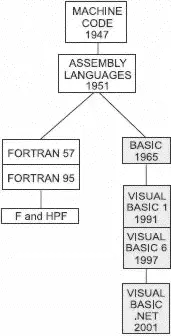
Figure 10.4 The Basics
In the early days, the emphasis was on ‘easy to learn’ and ‘using a minimum amount of memory’ as memory was very expensive. These two attributes made it very useful in colleges but was largely ignored ‘in the real world’. As microprocessors appeared and gave rise to the microcomputer, the benefits of low memory requirements gave it a renewed popularity and it ‘took off’.
To save memory, Basic was designed as an interpreted language. An interpreter rather than a compiler carried out the conversion of the source code to the object code.
What’s the difference? The compiler converts the whole program into object code, stores it, then runs the program. The interpreter takes a different approach. The first instruction in the program is converted to source code and it is then executed. The next item of source code is then converted to object code and then ran and so on right through the program (see Figure 10.5). The interpreter never stores the whole of the machine code program. It just generates it, a line at a time, as needed.
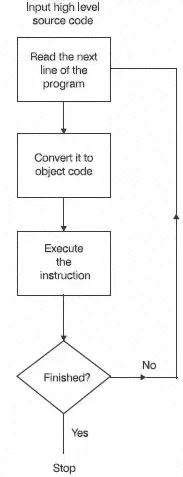
Figure 10.5 The Slow ’n’ easy interpreter
The development of Basic
The explosion of microcomputers in the 1980s resulted in widespread adoption of Basic. It was used, or at least played with, by more people than any programming language before or since. More variations, or dialects, started to appear, as occurred with Fortran.
In the case of Fortran, the American National Standard Institute (ANSI) collected all the ideas together and produced the standard Fortrans like Fortran 66, 77 and 90. This did not happen with Basic and the result is now an open market with several hundred different competing, sort of compatible, Basics floating around. Most of the earlier ones have withered away leaving a few popular versions like Q-Basic, GW Basic and Quick Basic. More recently, with the virtual monopoly of the Windows operating system, a new version called Visual Basic (VB) has appeared which has features to make the generation of Windows programs much easier.
Over the years, the language has developed to provide more and more features until it closely rivals Fortran, even for calculations. Basic has shaken off its beginner’s label and is used by many professional programmers. Now that memory size is not such a problem, compiled versions are now used to accelerate the execution of programs.
There has been a series of versions of Visual Basic, VB1 to VB6 and we now have VB.Net to allow easy manipulation of Windows™ and Web site material.
Basic is very readable
It uses line numbering as in Fortran and is generally readable. Here is an example. Test out its claim to readability by guessing the outcome.
10 input A, B
20 Let C = A * B
30 Print C
40 End
On line 10, it requests two numbers A and B to be entered, possibly via a keyboard. Line 20 defines a new number C as the result of multiplying them together. Print means providing an output either onto a printer or to the screen of the monitor. The last line stops the program.
As you will remember, we always have to give a microprocessor something safe to do after it has completed a program otherwise it will start following random instructions. We can do this by sending it in a loop as we did in the assembly example to follow the same instruction over and over again or we can send it off to follow another program. The END instruction does just this. The program is returned to a ‘monitor’ program. A monitor program does the often forgotten parts of the system like scanning the keyboard to accept further instructions and is in no way connected with the screen showing the visual images.
The line numbers are executed in numerical order and any missing numbers are just ignored. This allows us to use line numbers that increase in steps of five or ten instead of ones. The advantage of this is that any forgotten instruction can be added later by giving it a new line number. For example, if we remembered that we wanted to divide the value of C by 2 then print this result as well, we could add a couple of extra lines:
10 input A, B
20 Let C = A * B
30 Print C
32 Let D = C/2
35 Print D
40 End
A final point is that we do not say what A, B, C or D stand for before we start. The program implies the necessary information. In other words, we do not have to declare the variables.
Fortran and Basic, the son of Fortran, did not make enormous steps towards employing normal English language phrases. This was attempted by the US Defense Department who introduced Cobol in 1959 – just before Basic (see Figure 10.6). Its purpose was not number crunching, like Fortran, but information handling. It proved to be successful at this and spread from the US Navy where it kept records of stocks and supplies, to the business world. The name was derived from COmmon Business Oriented Language.
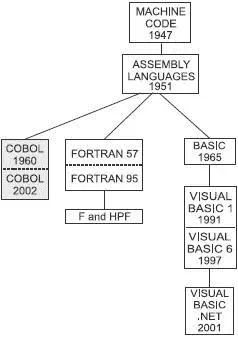
Figure 10.6 This is the business
Cobol was designed, more in hope than reality, to be easily read by non-programmers. However, it looked friendlier than the mathematical approach of Fortran and has survived to the present day. It is generally used by large corporate computers rather than Desktop PCs.
Large businesses handle enormous amounts of information data. Just imagine the amount of information involved in a few everyday activities. We apply to open a bank account – a form appears asking an almost infinite number of questions. Then we want a credit card – more forms, more information mostly the same as we gave them for the bank account. Then we buy something. What we bought, its stock number, its price, the date, our card number, and name are all transmitted to the national card centre and our account is amended. None of these transactions involve particularly complicated mathematics. The calculations are basically addition and subtraction of totals. So the calculating ability of Cobol does not need to rival Fortran or even Basic. But what it can do it to extract related information – put in our post code and out comes all sorts of information about us – credit rating, employment, home address, hobbies, purchasing patterns and almost anything else they want. Some of this information is bought and sold between companies without reference to us.
Читать дальшеИнтервал:
Закладка:
Похожие книги на «Introduction to Microprocessors and Microcontrollers»
Представляем Вашему вниманию похожие книги на «Introduction to Microprocessors and Microcontrollers» списком для выбора. Мы отобрали схожую по названию и смыслу литературу в надежде предоставить читателям больше вариантов отыскать новые, интересные, ещё непрочитанные произведения.












Обсуждение, отзывы о книге «Introduction to Microprocessors and Microcontrollers» и просто собственные мнения читателей. Оставьте ваши комментарии, напишите, что Вы думаете о произведении, его смысле или главных героях. Укажите что конкретно понравилось, а что нет, и почему Вы так считаете.