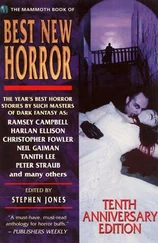
Stephen Jones - The Mammoth Book of Best New Horror. Volume 13
Здесь есть возможность читать онлайн «Stephen Jones - The Mammoth Book of Best New Horror. Volume 13» весь текст электронной книги совершенно бесплатно (целиком полную версию без сокращений). В некоторых случаях можно слушать аудио, скачать через торрент в формате fb2 и присутствует краткое содержание. Город: UK, Год выпуска: 2002, ISBN: 2002, Издательство: Robinson Publishing, Жанр: Ужасы и Мистика, Социально-психологическая фантастика, Фэнтези, на английском языке. Описание произведения, (предисловие) а так же отзывы посетителей доступны на портале библиотеки ЛибКат.

- Название:The Mammoth Book of Best New Horror. Volume 13
- Автор:
- Издательство:Robinson Publishing
- Жанр:
- Год:2002
- Город:UK
- ISBN:1-84119-540-5
- Рейтинг книги:5 / 5. Голосов: 1
-
Избранное:Добавить в избранное
- Отзывы:
-
Ваша оценка:
The Mammoth Book of Best New Horror. Volume 13: краткое содержание, описание и аннотация
Предлагаем к чтению аннотацию, описание, краткое содержание или предисловие (зависит от того, что написал сам автор книги «The Mammoth Book of Best New Horror. Volume 13»). Если вы не нашли необходимую информацию о книге — напишите в комментариях, мы постараемся отыскать её.
The Mammoth Book of Best New Horror. Volume 13 — читать онлайн бесплатно полную книгу (весь текст) целиком
Ниже представлен текст книги, разбитый по страницам. Система сохранения места последней прочитанной страницы, позволяет с удобством читать онлайн бесплатно книгу «The Mammoth Book of Best New Horror. Volume 13», без необходимости каждый раз заново искать на чём Вы остановились. Поставьте закладку, и сможете в любой момент перейти на страницу, на которой закончили чтение.
Интервал:
Закладка:
They were so close now that he could smell rat-stink on Delia Quercia’s breath, and see the yellow that had crept into his eyes. He had only one chance now, and so he let go of the knife’s handle and used both hands to reach round the back of the Venetian’s neck and unfasten the amulet once more.
It slipped from his sweaty fingers, and both he and Delia Quercia went for it. But the moment it lost contact with the possessed man’s flesh, the Venetian collapsed to the ground like a puppet whose strings had been cut. Da Silva kicked the necklace across the room, out of reach, then doubled over, breathing heavily, his hand over his face, trying to relieve the pain flaring through his head.
Looking down, he saw brown suddenly bleed into the prone man’s eyes again, and Delia Quercia looked out of them for a final time, his mouth opening and closing, but no sound coming out.
Kneeling, Da Silva picked up his knife, drew back the man’s head by its hair, and cut his employer’s throat. The blade slid through the Venetian’s flesh as though it was cutting butter, but the blood trickled out so slowly that it reinforced the captain’s thought that Delia Quercia had been dead for at least a quarter of an hour. Neither was Da Silva surprised when the corpse crumbled into dust much as had that of Maria Alvares; although he was relieved that no body was left to be discovered on the top floor of the palazzo.
He still had to dispose of the amulet, though, tired to the bone and in pain as he was; and covered in his own blood as he was, he had no intention of touching the item. Getting to his feet made him dizzy and he staggered, a floorboard creaking as he trod on it. By the door, he recalled, there was a loose board: he had felt it move earlier. It came up easily with the point of his knife.
Some months later, the one-eyed captain, Luis Da Silva, left Venice for good, taking his wife and children to Lisbon aboard his ship, the Isabella.
In the walls of the Casa Delia Scala, the rat-demon waited.
III
Jo was in a place of Escher architecture, a place of more than four dimensions. Whether that was the reality, or she was seeing by metaphor, she had no idea.
But real or imagined, her feet were on the ground again, such as it was, and it made her feel better. Her mind did not understand how she had got here, wherever ‘here’ was, so she put that on the back burner and set about looking for a way out.
Instead of the stairs and interiors that she associated with Escher, this was a place of bridges, interconnecting roads and paths, and cats scampering across them, pursuing rats hither and thither, up and down, upside down. White cats, black cats, piebald cats, grey cats; ginger, calico, tabby; tiger-striped and leopard-spotted.
It didn’t take a genius to figure that one out, Jo thought, laughing.
So it was a dream, she concluded; and as if to reassure her that that was all it was, the scene changed. A pulse boomed in her head, centred on her brow, drilled through like a migraine, and a red mist suffused her vision. She blinked, and flinched back as a huge rat’s face swelled at her and receded. It was hideous, but she was only dreaming—
— And she was back in the room at the palazzo and it was still there.
Jo backed away until she hit the wall, then realized that the giant rat was confined by the figure in the centre of the floor, which now looked fresher and sharper, newly drawn. Not only that, but the beast was fairly insubstantial: she seemed to be able to see through its edges, as though it were an image projected into the room.
But it was still pretty frightful, and an almost palpable stink of menace radiated from it like heat from a stove. It was because it was so big , she realized: almost any small thing blown up huge offends one’s sense of what is right; as if it no longer fitted into the small rat-shaped hole in her map of the world, and that made her hackles rise.
Belatedly, she noticed that the flayed cat was no longer pegged out in the centre of the chalked diagram. Had it ever been really there? Or was she still dreaming? She still felt a presence with her, but could not determine whether it was in the house or of the house.
‘Delia Quercia,’ she said, and her voice cast strange echoes in the empty room, off the pallid faded walls, the stained ceiling. ‘Delia Quercia, what do you want?’
Her mind answered: he wants you. And that seemed to clarify everything. It cut through her panic and left her head clear, as if she had woken healed after a long illness.
Keeping her eyes on the monstrous rat, she sidled to the tall central window and fumbled at its latches, finding bolts top and bottom in addition to the central fastening. A sense of urgency pressed her, but she pressed it back firmly. The window open, she sought for catches on the shutter, and found those too after a moment. It banged back in the wind, and chilly rain blew in; the cold light illuminated the gigantic thing crouched scratching in the middle of the room, trying to dig through the barrier of air that surrounded it. It hissed at her as she looked in its direction and caught its malevolent yellow eye: the thought of its getting free, and the sight of it, insubstantial as it was, impelled her to make haste.
Skirting the circle, she crossed the room again. As she passed the imprisoned rat, it started to fling itself against invisible walls in a frenzy, clawing at the barrier it could not pass through, biting at it. The sight of its great curved fangs was the stuff of nightmare.
Trying to ignore it, and the horror it engendered, Jo examined the plank her entry had dislodged. It was about eight feet in length: she hoped it would be long enough. It was also heavy, and awkward to carry. In the end, she simply dragged it to the window and pushed the end out, balancing it with her own weight, towards the cat tower.
Slowly, infinitely slowly, and taking infinite care, she inched the plank across the gap. It was so heavy that she had to struggle to keep control of it; the rain lashed at her, sweat ran down her sides, her arms shook with the effort, but inch by inch it moved across the gap. The opening she was aiming for was somewhat lower than the window, a fact for which she was extremely grateful, even though it made her worry that her bridge might slip when she tried to cross it.
As the end neared the cat tower, the plank grew more and more difficult to control. But at last it thumped onto the sill of the opening she’d been aiming for, and she breathed a great sigh of relief. At the same time, she felt rather than heard a sound like a chord of music, so loud it could have been the plucking of the constellation of the Lyre, and the back of her neck prickled. It gathered momentum, swelled; became, suddenly, perfection: too much to bear, because she was only human. Tears sprang into her eyes at the sheer beauty of it.
And in that melodious instant, the bridge grew whole again, despite its being only a plank of wood. Stones grew around it, coalesced out of the air that was nothing, and nowhere, and endless, into the semblance of a real bridge; and as she watched, the white cat jumped up onto the far end and sauntered across, flirting its tail.
Following their white pathfinder came a feline army, more than in her dream, dozens of cats, a myriad of them, moving purposefully and in silence across a road closed to them for more than a hundred years, coming to confront their old enemy.
Jo stood to one side to let the white cat spring lightly down to the floor, and as it did she felt a burning sensation in her back pocket, as if something in there had suddenly gone red-hot. She yelped and hauled it out: it was the antique necklace she’d forgotten picking up, and it burned her hand as she flung it away.
Читать дальшеИнтервал:
Закладка:
Похожие книги на «The Mammoth Book of Best New Horror. Volume 13»
Представляем Вашему вниманию похожие книги на «The Mammoth Book of Best New Horror. Volume 13» списком для выбора. Мы отобрали схожую по названию и смыслу литературу в надежде предоставить читателям больше вариантов отыскать новые, интересные, ещё непрочитанные произведения.





Обсуждение, отзывы о книге «The Mammoth Book of Best New Horror. Volume 13» и просто собственные мнения читателей. Оставьте ваши комментарии, напишите, что Вы думаете о произведении, его смысле или главных героях. Укажите что конкретно понравилось, а что нет, и почему Вы так считаете.