Jack McDevitt - Eternity Road
Здесь есть возможность читать онлайн «Jack McDevitt - Eternity Road» весь текст электронной книги совершенно бесплатно (целиком полную версию без сокращений). В некоторых случаях можно слушать аудио, скачать через торрент в формате fb2 и присутствует краткое содержание. Год выпуска: 1998, ISBN: 1998, Издательство: Harper Voyager, Жанр: sf_postapocalyptic, на английском языке. Описание произведения, (предисловие) а так же отзывы посетителей доступны на портале библиотеки ЛибКат.
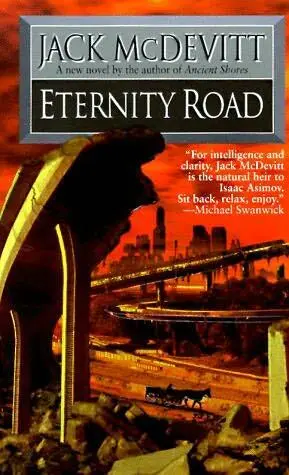
- Название:Eternity Road
- Автор:
- Издательство:Harper Voyager
- Жанр:
- Год:1998
- ISBN:978-0061054273
- Рейтинг книги:4 / 5. Голосов: 1
-
Избранное:Добавить в избранное
- Отзывы:
-
Ваша оценка:
Eternity Road: краткое содержание, описание и аннотация
Предлагаем к чтению аннотацию, описание, краткое содержание или предисловие (зависит от того, что написал сам автор книги «Eternity Road»). Если вы не нашли необходимую информацию о книге — напишите в комментариях, мы постараемся отыскать её.
Chaka’s brother was one of those who sought to find Haven and never returned. But now Chaka has inherited a rare Roadmaker artifact—a book called
—which has inspired her to follow in his footsteps. Gathering an unlikely band of companions around her, Chaka embarks upon a journey where she will encounter bloodthirsty river pirates, electronic ghosts who mourn their lost civilization and machines that skim over the ground and air. Ultimately, the group will learn the truth about their own mysterious past. Amazon.com Review
From Library Journal Eternity Road
After a cataclysmic viral plague wiped out humanity sometime in the 21st century, the next civilization arose in isolated pockets. In the Mississippi Valley, Illyrians built their town on what had been the Roadmakers’ Memphis. Some believed in the mythical Haven on the eastern ocean where books and other technological wonders had been saved. When all but one member of an expedition dies trying to find Haven, the leader's son joins a second party on the long overland trek east. Unfortunately, the book raises more questions than it answers about the knowledge that was lost, leaving the reader unsatisfied. From the author of
(HarperCollins, 1996); a possible candidate to sf collections.
Eternity Road — читать онлайн бесплатно полную книгу (весь текст) целиком
Ниже представлен текст книги, разбитый по страницам. Система сохранения места последней прочитанной страницы, позволяет с удобством читать онлайн бесплатно книгу «Eternity Road», без необходимости каждый раз заново искать на чём Вы остановились. Поставьте закладку, и сможете в любой момент перейти на страницу, на которой закончили чтение.
Интервал:
Закладка:
The Ohio looped away to the north, and after a couple of days they lost sight of it. A giant highway crossed above. It had partially collapsed and blocked Wilderness Road. “Used to be a tunnel through here, I guess,” said Shannon. Cottonwoods on both sides of the rubble were marked with the parallel lines. Stay straight. “We climb over and continue on the other side,” he said.
Within a half-mile, they plunged into heavy forest and Wilderness Road petered out. “Did we go the wrong way?” asked Silas, standing glumly at the head of a half-dozen horses.
“They’re headed for Beekum’s Trail,” said Shannon. “It isn’t far.”
A thick canopy shut off the sunlight. They moved single file through bushes and thickets. The trees, which were mostly elm and black oak, were marked every fifteen or twenty yards, and Chaka began to develop an appreciation for Landon Shay’s foresight.
Ruins appeared. Brick walls, hojjies, an old church, a factory, some shops. Some of the structures were crushed between trees, mute testimony to their age. A metal post had been pushed over, bearing a rectangular sign. Silas wiped it with a cloth.
“It’s a street sign,” Silas explained. “There are quite a few of them on display in the Imperium.” A few minutes later, they found a second sign, bigger, with an arrow under the legend: ALBEN BARKLEY MUSEUM.
The arrow pointed up.
“Strange name,” said Chaka.
They picked up Beekum’s Trail late next morning. It was narrow and heavily overgrown.
“Who was Beekum?” asked Avila.
“A legendary bandit,” Silas explained. “He supposedly collected tolls from anyone who passed here. Tolls or heads.”
“He was killed by Pelio,” said Quait. The equally legendary Argonite hero.
They crossed a tributary of the Ohio on a rickety bridge and stopped to catch some fish for the midday meal.
Beekum’s Trail curved north and the forests began to change. The familiar red cedars and white oak and cottonwoods held their own, but new trees filled the woods now, of types they had never seen before. The Ohio reappeared on their left and they camped several consecutive nights along its banks.
These were pleasant evenings, moonlit and unseasonably warm, filled with easy conviviality. They were now in their third week, and everyone was becoming more or less accustomed to life on the open road. On March 7, they came to the place where the great river threw a branch off to the north. “That’s the Wabash,” said Shannon. “Keep an eye open. There’s a ford just ahead, and that’s probably where they were heading.”
They found two sets of markings, both on cottonwoods, pointing into the river.
“He likes cottonwoods,” said Flojian.
Shannon took off his hat and wiped his brow. “Shay’ll use them wherever he can,” he said. “Makes it easier for us to know what we’re looking for.”
Chaka was studying the river. “That’s a long way across.” Shannon smiled. ‘It’s not as deep as it looks.”
“Not as deep as it looks?” she said. “It looks pretty deep.” It wasn’t the depth so much as the current that gave them trouble. Toward the middle of the river it became quite swift.
Piper stumbled and went down and was almost swept away with her rider, but Quait and Avila came to the rescue.
When they reached shore, they quit for the day, wrung out their clothes, and enjoyed a fish dinner.
The trail now moved north along the Wabash, past a sign on a low brick wall: HOVEY LAKE STATE CAME PRESERVE. The river was narrower than the Ohio, a placid stream covered each day until late morning with mist. There was no road. The weather turned wet and cold, as if crossing the Ohio had put them into a different climate. The first night they found shelter in a barn. Sleet fell in the morning, and miserable conditions persisted for five consecutive days. The good cheer they had felt during their week on the Ohio dissipated.
On the thirteenth, as they crossed another giant roadway, the weather broke. The sun came out, and the day grew warm. To the west, the new road soared high out over the Wabash, and stopped in midair.
Chaka sat on Piper, watching Silas try to sketch the scene into his journal. “Not a bridge to travel at night,” she said.
They rode into a glade bounded on the far side by a low ridge. Shannon brought them to a halt. “This is worth seeing,” he said.
Chaka looked around and saw nothing. The others were equally puzzled.
“The ridge,” said Shannon.
It was long and straight, emerging from the trees to their right, passing across their line of advance, and disappearing back into the forest. It had a rounded crest, covered with grass and dead leaves. Otherwise, it was remarkable for its lack of noteworthiness.
“It’s not really straight,” said Shannon. “It only looks that way because you can’t see much of it. In fact, it makes a perfect circle. Seventy miles around.”
Avila leaned forward in her saddle. “The Devil’s Eye,” she said.
One of the horses was nuzzling Chaka.
“You’ve heard of it?” Shannon looked surprised.
“Oh yes. I knew it was out here somewhere, but I didn’t expect to see it.”
“The ridge is always the same height. Sometimes the land drops away and it looks higher. And sometimes the ground rises and the ridge disappears altogether.”
“What’s the Devil’s Eye?” asked Chaka, feeling a chill work its way down her spine.
Avila dismounted and shielded her eyes. “It’s supposed to be the place where the Roadmakers conjured up a demon to help them look into Shanta’s secrets. So they could steal her divinity.” She looked uncomfortable. “I always thought it was probably just a loose configuration of hills. That people were exaggerating about the geometry.”
“Oh, no,” said Shannon. “Nobody exaggerated about this place.”
“How’d it get here?” asked Flojian, his voice hushed. “It can’t be natural.”
Shannon let them look, and then led them back into the woods, following the ridge. They were riding upslope, and consequently the summit was getting lower. Beyond the crest, the tops of several ruined buildings came into view.
Chaka guided her horse close to Shannon. “Do you know what it is?” she asked, hoping for a more mundane explanation.
He shook his head. “I have no idea.”
Silas could have identified Christianity as a major religion of the Roadmaker epoch. But his information was limited to the few volumes that had survived into his own age. He could not have known, for example, that, of the long panoply of supernatural names mentioned in the Scriptures, only the Devil’s lived on.
10
The ridge was matted with leaves and dead grass, and sprinkled with black cherry trees and yellow poplars. It was almost flat now, muscling into a rising slope. An old road crossed and curved in toward the ancient buildings.
Three of an original group of six or seven were still standing. Two were gray stone structures, half a dozen floors, windows punched out. The third was constructed primarily of large curved slabs of the kind of material that looked like glass but couldn’t have been, because it was still intact. All of the walls within six feet of the ground were smeared with arcane symbols, reversed letters and upside-down crosses and crescent moons and flowing lines. “They’re supposed to suppress local demons,” Avila said.
The glass building was about ten stories high. On the roof, a large gray disk had fallen off its mount onto the cornice and seemed on the verge of plunging to the terrace below. Rows of double windows lined the upper floors. At its base, wide pseudo-glass doors opened onto the terrace.
Читать дальшеИнтервал:
Закладка:
Похожие книги на «Eternity Road»
Представляем Вашему вниманию похожие книги на «Eternity Road» списком для выбора. Мы отобрали схожую по названию и смыслу литературу в надежде предоставить читателям больше вариантов отыскать новые, интересные, ещё непрочитанные произведения.


Обсуждение, отзывы о книге «Eternity Road» и просто собственные мнения читателей. Оставьте ваши комментарии, напишите, что Вы думаете о произведении, его смысле или главных героях. Укажите что конкретно понравилось, а что нет, и почему Вы так считаете.