Frank Tayell - Work. Rest. Repeat.
Здесь есть возможность читать онлайн «Frank Tayell - Work. Rest. Repeat.» весь текст электронной книги совершенно бесплатно (целиком полную версию без сокращений). В некоторых случаях можно слушать аудио, скачать через торрент в формате fb2 и присутствует краткое содержание. Город: London, Год выпуска: 2014, Жанр: sf_postapocalyptic, Детективная фантастика, на английском языке. Описание произведения, (предисловие) а так же отзывы посетителей доступны на портале библиотеки ЛибКат.
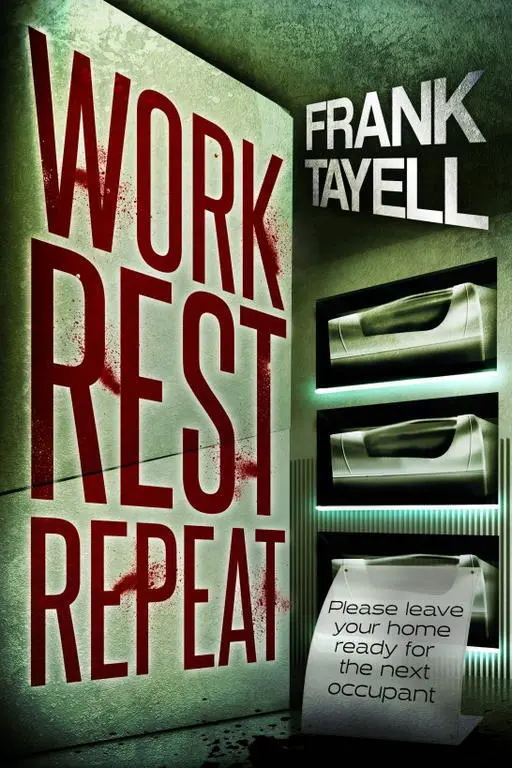
- Название:Work. Rest. Repeat.
- Автор:
- Жанр:
- Год:2014
- Город:London
- ISBN:нет данных
- Рейтинг книги:5 / 5. Голосов: 1
-
Избранное:Добавить в избранное
- Отзывы:
-
Ваша оценка:
Work. Rest. Repeat.: краткое содержание, описание и аннотация
Предлагаем к чтению аннотацию, описание, краткое содержание или предисловие (зависит от того, что написал сам автор книги «Work. Rest. Repeat.»). Если вы не нашли необходимую информацию о книге — напишите в комментариях, мы постараемся отыскать её.
Work. Rest. Repeat. — читать онлайн бесплатно полную книгу (весь текст) целиком
Ниже представлен текст книги, разбитый по страницам. Система сохранения места последней прочитанной страницы, позволяет с удобством читать онлайн бесплатно книгу «Work. Rest. Repeat.», без необходимости каждый раз заново искать на чём Вы остановились. Поставьте закладку, и сможете в любой момент перейти на страницу, на которой закончили чтение.
Интервал:
Закладка:
There was no panel by the door. Nor was there one of those old fashioned handles he’d seen down in the tunnels. He tried to lever the doors apart. They didn’t move. He rapped his knuckles against the metal. They rang with a dull, solid, thump.
He nodded to himself. Now he knew. There was nothing behind the door but a few inches of metal, and then the outside. Ely looked at the door for a moment longer.
His wristboard chimed. It was a message from Vauxhall, ‘Where are you Ely?’ He looked up at the camera in the ceiling of the corridor. Slowly, he took his wristboard off and laid it on the floor. He ignored the elevators, made his way back to the access ladder, and began to climb down.
Each time he reached the bottom of a ladder, and had to go out into the corridor to find another hatch, he found the hallways full of workers. A few, not many, still patiently queued. Others, and again, not many, looked as if they were trying to record and upload the event. Most were talking heatedly to one another, tapping out messages or throwing angry questions up at the cameras. When they saw him, some approached. When they saw his expression, they backed away.
He paused briefly at Level Three. The doors to the Control Room were open. He went inside. The room was empty. The screens were blank. He had been expecting that. It didn’t matter, he knew where he was going. He made his way back down to The Foundations.
The flashlight he’d taken from near the ghost’s body was where he’d left it, next to the panel leaning up against the Tower wall. He took it and climbed down the ladder.
At the bottom he didn’t head towards the hall where he had fought the ghost. He turned the other way. Using the light, he followed the corridor. The passageway appeared blocked after twenty yards. He played the light up and down until he found the old metal filing cabinet. He pushed it out of the way, revealing a narrow opening just wide enough for a person to squeeze through.
Beyond, the corridor was far cleaner, covered in the same white panels he knew from the Tower above. He counted out the distance as he walked. After two hundred yards he stopped and examined the wall. He found the hidden door. He opened it. Inside was a stairwell. He shone the light down. Five steps below, water lapped against the stairs. He went up. After two flights, the stairs ended in a short landing, with another door. He opened it.
He stepped outside. This time, there was no moment of blinding light.
It was the smell that struck him first. From the roof it had seemed almost fragrant. Here at ground level, it was far richer, with a darker, earthier tone. It was so intoxicating it filled his senses, yet it was forgotten a moment later when he heard the sounds. There were so many, and they were so alien it took him a few seconds to realise they weren’t all one sound, but many hundreds of smaller ones. Birds, he thought, birds and insects, chirruping and singing and calling to one another. They sounded nothing like those pale imitations he’d heard on the old movies.
But the street did look almost familiar. He’d seen it before, somewhere, sometime, perhaps in a photograph, though in that memory it looked achingly different to what he saw now.
The street, stretching off for a mile in either direction, was at least forty feet wide, bracketed on either side by the ruins of once tall buildings. The roadway was broken with grass and weeds that had spread up and over piles of rubble. He looked to his left and saw a tree growing up out of the concrete. Its branches had pushed through the windows of a nearby building. As the tree had grown, the branches had ripped up through the brickwork, causing the facade to fracture and break. The fallen masonry now lay in a jumbled heap at the tree’s base.
Beyond the tree lay other mounds of broken masonry and twisted metal, all covered in the same irregular sea of green leaves and flowering colours. It was the second most beautiful thing Ely had ever seen.
“ Who are you?” he had asked the ghost.
“ I was like you,” she had said. “Or I was a worker, anyway. Up until four years ago I worked down in the Assembly.”
“ I don’t recognise you.”
“ How many workers would you recognise?” she had retorted. “The three of us were recruited to go out and see what had become of the world. We weren’t the first. But we were determined that we would be the last.”
“ What does that mean?” he had asked.
“ Go to the edge of the roof and look down. You’ll see for yourself.”
Warily, still expecting some kind of trap, he had inched his way over to the side of the building and peered over the edge. It was both the most terrible, and the most beautiful, sight he had ever seen.
“ There’s no water. No flood,” he had said. Below him were the ruins of buildings, stretching off as far as the eye could see.
“ The city, the real city,” she had said, “was built by a river, long ago. It does flood, occasionally, but after a few days, the water level drops, and the streets clear again.”
“ They said it was built in the most remote part of the country. They said, before the rains began, before the flood, that there was a great toxic desert outside.”
“ I think,” she said, “that was partly true. It was never a desert, it was always like this, but it was toxic. There was some Great Disaster, though I doubt it happened quite as they told us. People did die, and they died suddenly. We found their remains in buildings and houses across the city and far beyond. We don’t know what killed them, not exactly, but we suspect it was done by the same people who originally built the Tower.”
Ely turned and looked up at the Tower that had been his home, his life. It wasn’t the gleaming edifice depicted in the pictures. The solar panels still covered the walls, but they appeared dented, some were cracked, others were clearly damaged beyond use.
“ If there was no flood,” he’d said, looking down at the ruined city below, “then there’s no tidal barrier. So, where does the Tower get its power from?”
“ Solar panels. Body heat. The turbines.” She pointed at the giant wind turbines towering over them. “And the machines in that Recreation Room, of course.”
“ They said the solar panels were replaced with panelling that captured the kinetic energy of the wind and rain.”
“ They said a lot of things, Ely.”
“ And I should believe you, and not them?” he had asked.
“ You should believe the evidence of your own eyes,” she had said.
He looked up and down, and around. “How long?” he asked. “I mean, if there was no Great Disaster, then has it really been sixty years?”
“ No,” she said, “it’s been a lot longer than that. The Tower was built as an enclosed system. It was a marvel for its time, designed to be a net producer of energy and heat. Those who constructed it utilised the most advanced technologies of their age. And those technologies were developed to take our species to Mars, that much is true. But turbines break.” She gestured to the idle windmill. “The self-cleaning system for the solar panels clog, and the panels become obscured by dirt. It was meant to last one hundred years. Exactly how much longer or shorter than that it’s been, we can’t be sure, but the technology is finally failing.”
“ Thanks to your sabotage,” he had said.
“ No, it was falling apart long before we returned. It was like this long before we left. It was why the microphones were turned off, why most of the servers are silent, there isn’t the energy to keep them going. That was why the Recreation Room was created. It is why the population keeps getting smaller.”
Читать дальшеИнтервал:
Закладка:
Похожие книги на «Work. Rest. Repeat.»
Представляем Вашему вниманию похожие книги на «Work. Rest. Repeat.» списком для выбора. Мы отобрали схожую по названию и смыслу литературу в надежде предоставить читателям больше вариантов отыскать новые, интересные, ещё непрочитанные произведения.




Обсуждение, отзывы о книге «Work. Rest. Repeat.» и просто собственные мнения читателей. Оставьте ваши комментарии, напишите, что Вы думаете о произведении, его смысле или главных героях. Укажите что конкретно понравилось, а что нет, и почему Вы так считаете.