Alistair MacLean - The Complete Navarone
Здесь есть возможность читать онлайн «Alistair MacLean - The Complete Navarone» — ознакомительный отрывок электронной книги совершенно бесплатно, а после прочтения отрывка купить полную версию. В некоторых случаях можно слушать аудио, скачать через торрент в формате fb2 и присутствует краткое содержание. Год выпуска: 2008, ISBN: 2008, Издательство: HarperCollins, Жанр: sf_mystic, Триллер, prose_military, на английском языке. Описание произведения, (предисловие) а так же отзывы посетителей доступны на портале библиотеки ЛибКат.
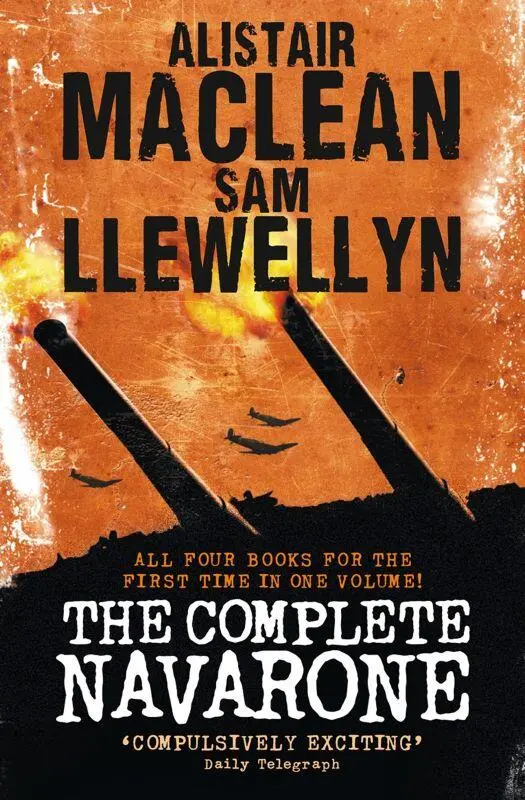
- Название:The Complete Navarone
- Автор:
- Издательство:HarperCollins
- Жанр:
- Год:2008
- ISBN:9780007438334
- Рейтинг книги:4 / 5. Голосов: 1
-
Избранное:Добавить в избранное
- Отзывы:
-
Ваша оценка:
The Complete Navarone: краткое содержание, описание и аннотация
Предлагаем к чтению аннотацию, описание, краткое содержание или предисловие (зависит от того, что написал сам автор книги «The Complete Navarone»). Если вы не нашли необходимую информацию о книге — напишите в комментариях, мы постараемся отыскать её.
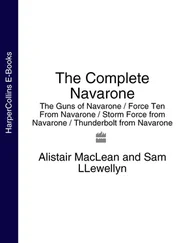
THE GUNS OF NAVARONE
Mallory, Miller and Andrea are united into a lethally effective team. Their mission: to silence the impregnable guns set in the tall cliffs of Navarone. On their success or failure rests one of the most critical offensives of the Second World War.
FORCE 10 FROM NAVARONE
Almost before the last echoes of the famous guns have died away, the three Navarone heroes are parachuted into war-torn Yugoslavia to rescue a division of partisans and fulfil a secret mission, so deadly that it must be hidden even from their own allies.
STORM FORCE FROM NAVARONE
The surviving commandos are sent on a perilous journey through the Pyrenees to disable the greatest threat to the impending D-Day landings: the 'Werwolf' U-boats. But their Basque guides declare it mission impossible — D-Day is less than six days away.
THUNDERBOLT FROM NAVARONE
Summoned back to Naval HQ, Mallory, Miller and Andrea are given a final assignment: to reconnoitre the Greek island of Kynthos and destroy the German facilities developing the lethal V3 weapon. A rocket expert is to accompany them — but can he be trusted not to turn the operation into a suicide mission?
The Complete Navarone — читать онлайн ознакомительный отрывок
Ниже представлен текст книги, разбитый по страницам. Система сохранения места последней прочитанной страницы, позволяет с удобством читать онлайн бесплатно книгу «The Complete Navarone», без необходимости каждый раз заново искать на чём Вы остановились. Поставьте закладку, и сможете в любой момент перейти на страницу, на которой закончили чтение.
Интервал:
Закладка:
‘Hey!’ said Andrea. ‘You!’
A small Wehrmacht man had been passing. He said, ‘Me?’
‘None other,’ drawled Andrea. ‘Take these clothes. Throw them away.’
‘Away?’ The man’s eyes were dull and stupid.
‘A tubercular patient in the village,’ said Andrea. ‘They are to be burned. Now. Where is the hospital?’
‘Third level,’ said the soldier.
‘Remember this,’ said Andrea. ‘The faster you go, the more likely you are to live. And don’t tell anyone, or they’ll give you the treatment.’
‘Treatment, Herr Leutnant? ’
‘Paraffin enemas,’ said Miller, with a ghastly grin.
The private gulped and scuttled off, holding the bundles as far away from him as possible.
‘Now,’ said Andrea. ‘Let us see to the state of the wiring in this pest hole.’
‘Yes indeed,’ said Miller, bowing his head over his clipboard and writing diligently. ‘After you, Herr Leutnant .’
They walked up the steel stairs, slowly, but putting distance between themselves and the crisis that would be developing in the shower. The base level seemed by a thrum in the rock to consist of machinery and shelters. Above were living quarters: they passed rooms in which double-tiered bunks stretched away to impossibly distant vanishing points, a couple of mess rooms wafting the sour smell of boiled sausage and fried onions. A Wehrmacht major was marching towards them. ‘Two hundred and ten,’ said Andrea. Miller scribbled on his clipboard. The Wehrmacht major stopped, frowning. Miller felt his stomach hollow out.
‘What are you doing?’ said the major.
Andrea crashed to attention. ‘Heil Hitler!’ he yelled, shooting out his right arm.
‘Oh,’ said the major, who had a mild, clerkish, non-Nazi sort of face. ‘Heil, er, Hitler.’ He gave the army salute. ‘What are you doing?’ he said again.
‘Light bulb audit,’ said Andrea, with a face like granite.
‘Light bulbs?’ said the major, frowning at the SS runes on Andrea’s smock.
‘Those are my orders,’ said Andrea.
‘Jawohl,’ said Miller, squinting furiously at the bridge of his nose and trying by willpower to stop the sweat running down his face.
The major sighed. ‘So they fly you from the Harz specially to count the light bulbs,’ he said. ‘Shouldn’t you be torturing women or something?’
‘Herr Major?’ Andrea’s face was as stiff as a poker.
The major shook his head. There was drink on his breath. ‘Oh, hell,’ he said. ‘I suppose someone’s got to do it.’
‘Jawohl Herr Major,’ shouted Andrea.
‘Carry on,’ said the major. He walked away, muttering.
They carried on. They went up more stairs to something that seemed from the smell of antiseptic to be a hospital level: though there was no hospital to be seen, merely a horizontal corridor with a steel catwalk suspended over a rough floor of volcanic rock. The hospital was an opening off the tunnel. At the tunnel’s end was a concrete doorframe with a lift inside it. On the right of the lift was a small wooden structure, like a sentry box, but bigger.
There were fewer people up here. A couple of men walked past, deep in conversation, wearing engineers’ coats like Miller’s. They looked at him as they passed. He nodded. They nodded back and walked on without altering their step. At the end they paused by the sentry box, fished out passes of some kind. An SS man came out of the sentry box. He looked at the passes, the engineers, back at the passes, the engineers again. Then the engineers signed a book, and moved on to the lift.
‘They’ve got keys,’ said Andrea.
‘You would almost think,’ said Miller, ‘that they did not want anyone to get in.’
As he spoke, there was a small, distinct bump that seemed to come not down the tunnel but through the rock itself. Miller felt a twinge of significant happiness. He was always suspicious of the ability of anyone but himself to use explosives. But it seemed likely now that Mallory had managed to make the stuff go off. And knowing Mallory, he would have put it in the right place.
All this he thought very fast indeed. There were klaxons moaning again, and he found that he was walking, walking alongside Andrea — not into the great mass of people seething and swirling behind them on the lower levels, but forward; forward towards the sentry box at the foot of the lift shaft.
Up in the Swallow’s Nest, Wills lay with his head on Clytemnestra’s belly and dust in his eyes and wondered why he was not dead yet.
He did not lie for long. He got up and grabbed at a Schmeisser and went once again to the loophole. The sun was all the way down now; outside, the world lay in deep shadow, deepest over the bodies crumpled in the gulley of the path. The killing ground was quiet, empty of living things. The last ray of sun lit the summit of the mountain above the Acropolis, where the aerials were.
From that summit there came a small, brilliant flash, followed some time later by the tiny thump of an explosion.
He raised his glasses to his eyes.
A black smear of smoke drifted in the light. The aerials had gone.
Down in the valley, the 88 crashed again. The shell smashed into the cliff, miles above their heads. Wills thought for a moment, then went back to Clytemnestra. He wanted to talk; but he found himself grinning too hard.
‘What is it?’ she said. She was picking herself up now.
‘They were talking to the radio room on the mountain,’ said Wills. ‘Someone was spotting for the 88. The aerials have gone. They’re firing blind.’
Clytemnestra got up and reeled to the loophole. She pushed the hair out of her eyes. Wills gave her a water bottle. She spat out the first mouthful, then drank deeply. ‘Fine,’ she said.
Wills had stopped grinning. The immediate danger was past. Longer-term, the situation had not changed. ‘We’re still stuck,’ he said. ‘All they’ve got to do is wait there till we starve.’
‘Oh, no,’ said Clytemnestra. ‘Not true, my sad English friend. Now it is dark.’
‘Can’t eat dark,’ said Wills.
She laughed. It was a confident laugh, most encouraging. ‘Tonight,’ she said, ‘we eat not dark, but sheep.’
Concussion, thought Wills. Poor girl, what the hell will I do with her now? ‘Sit down,’ he said. ‘More water.’
‘I have sat down enough,’ she said. ‘Also, I have drunk all a woman needs to drink, who is about to take a journey.’
‘Journey?’ said Wills, fogged.
‘We are leaving,’ said Clytemnestra, shouldering her pack. ‘Follow me.’
‘Top-hole,’ said Wills. He strapped on his pack and slung his Schmeisser. Once, before he had started skulking in the mountains with beautiful Furies, he had been the commander of an MTB. That had been in another life, over twenty-four hours ago. He squeezed a burst out of the loophole at the slot in the rocks, the muzzle flash making blue lightnings in the dark. Then he was jogging down the stone stairs into the mould-smelling lower room of the Swallow’s Nest, out into the warm night, up the alley that did duty as this hamlet’s main street, his back crawling with the expectation of bullets, through a passage so narrow he had to turn sideways, following the faint scuff of Clytemnestra’s boots in front. The passage became a path. Thick bushes brushed against his legs, and once something that looked like a wall of trees reared up in front of him and whipped his face, and he knew he had gone through a curtain of some kind. Then they were climbing athwart a slope so steep he could touch the ground with his right hand, while on his left he felt the presence of a dark and mighty gulf. At last, the voice in front said, ‘Stop.’ He groped his way along until he found an opening, and slid in. There was a scrape and a flare of light as Clytemnestra lit a match. She ran her hand along a ledge, and came down with a stub of candle. They were in a cave, square-sided: another tomb. ‘They won’t find us here,’ she said. ‘Not without dogs.’
Читать дальшеИнтервал:
Закладка:
Похожие книги на «The Complete Navarone»
Представляем Вашему вниманию похожие книги на «The Complete Navarone» списком для выбора. Мы отобрали схожую по названию и смыслу литературу в надежде предоставить читателям больше вариантов отыскать новые, интересные, ещё непрочитанные произведения.





Обсуждение, отзывы о книге «The Complete Navarone» и просто собственные мнения читателей. Оставьте ваши комментарии, напишите, что Вы думаете о произведении, его смысле или главных героях. Укажите что конкретно понравилось, а что нет, и почему Вы так считаете.