Jonathan Stroud - The Amulet of Samarkand
Здесь есть возможность читать онлайн «Jonathan Stroud - The Amulet of Samarkand» весь текст электронной книги совершенно бесплатно (целиком полную версию без сокращений). В некоторых случаях можно слушать аудио, скачать через торрент в формате fb2 и присутствует краткое содержание. Год выпуска: 2003, ISBN: 2003, Издательство: Hyperion Books for Children, Жанр: Фэнтези, на английском языке. Описание произведения, (предисловие) а так же отзывы посетителей доступны на портале библиотеки ЛибКат.
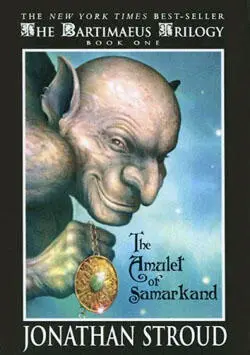
- Название:The Amulet of Samarkand
- Автор:
- Издательство:Hyperion Books for Children
- Жанр:
- Год:2003
- ISBN:0-7868-1859-X, 978-0-7868-1859-4
- Рейтинг книги:5 / 5. Голосов: 1
-
Избранное:Добавить в избранное
- Отзывы:
-
Ваша оценка:
The Amulet of Samarkand: краткое содержание, описание и аннотация
Предлагаем к чтению аннотацию, описание, краткое содержание или предисловие (зависит от того, что написал сам автор книги «The Amulet of Samarkand»). Если вы не нашли необходимую информацию о книге — напишите в комментариях, мы постараемся отыскать её.
The Amulet of Samarkand — читать онлайн бесплатно полную книгу (весь текст) целиком
Ниже представлен текст книги, разбитый по страницам. Система сохранения места последней прочитанной страницы, позволяет с удобством читать онлайн бесплатно книгу «The Amulet of Samarkand», без необходимости каждый раз заново искать на чём Вы остановились. Поставьте закладку, и сможете в любой момент перейти на страницу, на которой закончили чтение.
Интервал:
Закладка:
To sum up then: it seemed that to guard his own skin, this ungrateful child was risking bringing the wrath of a powerful magician down upon his innocent master's head. I was very impressed. Even though he had to be in cahoots with an adult—some enemy of his master, presumably—it was an admirably twisted plan for one so young.
I did an eightfold tiptoe out of the door. Then I saw the master.
I had not heard of this magician, this Mr. Arthur Underwood. I assumed him therefore to be a minor conjuror, a dabbler in fakery and mumbo—jumbo who never dared disturb the rest of higher beings such as me. Certainly, as he passed underneath me into the bathroom (I had evidently exited just in time), he fit the bill of second—rater. A sure sign of this was that he had all the time—honored attributes that other humans associate with great and powerful magic: a mane of unkempt hair the color of tobacco ash, a long whitish beard that jutted outward like the prow of a ship, and a pair of particularly bristly eyebrows. [29] Minor magicians take pains to fit this traditional wizardly bill. By contrast, the really powerful magicians take pleasure in looking like accountants.
I could imagine him stalking through the streets of London in a black velveteen suit, hair billowing behind him in a sorcerous sort of way. He probably flourished a gold—tipped cane, maybe even a swanky cape. Yes, he'd look the part then, all right: very impressive. As opposed to now, stumbling along in his pajama bottoms, scratching his unmentionables and sporting a folded newspaper under his arm.
"Martha!" He called this just before closing the bathroom door. A small, spherical female emerged from a bedroom. Thankfully, she was fully dressed.
"Yes, dear?"
"I thought you said that woman cleaned yesterday."
"Yes, she did, dear. Why?"
"Because there's a grubby cobweb dangling from the middle of the ceiling, with a repellent spider skulking in it. Loathsome. She should be sacked."
"Oh, I see it. How foul. Don't worry, I'll speak to her. And I'll get the duster to it shortly."
The great magician humphed and shut the door. The woman shook her head in a forgiving manner and, humming a lighthearted ditty, disappeared downstairs. The «loathsome» spider made a rude sign with two of its legs and set off along the ceiling, trailing its cobweb behind it.
It took several minutes' scuttering before I located the entrance to the study at the bottom of a short flight of stairs. And here I halted. The door was protected against interlopers by a hex in the form of a five—pointed star. It was a simple device. The star appeared to consist of flaking red paint; however, if an unwary trespasser opened the door the trap would be triggered and the «paint» would revert to its original state—a ricocheting bolt of fire.
Sounds good, I know, but it was pretty basic stuff actually. A curious housemaid might be frazzled, but not Bartimaeus. I erected a Shield around me and, touching the base of the door with a tiny claw, instantly sprang back a couple of feet.
Thin orange streaks appeared within the red lines of the five—pointed star. For a second the lines coursed like liquid, racing round and round the shape. Then a jet of flame burst from the star's uppermost point, rebounded off the ceiling and speared down toward me.
I was ready for the impact on my Shield, but it never took place.
The flame bypassed me altogether and hit the cobweb I was trailing. And the cobweb sucked it up, drawing the fire from the star like juice through a straw. In an instant it was over. The flame was gone. It had disappeared into the cobweb, which remained as cool as ever.
In some surprise, I looked around. A charcoal—black star was seared into the wood of the study door. As I watched, the hex began to redden slowly—it was reassembling its charge for the next intruder.
I suddenly realized what had happened. It was obvious. The Amulet of Samarkand had done what amulets are supposed to do—it had protected its wearer. [30] Amulets are protective charms; they fend off evil. They are passive objects and although they can absorb or deflect all manner of dangerous magic, they cannot be actively controlled by their owner. They are thus the opposite of talismans, which have active magical powers that can be used at their owner's discretion. A horseshoe is a (primitive) amulet; seven—league boots are a form of talisman.
Very nicely, too. It had absorbed the hex without any trouble whatsoever. That was fine by me. I removed my Shield and squeezed myself beneath the door and into Underwood's study.
Beyond the door I found no further traps on any of the planes, another sign that the magician was of a fairly low order. (I recalled the extensive network of defenses that Simon Lovelace had rigged up and which I'd broached with such easy panache. If the boy thought that the Amulet would be safe behind his master's «security» he had another thing coming.) The room was tidy, if dusty, and contained among other things a locked cupboard that I guessed housed his treasures. I entered via the keyhole, tugging the cobweb in my wake.
Once inside I performed a small Illumination. A pitiful array of magical gimcracks were arranged with loving care on three glass shelves. Some of them, such as the Tinker's Purse, with its secret pocket for making coins "vanish," were frankly not magical at all. It made my estimate of second—rater seem overly generous. I almost felt sorry for the old duffer. For his sake I hoped Simon Lovelace never came to call.
There was a Javanese bird totem at the back of the cupboard, its beak and plumes gray with dust. Underwood obviously never touched it. I pulled the cobweb between the purse and an Edwardian rabbit's foot and tucked it behind the totem. Good. No one would find it there unless they were really hunting. Finally I removed the Charm on it restoring it to its normal amulet—y size and shape.
With that, my assignment was complete. All that remained was to return to the boy. I exited cupboard and study without any hiccups and set off back upstairs.
This was where it got interesting.
I was heading up to the attic room again, of course, using the sloping ceiling above the stairs, when unexpectedly the boy passed me coming down. He was trailing in the wake of the magician's wife, looking thoroughly fed up. Evidently he had just been summoned from his room.
I perked up at once. This was bad for him, and I could see from his face that he realized it too. He knew I was loose, somewhere nearby. He knew I would be coming back, that my charge had been to return to him immediately, silent and unseen, to await further instructions. He knew I might therefore be following him now, listening and watching, learning more about him, and that he couldn't do anything about it until he got back to his room and stood again within the pentacle.
In short, he had lost control of the situation, a dangerous state of affairs for any magician.
I swiveled and followed eagerly in their wake. True to my charge, no one saw or heard me as I crept along behind.
The woman led the boy to a door on the ground floor. "He's in there, dear," she said.
"Okay," the boy said. His voice was nice and despondent, just how I like it.
They went in, woman first, boy second. The door shut so fast that I had to do a couple of quick—fire shots of web to trapeze myself through the crack before it closed. It was a great stunt—I wish someone had seen it. But no. Silent and unseen, that's me.
We were in a gloomy dining room. The magician, Arthur Underwood, was seated alone at the head of a dark and shiny dining table, with cup, saucer, and silver coffee pot close to hand. He was still occupied with his newspaper, which lay folded in half on the table. As the woman and the boy entered, he picked up the paper, unfolded it, turned the page crisply, and smacked the whole thing in half again. He didn't look up.
Читать дальшеИнтервал:
Закладка:
Похожие книги на «The Amulet of Samarkand»
Представляем Вашему вниманию похожие книги на «The Amulet of Samarkand» списком для выбора. Мы отобрали схожую по названию и смыслу литературу в надежде предоставить читателям больше вариантов отыскать новые, интересные, ещё непрочитанные произведения.









Обсуждение, отзывы о книге «The Amulet of Samarkand» и просто собственные мнения читателей. Оставьте ваши комментарии, напишите, что Вы думаете о произведении, его смысле или главных героях. Укажите что конкретно понравилось, а что нет, и почему Вы так считаете.