Jonathan Strahan - The Best Science Fiction & Fantasy of the Year Volume 5 An anthology of stories
Здесь есть возможность читать онлайн «Jonathan Strahan - The Best Science Fiction & Fantasy of the Year Volume 5 An anthology of stories» весь текст электронной книги совершенно бесплатно (целиком полную версию без сокращений). В некоторых случаях можно слушать аудио, скачать через торрент в формате fb2 и присутствует краткое содержание. Жанр: Фэнтези, Фантастика и фэнтези, на английском языке. Описание произведения, (предисловие) а так же отзывы посетителей доступны на портале библиотеки ЛибКат.
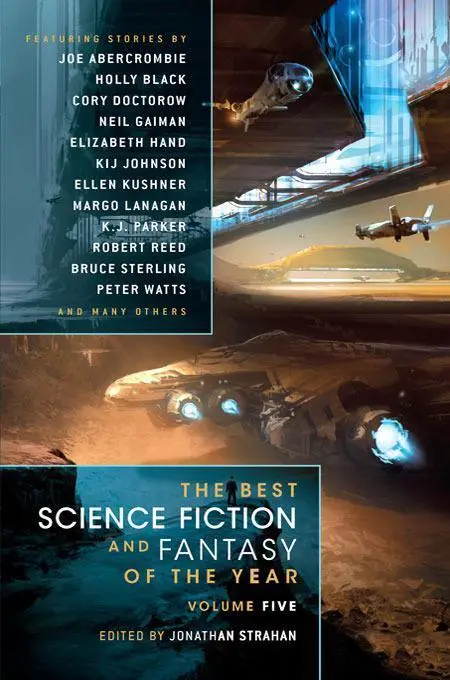
- Название:The Best Science Fiction & Fantasy of the Year Volume 5 An anthology of stories
- Автор:
- Жанр:
- Год:неизвестен
- ISBN:нет данных
- Рейтинг книги:4 / 5. Голосов: 1
-
Избранное:Добавить в избранное
- Отзывы:
-
Ваша оценка:
The Best Science Fiction & Fantasy of the Year Volume 5 An anthology of stories: краткое содержание, описание и аннотация
Предлагаем к чтению аннотацию, описание, краткое содержание или предисловие (зависит от того, что написал сам автор книги «The Best Science Fiction & Fantasy of the Year Volume 5 An anthology of stories»). Если вы не нашли необходимую информацию о книге — напишите в комментариях, мы постараемся отыскать её.
The Best Science Fiction & Fantasy of the Year Volume 5 An anthology of stories — читать онлайн бесплатно полную книгу (весь текст) целиком
Ниже представлен текст книги, разбитый по страницам. Система сохранения места последней прочитанной страницы, позволяет с удобством читать онлайн бесплатно книгу «The Best Science Fiction & Fantasy of the Year Volume 5 An anthology of stories», без необходимости каждый раз заново искать на чём Вы остановились. Поставьте закладку, и сможете в любой момент перейти на страницу, на которой закончили чтение.
Интервал:
Закладка:
I nodded. Clearly, plans had been made with no room for me.“How will I get in touch?” I asked. “What if I want to talk to Leah—to Doctor Hamakawa?”
“They’ll be able to find you. Don’t worry.” After a pause, she said, “Shall we show you to your place to domicile?”
The building to which I was shown was one of a cluster that seemed suspended in the air by crisscrossed cables. It was larger than many houses. I was used to living in the cubbyholes of habitat modules, and the spaciousness of the accommodations startled me.
“Good evening, Mr. Tinkerman.” The person greeting me was a tall Chinese man perhaps fifty years of age. The woman next to him, I surmised, was his wife. She was quite a bit younger, in her early twenties. She was slightly overweight by the standards I was used to, but I had noticed that was common here. Behind her hid two children, their faces peeking out from behind her and then darting back again to safety. The man introduced himself as Truman Singh, and his wife as Epiphany. “The rest of the family will be about to meet you in a few hours, Mr. Tinkerman,” he said, smiling. “They are mostly working.”
“We both work for His Excellency,” Epiphany added. “Carlos Fernando has asked our braid to house you. Don’t hesitate to ask for anything you need. The cost will go against the Nordwald-Gruenbaum credit, which is,” she smiled, “quite unlimited here. As you might imagine.”
“Do you do this often?” I asked. “House guests?”
Epiphany looked up at her husband. “Not too often,” she said, “not for His Excellency, anyway. It’s not uncommon in the cities, though; there’s a lot of visiting back and forth as one city or another drifts nearby, and everyone will put up visitors from time to time.”
“You don’t have hotels?”
She shook her head. “We don’t get many visitors from outplanet.”
“You said ‘His Excellency,’” I said. “That’s Carlos Fernando? Tell me about him.”
“Of course. What would you like to know?”
“Does he really—” I gestured at the city—“own all of this? The whole planet?”
“Yes, certainly, the city, yes. And also, no.”
“How is that?”
“He will own the city, yes—this one,and five thousand others—but the planet? Maybe, maybe not. The Nordwald-Gruenbaum family does claim to own the planet, but in truth that claim means little. The claim may apply to the surface of the planet, but nobody owns the sky. The cities, though, yes. But, of course, he doesn’t actually control them all personally.”
“Well, of course not. I mean, hey, he’s just a kid— He must have trustees, or proxies or something, right?”
“Indeed. Until he reaches his majority.”
“And then?”
Truman Singh shrugged. “It is the Nordwald-Gruenbaum tradition—written into the first Nordwald’s will. When he reaches his majority, it is personal property.”
There were, as I discovered, eleven thousand, seven hundred, and eight cities floating in the atmosphere of Venus. “Probably a few more,” Truman Singh told me. “Nobody keeps track, exactly. There are myths of cities that float low down, never rising above the lower cloud decks, forever hidden. You can’t live that deep—it’s too hot—but the stories say that the renegade cities have a technology that allows them to reject heat.” He shrugged. “Who knows?” In any case, of the known cities, the estate to which Carlos Fernando was heir owned or held shares or partial ownership of more than half.
“The Nordwald-Gruenbaum entity have been a good owners,” Truman said. “I should say, they know that their employees could leave, to another city, if they had to, but they don’t.”
“And there’s no friction?”
“Oh, the independent cities, they all think that the Nordwald-Gruenbaums have too much power!” He laughed. “But there’s not much they can do about it, eh?”
“They could fight.”
Truman Singh reached out and tapped me lightly on the center of my forehead with his middle finger. “That would not be wise.” He paused, and then said more slowly, “We are an interconnected ecology here, the independents and the sultanate. We rely on each other. The independents could declare war, yes, but in the end nobody would win.”
“Yes,” I said. “Yes, I see that. Of course, the floating cities are so fragile—a single break in the gas envelope—”
“We are perhaps not as fragile as you think,” Truman Singh replied. “I should say, you are used to the built worlds, but they are vacuum habitats, where a single blow-out would be catastrophic. Here, you know, there is no pressure difference between the atmosphere outside and the lifesphere inside; if there is a break, the gas equilibrates through the gap only very slowly. Even if we had a thousand broken panels, it would take weeks for the city to sink to the irrecoverable depths. And, of course, we do have safeguards, many safeguards.” He paused, and then said, “but if there were a war… we are safe against ordinary hazards, you can have no fear of that… but against metastable bombs… well, that would not be good. No, I should say that would not be good at all.”
The next day I set out to find where Leah had been taken, but although everyone I met was unfailingly polite, I had little success in reaching her. At least I was beginning to learn my way around.
The first thing I noticed about the city was the light. I was used to living in orbital habitats, where soft, indirect light was provided by panels of white-light diodes. In Hypatia City, brilliant Venus sunlight suffused throughout the interior. The next thing I noticed were the birds.
Hypatia was filled with birds. Birds were common in orbital habitats, since parrots and cockatiels adapt well to the free fall environment of space, but the volume of Hypatia was crowded with bright tropical birds, parrots and cockatoos and lorikeets, cardinals and chickadees and quetzals, more birds than I had names for, more birds than I had ever seen, a raucous orchestra of color and sound.
The floating city had twelve main chambers, separated from one another by thin, transparent membranes with a multiplicity of passages, each chamber well-lit and cheerful, each with a slightly different style.
The quarters I had been assigned were in sector Carbon, where individual living habitats were strung on cables like strings of iridescent pearls above a broad fenway of forest and grass. Within sector Carbon, cable-cars swung like pendulums on long strands, taking a traveler from platform to platform across the sector in giddy arcs. Carlos Fernando’s chambers were in the highest, centermost bubble—upcity, as it was called—a bubble dappled with colored light and shadow, where the architecture was fluted minarets and oriental domes. But I wasn’t, as it seemed, allowed into this elite sphere. I didn’t even learn where Leah had been given quarters.
I found a balcony on a tower that looked out through the transparent canopy over the clouds. The cloudscape was just as magnificent as it had been the previous day; towering and slowly changing. The light was a rich golden color, and the sun, masked by a skein of feathery clouds like a tracery of lace, was surrounded by a bronze halo. From the angle of the sun it was early afternoon, but there would be no sunset that day; the great winds circling the planet would not blow the city into the night side of Venus for another day.
Of the eleven thousand other cities, I could detect no trace—looking outward, there was no indication that we were not alone in the vast cloudscape that stretched to infinity. But then, I thought, if the cities were scattered randomly, there would be little chance one would be nearby at any given time. Venus was a small planet, as planets go, but large enough to swallow ten thousand cities—or even a hundred times that—without any visible crowding of the skies.
Читать дальшеИнтервал:
Закладка:
Похожие книги на «The Best Science Fiction & Fantasy of the Year Volume 5 An anthology of stories»
Представляем Вашему вниманию похожие книги на «The Best Science Fiction & Fantasy of the Year Volume 5 An anthology of stories» списком для выбора. Мы отобрали схожую по названию и смыслу литературу в надежде предоставить читателям больше вариантов отыскать новые, интересные, ещё непрочитанные произведения.






Обсуждение, отзывы о книге «The Best Science Fiction & Fantasy of the Year Volume 5 An anthology of stories» и просто собственные мнения читателей. Оставьте ваши комментарии, напишите, что Вы думаете о произведении, его смысле или главных героях. Укажите что конкретно понравилось, а что нет, и почему Вы так считаете.