Jonathan Strahan - The Best Science Fiction & Fantasy of the Year Volume 5 An anthology of stories
Здесь есть возможность читать онлайн «Jonathan Strahan - The Best Science Fiction & Fantasy of the Year Volume 5 An anthology of stories» весь текст электронной книги совершенно бесплатно (целиком полную версию без сокращений). В некоторых случаях можно слушать аудио, скачать через торрент в формате fb2 и присутствует краткое содержание. Жанр: Фэнтези, Фантастика и фэнтези, на английском языке. Описание произведения, (предисловие) а так же отзывы посетителей доступны на портале библиотеки ЛибКат.
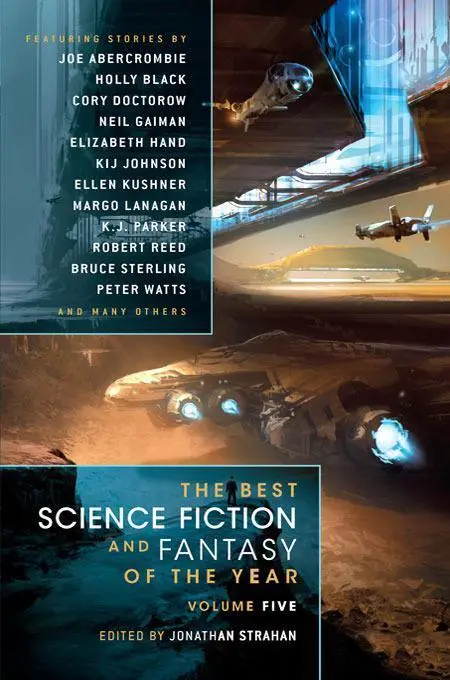
- Название:The Best Science Fiction & Fantasy of the Year Volume 5 An anthology of stories
- Автор:
- Жанр:
- Год:неизвестен
- ISBN:нет данных
- Рейтинг книги:4 / 5. Голосов: 1
-
Избранное:Добавить в избранное
- Отзывы:
-
Ваша оценка:
The Best Science Fiction & Fantasy of the Year Volume 5 An anthology of stories: краткое содержание, описание и аннотация
Предлагаем к чтению аннотацию, описание, краткое содержание или предисловие (зависит от того, что написал сам автор книги «The Best Science Fiction & Fantasy of the Year Volume 5 An anthology of stories»). Если вы не нашли необходимую информацию о книге — напишите в комментариях, мы постараемся отыскать её.
The Best Science Fiction & Fantasy of the Year Volume 5 An anthology of stories — читать онлайн бесплатно полную книгу (весь текст) целиком
Ниже представлен текст книги, разбитый по страницам. Система сохранения места последней прочитанной страницы, позволяет с удобством читать онлайн бесплатно книгу «The Best Science Fiction & Fantasy of the Year Volume 5 An anthology of stories», без необходимости каждый раз заново искать на чём Вы остановились. Поставьте закладку, и сможете в любой момент перейти на страницу, на которой закончили чтение.
Интервал:
Закладка:
GEOFFREY A. LANDIS
Geoffrey A. Landis is the author of one novel, Mars Crossing , and one collection of short stories, Impact Parameter and Other Quantum Realities . He has also written more than eighty short stories, which have appeared in publications such as Analog , Asimov’s and Fantasy & Science Fiction , as well as in anthologies. He is the winner of the Nebula Award, two Hugo Awards, and the Locus Award for his fiction, as well as two Rhysling awards for SF poetry. Outside of science fiction, Dr. Landis is a physicist who works for NASA at the John Glenn Research Center in Cleveland, Ohio. He was on the science team of the Mars Pathfinder and Mars Exploration Rover missions, and has published 400 scientific papers and been awarded seven patents. He currently works on developing new technology for future planetary missions, including missions to explore Venus. He lives in Berea, Ohio, with his wife, writer Mary A. Turzillo, and four cats.
When Leah Hamakawa and I arrived at Riemann orbital, there was a surprise waiting for Leah: a message. Not an electronic message on a link-pad, but an actual physical envelope, with Doctor Leah Hamakawa lettered on the outside in flowing handwriting.
Leah slid the note from the envelope. The message was etched on a stiff sheet of some hard crystal that gleamed a brilliant translucent crimson. She looked at it, flexed it, ran a fingernail over it, and then held it to the light, turning it slightly. The edges caught the light and scattered it across the room in droplets of fire. “Diamond,” she said. “Chromium impurities give it the red color; probably nitrogen for the blue. Charming.” She handed it to me. “Careful of the edges, Tinkerman; I don’t doubt it might cut.”
I ran a finger carefully over one edge, but found that Leah’s warning was unnecessary; some sort of passivation treatment had been done to blunt the edge to keep it from cutting. The letters were limned in blue, so sharply chiseled on the sheet that they seemed to rise from the card. The title read, “Invitation from Carlos Fernando Delacroix Ortega de la Jolla y Nordwald-Gruenbaum.” In smaller letters, it continued, “We find your researches on the ecology of Mars to be of some interest. We would like to invite you to visit our residences at Hypatia at your convenience and talk.”
I didn’t know the name Carlos Fernando, but the family Nordwald-Gruenbaum needed no introduction. The invitation had come from someone within the intimate family of the Satrap of Venus.
Transportation, the letter continued, would be provided.
The Satrap of Venus. One of the twenty old men, the lords and owners of the solar system. A man so rich that human standards of wealth no longer had any meaning. What could he want with Leah?
I tried to remember what I knew about the Sultan of the clouds, satrap of the fabled floating cities. It seemed very far away from everything I knew. The society, I thought I remembered, was said to be decadent and perverse, but I knew little more. The inhabitants of Venus kept to themselves.
Riemann station was ugly and functional, the interior made of a dark anodized aluminum with a pebbled surface finish. There was a viewport in the lounge, and Leah had walked over to look out. She stood with her back to me, framed in darkness. Even in her rumpled ship’s suit, she was beautiful, and I wondered if I would ever find the clue to understanding her.
As the orbital station rotated, the blue bubble of Earth slowly rose in front of her, a fragile and intricate sculpture of snow and cobalt, outlining her in a sapphire light. “There’s nothing for me down there,” she said.
I stood in silence, not sure if she even remembered I was there.
In a voice barely louder than the silence, she said, “I have no past.”
The silence was uncomfortable. I knew I should say something, but I was not sure what. “I’ve never been to Venus,” I said at last.
“I don’t know anybody who has.” Leah turned. “I suppose the letter doesn’t specifically say that I should come alone.” Her tone was matter of fact, neither discouraging nor inviting.
It was hardly enthusiastic, but it was better than no. I wondered if she actually liked me, or just tolerated my presence. I decided it might be best not to ask. No use pressing on my luck.
The transportation provided turned out to be the Sulieman , a fusion yacht.
Sulieman was more than merely first-class, it was excessively extravagant. It was larger than many ore transports, huge enough that any ordinary yacht could have easily fit within the most capacious of its recreation spheres. Each of its private cabins—and it had seven—was larger than an ordinary habitat module. Big ships commonly were slow ships, but Sulieman was an exception, equipped with an impressive amount of delta-V, and the transfer orbit to Venus was scheduled for a transit time well under that of any commercial transport ship.
We were the only passengers.
Despite its size, the ship had a crew of just three: captain, and first and second pilot. The captain, with the shaven head and saffron robe of a Buddhist novice, greeted us on entry, and politely but firmly informed us that the crew were not answerable to orders of the passengers. We were to keep to the passenger section, and we would be delivered to Venus. Crew accommodations were separate from the passenger accommodations, and we should expect not to see or hear from the crew during the voyage.
“Fine,” was the only comment Leah had.
When the ship had received us and boosted into a fast Venus transfer orbit, Leah found the smallest of the private cabins and locked herself in it.
Leah Hamakawa had been with the Pleiades Institute for twenty years. She had joined young, when she was still a teenager—long before I’d ever met her—and I knew little of her life before then, other than that she had been an orphan. The institute was the only family that she had.
It seems to me sometimes that there are two Leahs. One Leah is shy and childlike, begging to be loved. The other Leah is cool and professional, who can hardly bear being touched, who hates—or perhaps disdains—people.
Sometimes I wonder if she had been terribly hurt as a child. She never talks about growing up, never mentions her parents. I had asked her, once, and the only thing she said was that that is all behind her, long ago and far away.
I never knew my position with her. Sometimes I almost think that she must love me, but cannot bring herself to say anything. Other times she is so casually thoughtless that I believe she never thinks of me as more than a technical assistant, indistinguishable from any other tech. Sometimes I wonder why she even bothers to allow me to hang around.
I damn myself silently for being too cowardly to ask.
While Leah had locked herself away, I explored the ship. Each cabin was spherical, with a single double-glassed octagonal viewport on the outer cabin wall. The cabins had every luxury imaginable, even hygiene facilities set in smaller adjoining spheres, with booths that sprayed actual water through nozzles onto the occupant’s body.
Ten hours after boost, Leah had still not come out. I found another cabin and went to sleep.
In two days I was bored. I had taken apart everything that could be taken apart, examined how it worked, and put it back together. Everything was in perfect condition; there was nothing for me to fix.
But, although I had not brought much with me, I’d brought a portable office. I called up a librarian agent, and asked for history.
In the beginning of the human expansion outward, transport into space had been ruinously expensive, and only governments and obscenely rich corporations could afford to do business in space. When the governments dropped out, a handful of rich men bought their assets. Most of them sold out again, or went bankrupt. A few of them didn’t. Some stayed on due to sheer stubbornness, some with the fervor of an ideological belief in human expansion, and some out of a cold-hearted calculation that there would be uncountable wealth in space, if only it could be tapped. When the technology was finally ready, the twenty families owned it all.
Читать дальшеИнтервал:
Закладка:
Похожие книги на «The Best Science Fiction & Fantasy of the Year Volume 5 An anthology of stories»
Представляем Вашему вниманию похожие книги на «The Best Science Fiction & Fantasy of the Year Volume 5 An anthology of stories» списком для выбора. Мы отобрали схожую по названию и смыслу литературу в надежде предоставить читателям больше вариантов отыскать новые, интересные, ещё непрочитанные произведения.








Обсуждение, отзывы о книге «The Best Science Fiction & Fantasy of the Year Volume 5 An anthology of stories» и просто собственные мнения читателей. Оставьте ваши комментарии, напишите, что Вы думаете о произведении, его смысле или главных героях. Укажите что конкретно понравилось, а что нет, и почему Вы так считаете.