Django Wexler - The Thousand Names
Здесь есть возможность читать онлайн «Django Wexler - The Thousand Names» весь текст электронной книги совершенно бесплатно (целиком полную версию без сокращений). В некоторых случаях можно слушать аудио, скачать через торрент в формате fb2 и присутствует краткое содержание. Жанр: Фэнтези, на английском языке. Описание произведения, (предисловие) а так же отзывы посетителей доступны на портале библиотеки ЛибКат.
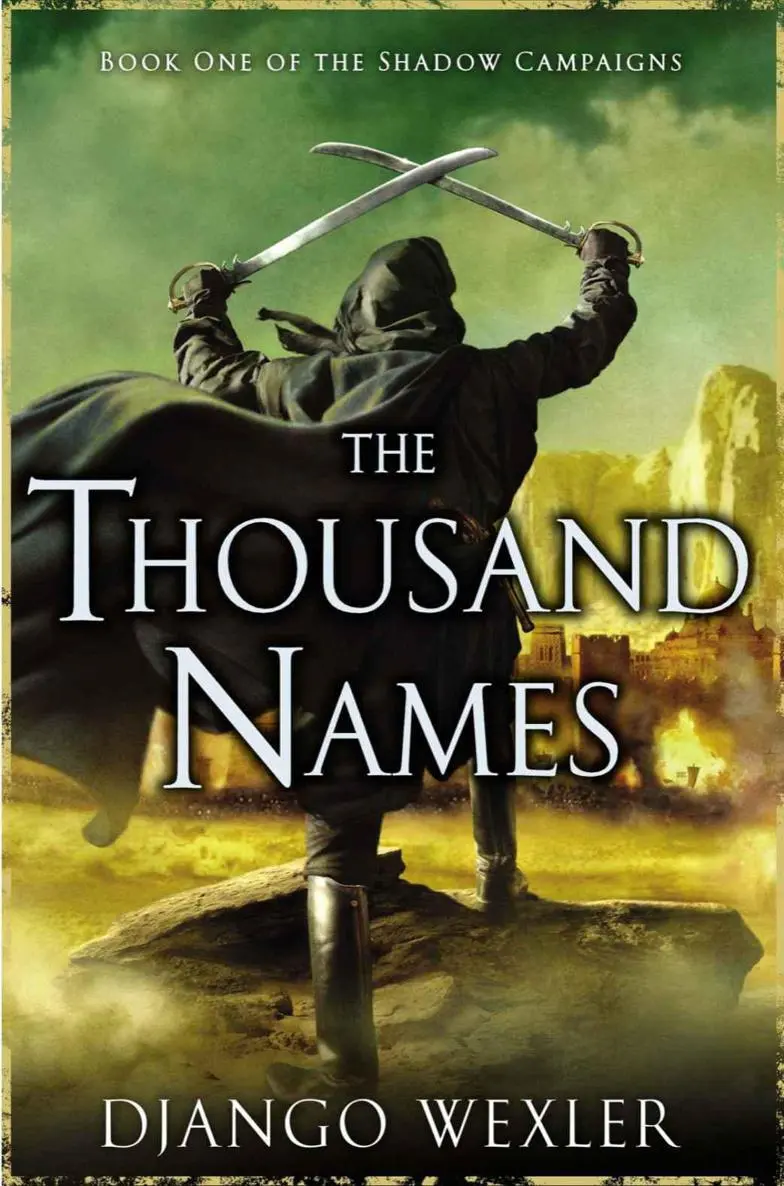
- Название:The Thousand Names
- Автор:
- Жанр:
- Год:неизвестен
- ISBN:нет данных
- Рейтинг книги:4 / 5. Голосов: 1
-
Избранное:Добавить в избранное
- Отзывы:
-
Ваша оценка:
The Thousand Names: краткое содержание, описание и аннотация
Предлагаем к чтению аннотацию, описание, краткое содержание или предисловие (зависит от того, что написал сам автор книги «The Thousand Names»). Если вы не нашли необходимую информацию о книге — напишите в комментариях, мы постараемся отыскать её.
The Thousand Names — читать онлайн бесплатно полную книгу (весь текст) целиком
Ниже представлен текст книги, разбитый по страницам. Система сохранения места последней прочитанной страницы, позволяет с удобством читать онлайн бесплатно книгу «The Thousand Names», без необходимости каждый раз заново искать на чём Вы остановились. Поставьте закладку, и сможете в любой момент перейти на страницу, на которой закончили чтение.
Интервал:
Закладка:
She and Bobby were crouched in one of the little clay huts. It was nearly empty inside, the inhabitants having carried away everything they could when they left. The only evidence of the occupant’s profession was a pile of half-mended net lying against the wall. The building was a simple dirt-floored affair, with a ring of stones in the center for a fire and a single doorway. It now also boasted an impromptu window-a few minutes’ work with bayonets had been enough to carve a head-sized hole through the soft clay. It was through this hole that Bobby was keeping watch to the northeast, the direction from which the prisoner had said the Khandarai would come.
When the boy waved her over, Winter’s tension ratcheted up another notch. She’d been halfway hoping the Auxie had been lying, out of bravado or a desire to frighten her off. Apparently not. Leaning out the doorway, she could see men in the distance, marching across the sodden fields. They were in close order, as though on parade, a wall of brown uniforms and glittering weapons.
At least she couldn’t see any guns. That would have spelled the end of any chance of effective resistance-these clay walls would offer little protection from cannonballs, and the Auxiliaries would be happy to blast the huts to pieces and march in over the ruins. As it is. .
She watched for a few tense minutes. Bobby, at the loophole, had a better view than Winter.
“They’re doing something,” he said. “Changing formation, or-”
“Breaking off.” Winter saw it, too. “Damn. They’ll send part of the force in and keep the rest as a reserve.”
“Should we change the plan?”
“No time now. Just don’t shoot until I tell you.”
While one group of men stood, staid as cows, out in the fields, the advance force closed in. Winter guessed there were two companies-two hundred forty men, give or take-in a neat column on a half-company front. The leading men passed between the outermost pair of huts, stepping in unison to the steady beat of their drums. She could see a lieutenant in front of the first rank, his drawn sword in his hand.
Winter sent up a silent prayer that her men would remember their instructions, and have the stomach to sit on their hands until the Khandarai got closer. Surprise was a precious thing, and they would get only one chance at it. Though with another two companies in reserve. . She shook off the thought.
Apparently the Almighty was listening. No shots echoed through the village as the Auxiliaries advanced, neat tan boots spattered with mud. The head of the column was nearly level with her hut now, which was most of the way to the waterfront. The rear was just entering the village.
“Think you can hit that lieutenant?” Winter said.
The boy frowned. “That seems a little unsporting, sir.”
“Sporting is for handball. Drop him.”
The boy nodded and bent to one knee, resting the barrel of his musket on the edge of the loophole. The man Winter had so casually marked for death was barely ten yards away, still oblivious, conducting the march with his shiny sword as if he were in review in front of the palace.
The crack of the musket was magnified in the tiny interior of the hut until it sounded like a mountain shattering. Smoke boiled up from the barrel and the lock of Bobby’s weapon, obscuring the view through the loophole, but watching from the doorway Winter could see the lieutenant spin and fall.
Almost immediately, shots cracked from all over the village, puffs of smoke rising from doorways and loopholes. The tight column was a difficult target to miss, and a chorus of screams and shouts from the Khandarai attested to the effect of the fire. Bobby grabbed Winter’s musket, loaded beforehand, and returned to the loophole. Winter watched a moment longer from the doorway.
As she’d hoped, the ground-in discipline of the Auxiliaries held them in position while their officers tried to make sense of what was happening. With the lieutenant down, some poor sergeant would be shouting orders. In the meantime, the column had halted, the men standing impassively in the face of balls that whistled by or stung like hornets.
That won’t last, though. Discipline or not, no soldiers would stand and be slaughtered without replying. The tight ranks of the Khandarai started to break up, individuals or pairs dropping to one knee or turning to find their tormentors. Muskets started to sound from the column, and the zip and whine of balls was soon accompanied by the pock-pock-pock of shots hitting clay.
Winter ducked inside, grabbed Bobby’s fired musket, and started to reload it. Bobby, having fired his second shot, hit the ground beside her to work on the other weapon. Outside, the fusillade continued. Winter had little doubt the Auxiliaries were getting the worst of it. It would be easy enough to see where the ambushers were firing from, as each loophole and doorway was marked by a cloud of powder smoke. Scoring a hit on the fleeting shapes beyond was another matter.
If they had any sense, they’d have run for it the minute we opened fire. Discipline and the tactics manual triumphed over sense, however. Winter fell into the simple routine-bite the cartridge open, pour in the powder, spit the ball down, and ram the whole thing home. Prime the pan, hand the musket to Bobby, accept a just-fired weapon in return. The barrels grew hotter with each firing, until they scorched her skin when she touched them, but she kept on. Shots hit the house in a steady rain. One or two even broke through the clay. Winter watched, fascinated, as a musket ball smashed through six inches above Bobby’s head, caromed weakly off the opposite wall, and rolled to a stop at her feet like a flattened marble.
And then there wasn’t another musket to load. The firing died away in fits and starts, but after a minute or so of silence, Winter risked a look out the doorway while Bobby stood vigil at the loophole with a loaded weapon.
The field of battle-if it could be called a battle-was empty except for corpses and a few wounded men, the latter beginning to raise piteous cries. It was hard to get a good sense through the smoke, but there seemed to be a great many corpses, for the most part lying in the neat rows in which they’d stood. Winter emerged from the hut and cupped her hands over her mouth.
“I’m coming out!” she shouted. “Everyone hold fire!”
She could hear a ragged chorus of laughter from the closest buildings. Bobby hurried to fall in behind her, still carrying his weapon, and Winter walked out into the center of the field. Smoke lay as dense as a blanket, drifting only sluggishly in the calm air. The smell of it assaulted her nostrils, an acrid, salty tang with an occasional undercurrent of blood or offal. There was no sign of any upright Khandarai.
Winter turned sharply when a pair of figures loomed through the smoke, but it was only Graff and Folsom. The rest of the company was beginning to emerge. As the realization of what they’d done sank in, here and there they sent up a ragged cheer.
Graff looked over the field of corpses with professional satisfaction. “They won’t forget that in a hurry,” he said. “Those that got away, anyhow.”
Winter gave a weary nod. All the Auxiliaries she could see were either dead or obviously nearly so. The retreating Khandarai had taken the more lightly wounded with them, for which she was grateful. The Colonials could hardly have spared the time to care for them.
“Right,” she said, more or less to herself. Then again. “Right. We’ve probably got a little while before they figure things out. Folsom, collect all our people and find out what we lost. Graff, take a detail and go over the field. The Auxies use the same muskets we do, so gather them all up, along with all the ammunition you can find. If there’s anyone out there who looks like they might make it, bring them along. Once that’s done, back to the river.”
Читать дальшеИнтервал:
Закладка:
Похожие книги на «The Thousand Names»
Представляем Вашему вниманию похожие книги на «The Thousand Names» списком для выбора. Мы отобрали схожую по названию и смыслу литературу в надежде предоставить читателям больше вариантов отыскать новые, интересные, ещё непрочитанные произведения.











Обсуждение, отзывы о книге «The Thousand Names» и просто собственные мнения читателей. Оставьте ваши комментарии, напишите, что Вы думаете о произведении, его смысле или главных героях. Укажите что конкретно понравилось, а что нет, и почему Вы так считаете.