Дэн Симмонс - The Fall of Hyperion
Здесь есть возможность читать онлайн «Р”СЌРЅ РЎРёРјРјРѕРЅСЃ - The Fall of Hyperion» весь текст электронной книги совершенно бесплатно (целиком полную версию без сокращений). В некоторых случаях можно слушать аудио, скачать через торрент в формате fb2 и присутствует краткое содержание. Город: London, Год выпуска: 2006, ISBN: 2006, Издательство: Orion Publishing Group, Жанр: Эпическая фантастика, Космическая фантастика, на английском языке. Описание произведения, (предисловие) а так же отзывы посетителей доступны на портале библиотеки ЛибКат.
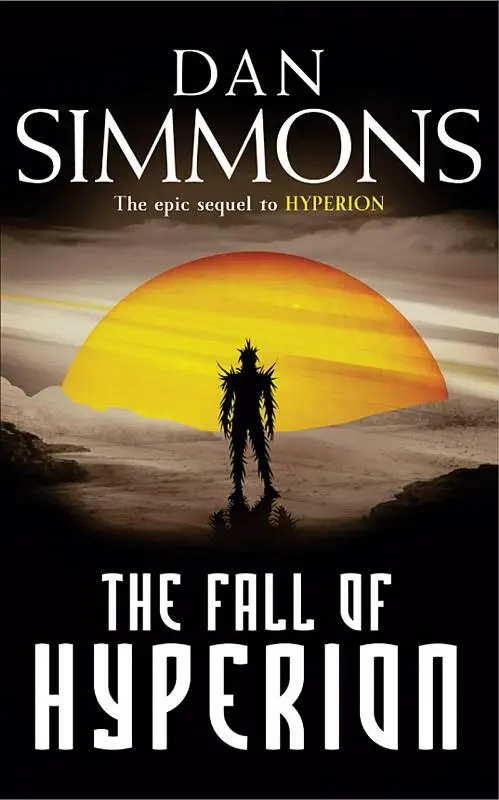
- Название:The Fall of Hyperion
- Автор:
- Издательство:Orion Publishing Group
- Жанр:
- Год:2006
- Город:London
- ISBN:9780575076389
- Рейтинг книги:5 / 5. Голосов: 1
-
Избранное:Добавить в избранное
- Отзывы:
-
Ваша оценка:
The Fall of Hyperion: краткое содержание, описание и аннотация
Предлагаем к чтению аннотацию, описание, краткое содержание или предисловие (зависит от того, что написал сам автор книги «The Fall of Hyperion»). Если вы не нашли необходимую информацию о книге — напишите в комментариях, мы постараемся отыскать её.
The Fall of Hyperion — читать онлайн бесплатно полную книгу (весь текст) целиком
Ниже представлен текст книги, разбитый по страницам. Система сохранения места последней прочитанной страницы, позволяет с удобством читать онлайн бесплатно книгу «The Fall of Hyperion», без необходимости каждый раз заново искать на чём Вы остановились. Поставьте закладку, и сможете в любой момент перейти на страницу, на которой закончили чтение.
Интервал:
Закладка:
Meina Gladstone folded her hands on her lap and studied them. “If you were writing about the events unfolding now,” she said, “what kind of poem would you create?”
I laughed. “I’ve already begun it and abandoned it twice… or rather, he had. It was about the death of the gods and their difficulty in accepting their displacement. It was about transformation and suffering and injustice. And it was about the poet whom he thought suffered most at such injustice.”
Gladstone looked at me. Her face was a mass of lines and shadows in the dimming light. “And who are the gods that are being replaced this time, M. Severn? Is it humanity or the false gods we created to depose us?”
“How the hell should I know?” I snapped and turned away to watch the stream.
“You are part of both worlds, no? Humanity and TechnoCore?”
I laughed again. “I’m part of neither world. A cybrid monster here, a research project there.”
“Yes, but whose research? And for what ends?”
I shrugged.
Gladstone rose and I followed. We crossed the stream and listened to water moving over the stones. The path wound between tall boulders covered with exquisite lichen which glowed in the lantern light.
Gladstone paused at the top of a short flight of stone steps. “Do you think the Ultimates in the Core will succeed in constructing their Ultimate Intelligence, M. Severn?”
“Will they build God?” I said. “There are those AIs which do not want to build God. They learned from the human experience that to construct the next step in awareness is an invitation to slavery, if not actual extinction.”
“But would a true God extinguish his creatures?”
“In the case of the Core and the hypothetical UI,” I said, “God is the creature, not the creator. Perhaps a god must create the lesser beings in contact with it in order for it to feel any responsibility for them.”
“Yet the Core has appeared to take responsibility for human beings in the centuries since the AI Secession,” said Gladstone. She was gazing intently at me, as if gauging something by my expression.
I looked out at the garden. The path glowed whitely, almost eerily in the dark. “The Core works toward its own ends,” I said, knowing as I spoke that no human being knew that fact better than CEO Meina Gladstone.
“And do you feel that humanity no longer figures as a means toward those ends?”
I made a dismissive gesture with my right hand. “I’m a creature of neither culture,” I said again. “Neither graced by the naivete of the unintentional creators, nor cursed by the terrible awareness of their creatures.”
“Genetically, you are fully human,” said Gladstone.
It was not a question. I did not respond.
“Jesus Christ was said to be fully human,” she said. “And also fully divine. Humanity and Godhead at intersection.”
I was amazed at her reference to that old religion. Christianity had been replaced first by Zen Christianity, then Zen Gnosticism, then by a hundred more vital theologies and philosophies. Gladstone’s home-world was no repository for discarded beliefs and I assumed—and hoped—that neither was the CEO. “If he was fully human and fully God,” I said, “then I am his antimatter image.”
“No,” said Gladstone, “I would imagine that the Shrike your pilgrim friends are confronting is that.”
I stared. It was the first time she had mentioned the Shrike to me, despite the fact that I knew—and she knew that I knew—that it had been her plan which led the Consul to open the Time Tombs and release the thing.
“Perhaps you should have been on that pilgrimage, M. Severn,” said the CEO.
“In a way,” I said, “I am.”
Gladstone gestured, and a door to her private quarters opened. “Yes, in a way you are,” she said. “But if the woman who carries your counterpart is crucified on the Shrike’s legendary tree of thorns, will you suffer for all eternity in your dreams?”
I had no answer, so I stood there and said nothing.
“We will talk in the morning after the conference,” said Meina Gladstone. “Good night, M. Severn. Have pleasant dreams.”
Eight
Martin Silenus, Sol Weintraub, and the Consul are staggering up the dunes toward the Sphinx as Brawne Lamia and Fedmahn Kassad return with Father Hoyt’s body. Weintraub clutches his cape tight around him, trying to shelter his infant from the rage of blowing sand and crackling light. He watches as Kassad descends the dune, his long legs black and cartoonish against electrified sand, Hoyt’s arms and hands dangling, moving slightly with each slide and step.
Silenus is shouting, but the wind whips away words. Brawne Lamia gestures toward the one tent still standing; the storm has collapsed or ripped away the others. They crowd into Silenus’s tent. Colonel Kassad coming last, passing the body in gently. Inside, their shouts can be heard above the crack of fiberplastic canvas and the paper-splitting rip of lightning.
“Dead?” shouts the Consul, peeling back the cloak Kassad had wrapped around Hoyt’s nude body. The cruciforms glow pinkly.
The Colonel points to the telltales blinking on the surface of the FORCE-issue medpak adhered to the priest’s chest. The lights blink red except for the yellow winking of the systems-sustaining filaments and modules. Hoyt’s head rolls back, and now Weintraub can see the millipede suture holding the ragged edges of the slashed throat together.
Sol Weintraub tries to locate a pulse manually; finds none. He leans forward, sets his ear to the priest’s chest. There is no heartbeat, but the welt of the cruciform there is hot against Sol’s cheek. He looks at Brawne Lamia. “The Shrike?”
“Yes… I think… I don’t know.” She gestures toward the antique pistol she still holds. “I emptied the magazine. Twelve shots at… whatever it was.”
“Did you see it?” the Consul asks Kassad.
“No. I entered the room ten seconds after Brawne, but I didn’t see anything.”
“What about your fucking soldier gadgets?” says Martin Silenus. He is crowded in the back of the tent, huddled in a near-fetal position.
“Didn’t all that FORCE shit show something?”
“No.”
A small alarm sounds from the medpak, and Kassad detaches another plasma cartridge from his belt, feeds it into the pak’s chamber, and sits back on his heels, nipping his visor down to watch out the opening of the tent. His voice is distorted by the helmet speaker. “He’s lost more blood than we can compensate for here. Did anyone else bring first aid equipment?”
Weintraub rummages in his pack. “I have a basic kit. Not enough for this, though. Whatever slashed his throat cut through everything.”
“The Shrike,” whispers Martin Silenus.
“It doesn’t matter,” says Lamia, hugging herself to stop her body from shaking. “We’ve got to get help for him.” She looks at the Consul.
“He’s dead,” says the Consul. “Even a ship’s surgery won’t bring him back.”
“We have to try!” shouts Lamia, leaning forward to grab the Consul’s tunic front. “We can’t leave him to those… things…” She gestures toward the cruciform glowing beneath the skin of the dead man’s chest.
The Consul rubs his eyes. “We can destroy the body. Use the Colonel’s rifle…”
“We’re going to die if we don’t get out of this fucking storm!” cries Silenus, The tent is vibrating, fiberplastic pounding the poet’s head and back with each billow. The sound of sand against fabric is like a rocket taking off just outside. “Call the goddamned ship. Call it!”
The Consul pulls his pack closer, as if guarding the antique comlog inside it. Sweat glistens on his cheeks and forehead.
Читать дальшеИнтервал:
Закладка:
Похожие книги на «The Fall of Hyperion»
Представляем Вашему вниманию похожие книги на «The Fall of Hyperion» списком для выбора. Мы отобрали схожую по названию и смыслу литературу в надежде предоставить читателям больше вариантов отыскать новые, интересные, ещё непрочитанные произведения.







Обсуждение, отзывы о книге «The Fall of Hyperion» и просто собственные мнения читателей. Оставьте ваши комментарии, напишите, что Вы думаете о произведении, его смысле или главных героях. Укажите что конкретно понравилось, а что нет, и почему Вы так считаете.