John Schettler - Fallen Angels - 9 Days Falling, Volume II
Здесь есть возможность читать онлайн «John Schettler - Fallen Angels - 9 Days Falling, Volume II» весь текст электронной книги совершенно бесплатно (целиком полную версию без сокращений). В некоторых случаях можно слушать аудио, скачать через торрент в формате fb2 и присутствует краткое содержание. Год выпуска: 2013, Издательство: The Writing Shop Press, Жанр: Боевая фантастика, Альтернативная история, на английском языке. Описание произведения, (предисловие) а так же отзывы посетителей доступны на портале библиотеки ЛибКат.
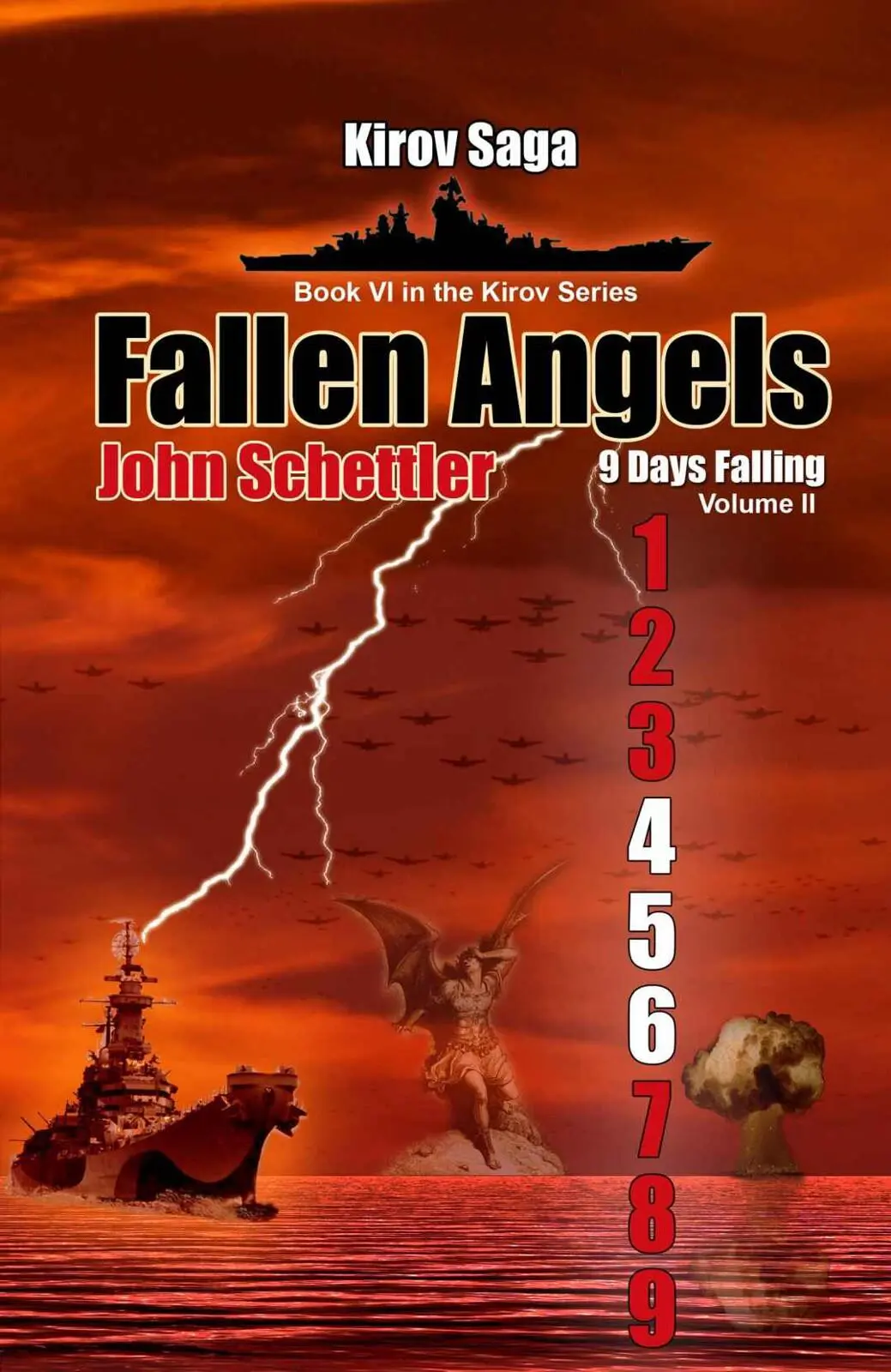
- Название:Fallen Angels: 9 Days Falling, Volume II
- Автор:
- Издательство:The Writing Shop Press
- Жанр:
- Год:2013
- ISBN:нет данных
- Рейтинг книги:3 / 5. Голосов: 1
-
Избранное:Добавить в избранное
- Отзывы:
-
Ваша оценка:
Fallen Angels: 9 Days Falling, Volume II: краткое содержание, описание и аннотация
Предлагаем к чтению аннотацию, описание, краткое содержание или предисловие (зависит от того, что написал сам автор книги «Fallen Angels: 9 Days Falling, Volume II»). Если вы не нашли необходимую информацию о книге — напишите в комментариях, мы постараемся отыскать её.
and the heart of the Red Banner Pacific Fleet has vanished, blown into the past by the massive wrath of the Demon Volcano. There Captain Karpov finds himself at the dying edge of the last great war, yet his own inner demons now wage war with his conscience as he contemplates another decisive intervention.
After secretly assisting the Soviet invasion of the Kuriles and engaging a small US scouting force in the region, Karpov has drawn the attention of Admiral Halsey’s powerful 3rd Fleet. Now Halsey sends one of the toughest fighting Admirals of the war north to investigate, the hero of the Battle off Samar, Ziggy Sprague, and fast and furious sea battles are the order of the day.
Meanwhile tensions rise in the Black Sea as the Russian mission to rescue Fedorov and Orlov has now been expanded to include a way to try and deliver new control rods to
from the same batch and lot as the mysterious Rod-25. Will they work? Yet Admiral Volsky learns that the Russian Black Sea Fleet has engaged well escorted units of a British oil conveyor, Fairchild Inc., and the fires of war soon endanger his mission.
All efforts are now focused on a narrow stretch of coastline on the Caspian Sea, where men of war from the future and past are locked in a desperate struggle to decide the outcome of history itself. Naval combat, both future and past, combine with action and intrigue as Volsky’s mission is launched and the mystery of Rod-25 and Fedorov’s strange experience on the Trans-Siberian Rail deepens. Can they stop the nuclear holocaust of the Third World War in 2021 or will it begin off the coast of Japan in 1945?
Fallen Angels: 9 Days Falling, Volume II — читать онлайн бесплатно полную книгу (весь текст) целиком
Ниже представлен текст книги, разбитый по страницам. Система сохранения места последней прочитанной страницы, позволяет с удобством читать онлайн бесплатно книгу «Fallen Angels: 9 Days Falling, Volume II», без необходимости каждый раз заново искать на чём Вы остановились. Поставьте закладку, и сможете в любой момент перейти на страницу, на которой закончили чтение.
Интервал:
Закладка:
In his wake, far to the south, Princess Irene would burn all night before her hull gave way and she listed heavily into the massive oil slick blighting the sea. Turkish ships were out on a rescue operation, trying to fish as many of the crew out of the sea as possible. Half a million barrels of oil would go down with her, and now the hopes of the Fairchild company rested on those two last tankers, slowly creeping west along the Anatolian coast and soon joined by two more Turkish Frigates in escort. NATO was late to the game, but they were welcome, as were the flights of Turkish fighters up now to provide additional air cover.
By dawn of the fourth day of the war, Argos Fire had but one last charge to recover. The ship still had three of her X-3 helos and thirty Argonauts in the Caspian Sea region, and each minute that passed extended the range and stretched the tether of safe recovery thinner and thinner. Captain MacRae headed to the Executive cabin to see the company CEO and explain what had happened. He was determined to push for the immediate extraction of the Argonauts and a speedy run for the Bosporus before the Russians could scrape up more aircraft for another attack.
When he got there the little nightmare of naval combat that had darkened his watch was about to deepen to yet another shade of black.
Chapter 5
“Steadyon that winch!” said Dobrynin, hands on his hips as he supervised the loading operation. They had a crane up on the upper roof of the Anatoly Alexandrov, and they were hoisting up a long metal tube that might resemble a missile canister to any watchful eyes. Cover of darkness and overhead clouds would prevent satellites from looking in, but they had seen NATO drones earlier, and it was obvious that someone was taking an interest in the operation being mounted on the Caspian coast.
Dobrynin watched until the tube was safely hoisted up and lowered into an ordnance mover. It wasn’t a missile canister, but a radiation safe container housing some very special cargo, a fresh delivery from Admiral Volsky that had been flown all the way from Severomorsk up north. The Admiral had spoken to him an hour ago on a very secure channel.
“Is Rod-25 mounted, Dobrynin?”
“Yes sir, and I have the reactor up and ready for operations.”
“Good news. Well, I’m sending you a backup.” The Admiral went on to explain the complex new twist in the mission they had planned, and the longer Dobrynin listened, the more he began to silently shake his head.
“1945?” he said incredulously. “How could it happen, Admiral? We had Rod-25 safe with us here.”
Volsky explained what he could, but the fact remained that it was all still a mystery. Kirov was gone, and so were Orlan and Admiral Golovko . Aside from his submarines he now had no Red Banner Pacific Fleet to speak of, and the Black Sea Fleet had just been gutted and largely neutralized as an effective fighting force in a scrap with the British. Everything was now riding on this mission, Volsky explained. It wasn’t only to try and bring Fedorov home again, or even Orlov. Now there were three ships and over 1500 officers and crew to worry about as well.
“I’m sending you a big helicopter and a lot of extra aviation fuel.”
“But Admiral, we can’t bring the ships home with that. What is this for?”
Volsky explained, and Dobrynin’s eyes got wider and wider. “As for your part,” the Admiral concluded, “you just focus on Fedorov. Bukin is going to handle the mission involving the Mi-26. My question to you is this—can the landing pad on Anatoly Alexandrov hold up if we land the Mi-26 there?”
“Yes sir. It’s a heavy, reinforced structure. In fact we used Mi-26 helos to load the reactor elements and other equipment and supplies last year when we commissioned the barge.”
“Very good. Carry on, Chief. I’m counting on you. You may launch your mission when ready. Remember our briefing. Your first task is to discover the year and date!”
Yes, yes, Dobrynin remembered the briefing. The key dates were September 30 thru October 5, 1942. He was to secure the Anatoly Alexandrov , then get a scouting detail ashore north of Makhachkala and begin his search. Troyak would be broadcasting his position, and he had the exact frequency so he could monitor it 24/7. Once a signal was received he was to put men ashore in force with any of the equipment that made it back with him, and use any means necessary to secure his objective and get safely home. Yet two more control rods had been received, one from Vladivostok and this last one from Severomorsk. They were to be loaded on the helicopter the Admiral mentioned. What was in the Admiral’s vodka this time?
The Mi-26 had been used to move in the last of their equipment, and was now at rest, its enormous bulk squatting on the roof of Anatoly Alexandrov like a giant bug, the eight long props drooping toward the landing pad like enormous spider legs. Bukin had been promoted from Corporal to Sergeant and he was now in charge of a small detachment of Marines, five men. One was a pilot, and the others stood in as flight engineers, but all were trained for combat, and armed to the teeth. They had supplies consisting mostly of food and ammunition, and the entire cargo section of the helo was packed with as much aviation fuel as the Mi-26 could carry.
Wherever they are going it must be some good long way, thought Dobrynin. He had enough to worry about getting the reactor certified and ready for use. Let Bukin handle the helicopter mission.
NowVolsky sat in the deep underground bunker beneath Naval Headquarters Fokino, a precaution given the steady buildup of American bomber assets in the Pacific. That and the rain of ash fall from the Demon volcano had cast a pall over the entire region, imposing a lull on operations as nature revealed her awesome temper. It was humbling to look out and see the titanic column of smoke and ash billowing up into the atmosphere, even to the edge of space. The first night after the eruption had been black beyond measure, as if the sky itself had been broiled to char. No moonlight could penetrate the thickening air, and a muffled silence fell over the sea and land as more and more material billowed up into the brimstone night. It created a deeply ominous feeling in the gut, a sense of warning and desperate urgency settling over the Admiral’s mind.
This war was a ragged and haphazard affair, he thought, and a tempest in a teacup compared to that Demon. Hokkaido Island is being inundated with ash, and the Americans have pulled everything they had out of Misawa in northernmost Honshu for bases on the main island further south. China seems single mindedly focused on Taiwan, and now the North Koreans are launching missiles for the Americans to shoot down.
The great standoff with the American fleet was suddenly held in abeyance. CVBG Nimitz had altered course and was now steaming to join the stricken Washington strike group in the Marianas. The third carrier, CVBG Eisenhower had also diverted from its course and was heading east through the Sulu Sea and into the Philippines, apparently also bound for Guam. They were moving their principle assets to a secure forward base to reorganize prior to resuming operations.
Karpov had beaten the Washington group with his daring and aggressive tactic of getting in that all important first salvo. Volsky wondered what he might have accomplished if he had carried out the remainder of his plan. After code Longarm sent the last of their longer range missiles out after the carrier, the fleet itself was going to execute a hard right and make a high speed rush south. Karpov planned to use the initial plume from the smaller eruption of the volcano as top cover, surging south beneath the pall to get his ships inside the 300 kilometer range. At that point he had P-900s on all three ships in the core fleet for another massed barrage of 42 missiles. These would fire even as the fleet continued south at their best speed, and if they got inside 200 kilometers the Moskit-II Sunburns on Kirov would fire next, followed by the high speed MOS-III Starfires , 30 more missiles with another eight P-800s on Golovko . After that it would be down to deck guns.
Читать дальшеИнтервал:
Закладка:
Похожие книги на «Fallen Angels: 9 Days Falling, Volume II»
Представляем Вашему вниманию похожие книги на «Fallen Angels: 9 Days Falling, Volume II» списком для выбора. Мы отобрали схожую по названию и смыслу литературу в надежде предоставить читателям больше вариантов отыскать новые, интересные, ещё непрочитанные произведения.









Обсуждение, отзывы о книге «Fallen Angels: 9 Days Falling, Volume II» и просто собственные мнения читателей. Оставьте ваши комментарии, напишите, что Вы думаете о произведении, его смысле или главных героях. Укажите что конкретно понравилось, а что нет, и почему Вы так считаете.