Fran Wilde - Updraft
Здесь есть возможность читать онлайн «Fran Wilde - Updraft» весь текст электронной книги совершенно бесплатно (целиком полную версию без сокращений). В некоторых случаях можно слушать аудио, скачать через торрент в формате fb2 и присутствует краткое содержание. Год выпуска: 2015, Издательство: Tor Books, Жанр: Фантастика и фэнтези, на английском языке. Описание произведения, (предисловие) а так же отзывы посетителей доступны на портале библиотеки ЛибКат.
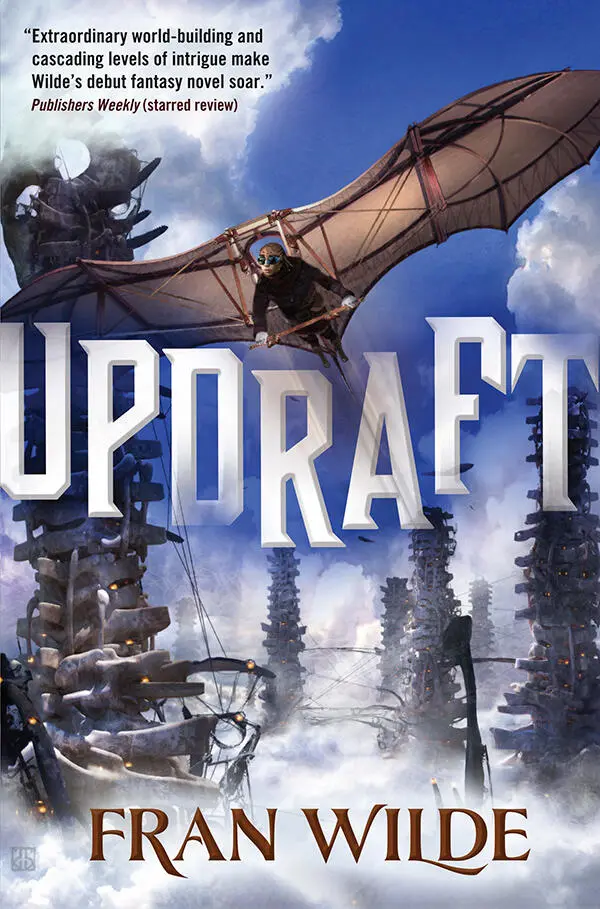
- Название:Updraft
- Автор:
- Издательство:Tor Books
- Жанр:
- Год:2015
- ISBN:нет данных
- Рейтинг книги:5 / 5. Голосов: 1
-
Избранное:Добавить в избранное
- Отзывы:
-
Ваша оценка:
Updraft: краткое содержание, описание и аннотация
Предлагаем к чтению аннотацию, описание, краткое содержание или предисловие (зависит от того, что написал сам автор книги «Updraft»). Если вы не нашли необходимую информацию о книге — напишите в комментариях, мы постараемся отыскать её.
Welcome to a world of wind and bone, songs and silence, betrayal and courage.
Kirit Densira cannot wait to pass her wingtest and begin flying as a trader by her mother's side, being in service to her beloved home tower and exploring the skies beyond. When Kirit inadvertently breaks Tower Law, the city's secretive governing body, the Singers, demand that she become one of them instead. In an attempt to save her family from greater censure, Kirit must give up her dreams to throw herself into the dangerous training at the Spire, the tallest, most forbidding tower, deep at the heart of the City.
As she grows in knowledge and power, she starts to uncover the depths of Spire secrets. Kirit begins to doubt her world and its unassailable Laws, setting in motion a chain of events that will lead to a haunting choice, and may well change the city forever — if it isn't destroyed outright.
Updraft — читать онлайн бесплатно полную книгу (весь текст) целиком
Ниже представлен текст книги, разбитый по страницам. Система сохранения места последней прочитанной страницы, позволяет с удобством читать онлайн бесплатно книгу «Updraft», без необходимости каждый раз заново искать на чём Вы остановились. Поставьте закладку, и сможете в любой момент перейти на страницу, на которой закончили чтение.
Интервал:
Закладка:
She sang clear and proud, her eyes on Rumul.
Then we stood, turning to face the council. We rehearsed once with them the song for those lost in defense of the city. I sang it true this time.
Singers came forward to check our wings for us. Strong fingers tightened straps. My wings tugged at my shoulders as someone adjusted a batten in its sleeve. We had a long flight ahead.
Rumul faced us. “You will fly southeast to Narath tower and present the second challenger’s wings to her relatives. Then to Ginth, to present windbeater Vess’s wings. By day’s end, you will reach Viit and the new bridge that connects that tower to Densira. You will bless the bridge. You will not linger.”
A bridge for Densira. They had rewarded my tower for my sacrifice. I was glad to hear it.
“Once the bridge is blessed, you will cross to Densira,” he continued. To Elna. To Ezarit.
A council member came forward, carrying Vess’s wings, along with those of the Narath challenger. Beneath them lay a spare set of wings, the battens broken beyond repair. The silk torn.
Rumul explained, “Because we cannot return the Densira challenger’s wings, you will take these.”
So Elna would have a pair of wings that no one could ever use.
The council spoke all around us. “Singer’s duty.”
Sellis and I repeated the words. I felt them echo in my stomach.
It was time to fly. We lifted our burdens and strapped them to our chests.
Atop the Spire, the sun rose over our brethren. We unfurled our wings and engaged the fingertip grips, then soared for the first time as Singers among the towers, to show the city what we had become in its name.
21. RETURN
Narath tower was the height of the southeast. From our approach, we could see Narath had at least two tiers on its closest neighbors, and its gardens bloomed green and lush. Alerted by kavik messenger, residents had gathered on the top of the tower, many families’ worth. Sellis’s challenger had been popular.
Though I carried the challenger’s wings, I realized that I did not know her name.
“Who was she?” I asked Sellis again as we prepared to land.
“A challenger,” Sellis responded in clipped tones. “They will name her.”
Unsettled, I stepped from my footsling and cut my glide, dropping to the tower with practiced Singer’s grace. Sellis landed beside me at the same time. The Narath residents whispered. Bowed to us, but not too deeply.
The tower’s councilman stepped forward. His robes were embroidered at the shoulders with green and purple chevrons.
“Our daughter Dita Narath dared challenge the city,” the man said, giving me a name to work with. My breathing eased.
“Dita fought well,” I answered. “She has honored your tower by elevating a Singer.”
“She would fight well,” the councilman said. “She was of Narath.”
The crowd murmured again, a soft, pleased sound. They were not shamed here by Dita’s challenge. Within the murmur, my ears caught a sob and someone being hushed.
I passed Dita Narath’s wings to the man who had greeted us, and Sellis handed them a silk banner to be dyed for Remembrances.
“Would you sing with us?” the tower councilman asked formally.
We would.
Sellis’s voice was thinner than usual, but I carried us both. The voices of the tower flowed around the rough edges of my voice, until we all sang together. The sound was beautiful.
“We will return to sing her honors,” I promised. Beside me, Sellis nodded. The tower’s gathered crowd stepped back from us. Turned inward to pass the wings to the center, where the sob had come from. We were no longer part of their grief.
Sellis took off first, and I followed. It had felt too easy, that.
When we landed on Ginth, our shoulders ached from the distance. This was how my mother flew. This was how traders moved, from east to west and then up around the gusts of the city.
On Ginth, only one person greeted us. Vess’s older brother, by his age and looks. The tower’s gardens were spare, and the brother’s chest was not broad like the men of Narath. Instead, shoulders rounded, his cheeks sunken, he stood bowed around the emptiness of his stomach. To my knowledge, Vess had never spoken of Ginth.
“I barely remember Vess,” he said sadly. “Though we are grateful to the Singers for taking him. Two others starved in our tier that year.”
Sellis spoke of her friend without hesitation. “He has a beautiful voice. And has added much to the life of novices in the Spire.” She drew a breath. “But he was not strong enough to defend the city. He will continue to serve the Spire, but you will not see him again.”
Vess’s brother sadly accepted the broken wings. We did not sing with him: Vess was not dead.
“On your wings, Singers,” he said. He watched us depart. I ducked my head below my wings to look back at him growing smaller on the tower’s roof.
* * *
By the time we landed on Viit, the sun had crossed the top quadrants of the sky, and my shoulders were numb. Sellis didn’t complain, but I winced as I furled my wings. I carried only one extra pair of wings now, strapped to my chest, but the flights had been long.
Viit had prepared a meal of goose meat and apples for us, left out in large bone bowl, but no one waited to greet us on this rooftop. A bridge blessing required that they await us below, and on Densira. We ate in exhausted silence.
Flying the city was so different from what I’d thought it would be. It was lonely and quiet in the sky, with too many thoughts tugging at my attention. And attention was required to stay aloft on the city’s drafts and gusts. We’d flown above the city’s day-to-day traffic, and I’d watched the colorful wings weave in familiar patterns below, wanting to join them once more.
The bridge blessing was a simple ritual. When we had eaten, Sellis flew across to Densira without a word to me, and I descended to the Viit balcony where the sinew and rope spans had been anchored by one of Viit’s Spire-trained artifexes.
Bone hooks and eyes had been carved carefully around this tier and incorporated into the cable system to help distribute the load of the main cables. The cables wrapped the tower’s bone core, secured with a complex series of braids and tethers. Pulleys brought from Wirra allowed the bridge’s artifexes to tend it during wind shifts and periodic rebalancing. More support cables ran to tiers above and below.
Near the core, a surprised whisper. “Kirit! You live!” I looked up to find familiar eyes: Ceetcee. She wore the tools of a novice artifex on cords around her neck: bone hooks and cutters, a thick awl for splicing ropes.
She clasped my fingers in hers: the first time a non-Singer had touched me in half a year. I did not want to let go of her chapped hands, though she smelled of dried skymouth sinew and rope.
“Well met, Artifex Viit,” I greeted her formally, after a moment. Sellis waited on the other tower. I could not linger, no matter how much I wished to do so.
Ceetcee loosened her grip and stepped back too, then bowed. “Well met, Singer.”
Two more Viit artifexes stepped forward and bowed. I saw Beliak peeking around a spine in the tier. Of course. As a ropemaker, he would be here.
“You are welcome, Artifexes,” I replied, reminding everyone that the bridges were Singer-gifts to the towers. I added, “And gladly met.”
The artifexes showed me their work. It was a great honor to tie a bridge. It was also nerve-racking. If the bridge was tethered wrong, or if Singers and artifexes had miscalculated the balance of the towers, a tower’s core could be weakened. Its growth could be slowed.
Every tower resident learned bridge songs as fledges, whether they had a bridge or not. During my Spire training, I’d learned even more. I knew tension and binding songs. I’d seen how long-lived bridges were maintained and supported with new material, until a tower’s core became too wide to accommodate the bindings, and then the sinew fell or was cut away. I’d examined remnants and drawings of failed bridges, and those of bridges that had survived almost down to the clouds.
Читать дальшеИнтервал:
Закладка:
Похожие книги на «Updraft»
Представляем Вашему вниманию похожие книги на «Updraft» списком для выбора. Мы отобрали схожую по названию и смыслу литературу в надежде предоставить читателям больше вариантов отыскать новые, интересные, ещё непрочитанные произведения.









Обсуждение, отзывы о книге «Updraft» и просто собственные мнения читателей. Оставьте ваши комментарии, напишите, что Вы думаете о произведении, его смысле или главных героях. Укажите что конкретно понравилось, а что нет, и почему Вы так считаете.