Fran Wilde - Updraft
Здесь есть возможность читать онлайн «Fran Wilde - Updraft» весь текст электронной книги совершенно бесплатно (целиком полную версию без сокращений). В некоторых случаях можно слушать аудио, скачать через торрент в формате fb2 и присутствует краткое содержание. Год выпуска: 2015, Издательство: Tor Books, Жанр: Фантастика и фэнтези, на английском языке. Описание произведения, (предисловие) а так же отзывы посетителей доступны на портале библиотеки ЛибКат.
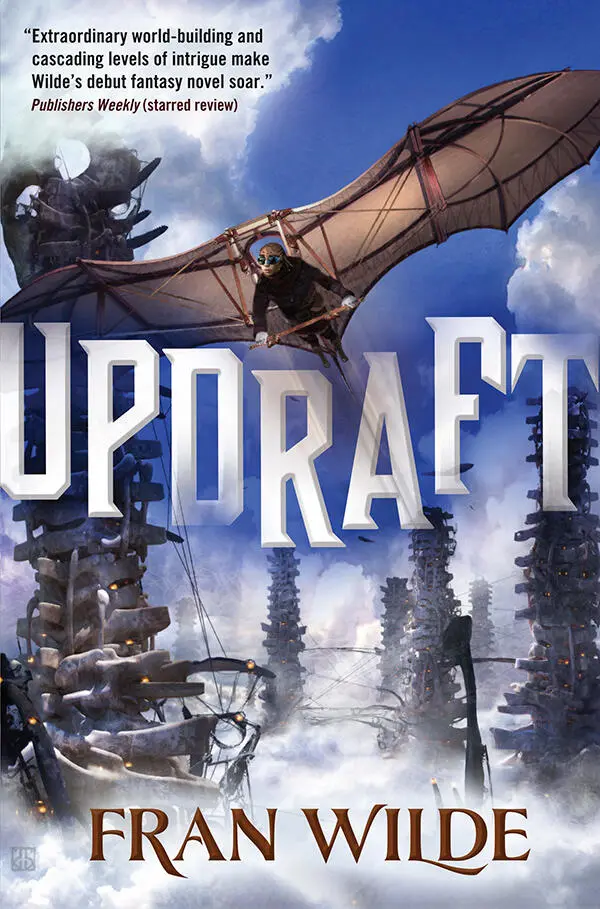
- Название:Updraft
- Автор:
- Издательство:Tor Books
- Жанр:
- Год:2015
- ISBN:нет данных
- Рейтинг книги:5 / 5. Голосов: 1
-
Избранное:Добавить в избранное
- Отзывы:
-
Ваша оценка:
Updraft: краткое содержание, описание и аннотация
Предлагаем к чтению аннотацию, описание, краткое содержание или предисловие (зависит от того, что написал сам автор книги «Updraft»). Если вы не нашли необходимую информацию о книге — напишите в комментариях, мы постараемся отыскать её.
Welcome to a world of wind and bone, songs and silence, betrayal and courage.
Kirit Densira cannot wait to pass her wingtest and begin flying as a trader by her mother's side, being in service to her beloved home tower and exploring the skies beyond. When Kirit inadvertently breaks Tower Law, the city's secretive governing body, the Singers, demand that she become one of them instead. In an attempt to save her family from greater censure, Kirit must give up her dreams to throw herself into the dangerous training at the Spire, the tallest, most forbidding tower, deep at the heart of the City.
As she grows in knowledge and power, she starts to uncover the depths of Spire secrets. Kirit begins to doubt her world and its unassailable Laws, setting in motion a chain of events that will lead to a haunting choice, and may well change the city forever — if it isn't destroyed outright.
Updraft — читать онлайн бесплатно полную книгу (весь текст) целиком
Ниже представлен текст книги, разбитый по страницам. Система сохранения места последней прочитанной страницы, позволяет с удобством читать онлайн бесплатно книгу «Updraft», без необходимости каждый раз заново искать на чём Вы остановились. Поставьте закладку, и сможете в любой момент перейти на страницу, на которой закончили чтение.
Интервал:
Закладка:
I described it to Wik. “Good!” He removed the tool from my head, the blindfold from my eyes.
In front of me, Ciel stood holding a broad piece of bone. She lowered it and rubbed her arms.
“You see?” she asked.
I didn’t, not really. “I see the panel you’re holding.”
“But what did you hear, before? Think.”
I heard vibrations. Waves of sound colliding behind my blindfolded eyes. They hurt. “The vibrations were different when you stood in front of me?”
Ciel grinned. Her eyes glowed as if I’d performed a wonderful trick.
Wik smiled too. “Good.” They blindfolded me again, but without the metal rod. “Now try to mimic the vibration the rod made: tilt your head back slightly, open your mouth — yes, just like that — and click your tongue against the roof of your mouth very quickly.”
That sounded ridiculous. I lifted the edge of my blindfold with a finger and looked at them. They were surely making fun of me.
“Just do it!” Wik was growing exasperated. He wanted discipline, not questions.
Blindfold dropped, the dark complete, I tried to do what he asked. My mouth gaped open, and I pressed the tip of my tongue against my mouth to make a clicking sound, as I’d heard Sellis do sometimes in flight.
“Faster!” Ciel whispered.
I heard the clicks in my head, but still they meant nothing.
Until their shape changed. Instead of sound leaving me, some of it returned, faintly, as if the noises I made had bounced off something. Echoing. I tried to lift the blindfold again. Wik stopped my hand. “No. Tell me what you heard.”
“The sound changed. Like Ciel was holding the chip up in front of me again.”
Wik took my hand from the silk blindfold and guided it away from me, until my fingers connected with the hard slab of the bone chip, an arm’s span from my face.
“You heard it there.”
“So?” I couldn’t see how this was important.
Wik sighed at my tone. Even blindfolded, I could guess the face he made. Frustrated. Full of frowns.
“So. Try it again.”
I heard robes swish, then silence. Something had changed, and they wanted me to guess it by making that ridiculous face while clicking my tongue. Fine. Though I could not imagine the dignified Singers doing something like this, I tilted my head back and clicked again, faster this time.
I strained to hear the echoes. “The chip is farther away?”
“How do you know?”
“The echoes are fainter?”
“Echoes? Plural? Listen to what your body is telling you.”
And I got it. “Plural echoes. Two objects, farther away.”
“Reach out.”
I swept my arm in a half circle. Stretched my fingers as far as they would go. Touched nothing. I attempted again to lift the blindfold, but Wik stopped me once more.
“Walk forward two steps, then reach out again.”
When I did, my sweeping hand brushed one bone chip to my left, then Moc or Ciel’s small fingers, then air, then a silk panel held taut by more small fingers.
“That’s very useful, Wik. I can find small children holding objects in an empty room with my eyes closed.” I felt ridiculous. Like they were setting me up for a prank.
I heard the smile in his voice. “You learned that very fast, Kirit. Good. You will need to learn much more, even faster.”
I waited.
“This is your room now, Kirit. No more sleeping outside Sellis’s alcove.”
I sighed with relief. That was a very good change.
“But,” Wik added, “you will live here blindfolded. If you remove the blindfold, you will fail the training.” His voice didn’t waver. He was serious.
Fail. How much? I wondered. Could I fail just this portion of being a Singer, like with the wingtest? Or would I fail the whole thing? I resolved to not fail any of it.
He continued, “When you are ready, you may meet us in the dining alcove for something to eat. But you may not remove the blindfold.”
That didn’t sound like such a bad task. When I said so, I heard Ciel laugh. Something grated, bone on bone. A lid, being rolled away from the floor. Ciel took my hand and walked me forward five steps. I heard the sucking sound of a windbeaters’ tunnel, low, near the floor.
My new alcove was seemingly part of the vent system. If I made a mistake and got too close to it, I could be sucked out of the Spire. Worse, whenever I left the alcove, I would know the Gyre’s edge was nearby.
“You wouldn’t risk me falling. You need me.” My voice was almost pleading.
“We need someone who can fly as we do, not someone who stands on ledges and shouts at the sky.” Wik’s voice was firm. He meant every word.
They bound the blindfold and covered it with another layer of silk. If I broke the second layer, it would be obvious for all to see.
“I don’t know how to do this.” All I’d been shown was some sort of mouth trick, a stunt with echoes.
“Use your ears, Kirit. Use the feeling in your bones,” Wik said from farther away. He pressed the metal rod into my hands. “Few animals fly at night. You must become a bat.”
And they said no more. I reached out with my hands, but they were gone. All was silent. And dark.
At first, all I could hear was my own heartbeat. Then the sounds of the city, the passage of robed Singers above and below me, the bones all around me, began to whisper.
With the blindfold tight around my eyes, I was caught within a wall of darkness. My own enclosure. I felt panic stir.
To quiet the noise, I tried standing still where Ciel had left me. I tilted my head back and clicked, my tongue soft against my palate. I experimented with different speeds. The alcove’s dimensions were small, though not as small as the pocket where I was first held in the Spire. And this room’s exit was an obvious arch. No echoes at all. But I refused to walk out yet, into the jumble of the Spire, and towards the edge of the Gyre. I needed to practice, a lot. And fast.
I explored the alcove with my hands and with the echoes I could make. I tried using the rod and humming. I sensed that the ceiling was low.
A different set of echoes, lower and less sharp, told me something about what was arranged along the far wall. I slid my foot forward and skirted the vent to reach the sleeping pad and the necessaries. Then I curled into a ball and slept.
When I woke, it was dark. My hands went to my face, and I realized it would always be dark until the blindfold was taken away. I lay still and listened, trying to breathe slowly, so that I could hear other things besides my heart pounding.
The rhythm of the Spire had slowed. I heard robes sliding down the bone ladders and across the floors. I heard whispers from passing Singers, but not many. Then I heard a snap of silk and battens, the sound of someone leaping into the Gyre nearby. This was glorious: the sharp sounds wings made against wind, the song a body made when it cut through the air.
I sat up. Others had learned to hear. I could too. I touched my tongue to the roof of my mouth again. It felt fuzzy, like I’d been doing this too much. I clicked my tongue fast, and I found the shape of the space I occupied. When I knew that, I could walk it.
I thunked my shins hard against a bone bench. My own yelp was the loudest sound I’d heard in hours.
Giving up seemed so easy. I had to find my wings by touch.
Still, I pulled them over my shoulders without removing the blindfold. I heard the drag of the straps across my robe. The city whispered blandishments from the walls. A class let out two tiers above me, and I heard the almost-whispers of the youngest novices as if they were much closer.
Focus. I needed to focus.
I shuffled back to the center of the room and made a slow turn. My echoes bounced off the bench differently than the wall. My sleeping mat muffled sound, while the alcove’s archway pulled it out into the passage beyond.
Читать дальшеИнтервал:
Закладка:
Похожие книги на «Updraft»
Представляем Вашему вниманию похожие книги на «Updraft» списком для выбора. Мы отобрали схожую по названию и смыслу литературу в надежде предоставить читателям больше вариантов отыскать новые, интересные, ещё непрочитанные произведения.










Обсуждение, отзывы о книге «Updraft» и просто собственные мнения читателей. Оставьте ваши комментарии, напишите, что Вы думаете о произведении, его смысле или главных героях. Укажите что конкретно понравилось, а что нет, и почему Вы так считаете.