Fran Wilde - Updraft
Здесь есть возможность читать онлайн «Fran Wilde - Updraft» весь текст электронной книги совершенно бесплатно (целиком полную версию без сокращений). В некоторых случаях можно слушать аудио, скачать через торрент в формате fb2 и присутствует краткое содержание. Год выпуска: 2015, Издательство: Tor Books, Жанр: Фантастика и фэнтези, на английском языке. Описание произведения, (предисловие) а так же отзывы посетителей доступны на портале библиотеки ЛибКат.
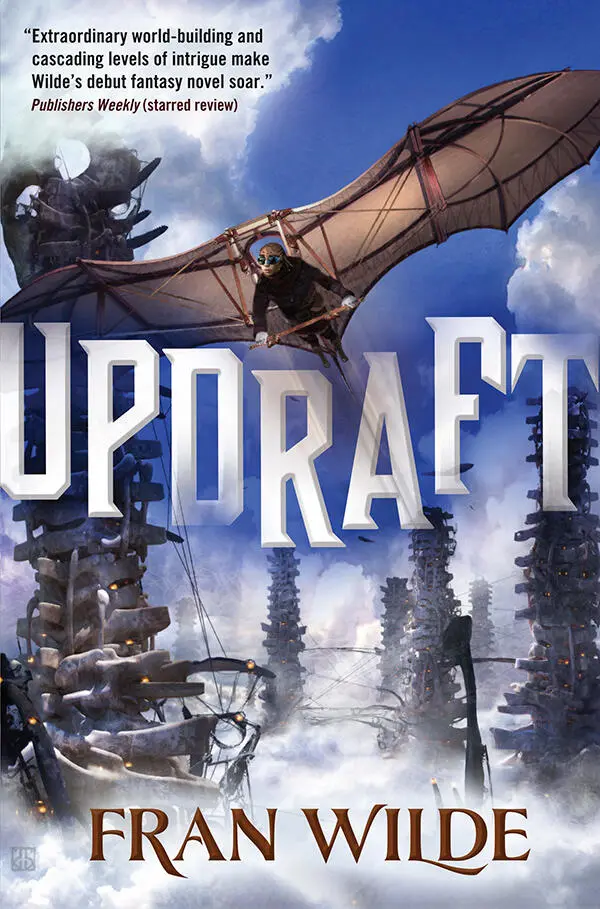
- Название:Updraft
- Автор:
- Издательство:Tor Books
- Жанр:
- Год:2015
- ISBN:нет данных
- Рейтинг книги:5 / 5. Голосов: 1
-
Избранное:Добавить в избранное
- Отзывы:
-
Ваша оценка:
Updraft: краткое содержание, описание и аннотация
Предлагаем к чтению аннотацию, описание, краткое содержание или предисловие (зависит от того, что написал сам автор книги «Updraft»). Если вы не нашли необходимую информацию о книге — напишите в комментариях, мы постараемся отыскать её.
Welcome to a world of wind and bone, songs and silence, betrayal and courage.
Kirit Densira cannot wait to pass her wingtest and begin flying as a trader by her mother's side, being in service to her beloved home tower and exploring the skies beyond. When Kirit inadvertently breaks Tower Law, the city's secretive governing body, the Singers, demand that she become one of them instead. In an attempt to save her family from greater censure, Kirit must give up her dreams to throw herself into the dangerous training at the Spire, the tallest, most forbidding tower, deep at the heart of the City.
As she grows in knowledge and power, she starts to uncover the depths of Spire secrets. Kirit begins to doubt her world and its unassailable Laws, setting in motion a chain of events that will lead to a haunting choice, and may well change the city forever — if it isn't destroyed outright.
Updraft — читать онлайн бесплатно полную книгу (весь текст) целиком
Ниже представлен текст книги, разбитый по страницам. Система сохранения места последней прочитанной страницы, позволяет с удобством читать онлайн бесплатно книгу «Updraft», без необходимости каждый раз заново искать на чём Вы остановились. Поставьте закладку, и сможете в любой момент перейти на страницу, на которой закончили чтение.
Интервал:
Закладка:
Moc’s voice was a tremulous quaver, but his friends joined in, and the sound of young voices filled the room. Theirs was a boisterous retelling of The Rise — but not a version I’d ever heard before. This Rise told of danger, of dying, and of tower fighting tower. This Rise was not beautiful. It put music and memory to fear bred of long privations. It was a warning, wrapped in familiar notes.
In the Spire, even the songs were different.
Nat would have loved to know about this. As for me, I realized Sellis was right: I was worse than a fledge. If I was to get my wings back, I would need to learn fast.
By the time we broke for the evening meal, I had committed several verses to memory. My stomach growled as we walked to the common dining hall. Moc and Ciel took long strides on each side of me.
“We’ll help you remember,” Ciel said. “We’ll practice with you.”
“Don’t you sleep?”
Moc shook his head and grinned. “We learn a lot when everyone’s sleeping.”
And they did help me — on that day, and on many days after.
In the dining alcove, the twins seemed to know everyone. They filled their bowls with the day’s meal — peas, or potatoes, or spiced bird — and began chattering with other novices before they’d set their meals down on the long bone tables. I was swept up in their conversations and barely needed to speak myself. Often, I found that we sat near Sellis, who was surly but not outwardly rude.
The children of the Spire swirled around us, eating, talking with both hands and mouths full. They were much like children of any tower. And yet they knew things the rest of the city did not. I wished for the first time that I could have grown up here, that I’d been taught what had really happened, instead of a merely a pretty song filled with lies about the city I loved. There was power in the knowing.
* * *
The moon waned and filled, then waned again. I mended Sellis’s robes, badly at first, then better. Cleaned buckets and her cell.
My throat went raw from singing with the children.
Many evenings, Wik came to test my shouts and to instruct me further.
“There aren’t many of us,” he said.
I caught his meaning. “You are a skymouth shouter, too.”
“Yes, but not naturally. I had to train, and I’m still never certain—” He swallowed before continuing. “Whether it is enough to stop the next one. It has been, so far. I am lucky.”
He taught me to aim my voice, by standing across the Gyre until I could shout at him in any wind. He made me do breathing exercises to strengthen my diaphragm and lengthen my shouts. “So you don’t black out again,” he said.
He frustrated me with his criticisms. “You are not trying hard enough. Your voice doesn’t have the right timbre, as it did at Densira. You must try harder.”
The harder I tried, the more I was unable to recall what shouting at the skymouth had sounded like, or felt like, and the more I was convinced that I was unable to manage it on demand. What good was I to the Singers if I could not control my voice?
“It’s no good, Wik.” My voice rasped from the exercises.
“We will find another way,” he said. “I must ask the council for permission.” He refused to elaborate.
Meantime, we walked the Spire and practiced. Wik and Sellis and I. For Sellis lurked these lessons, and sometimes tried to accomplish the same types of shouts that Wik and I were practicing. Her frustration built when Wik shook his head at her attempts, but she kept trying.
“Most Singers can’t, Sellis,” he said. “It’s all right to not be perfect at something.”
“There are many things I haven’t perfected — yet,” she said, frowning.
The lower tiers we walked through were as richly carved with city and Singer history as the oubliette had been carved with fears and monsters. As we walked, I noticed that at least one place — sometimes less than two hands wide — on each Spire tier had been left bare. We passed Singers paused by those walls, hands laid gently against those uncarved stretches of bone. Their eyes closed as if listening. I wished to understand what they heard, but when I reached out to a wall, Sellis swatted at my hand. “You may not. Not yet.”
On the other side of the passage, beyond the steep drop, Singers and older novices flew the Gyre’s swirling winds.
I wanted to regain my wings so that I might fly with them.
Sellis saw me watching. “Not yet.” She found me more carvings to study. “Soon,” Sellis encouraged me as she rousted me from the floor to clean her bucket and her bowl. “Soon,” the Magister said as I scrubbed the carvings on the upper tiers clean of grime. “Soon,” Wik promised, before asking me to shout for three minutes; my voice turned to gravel.
But I flew the Gyre in my dreams, before the galleries, up to the council balcony, and out through the apex into the blue sky.
And I learned to listen to the Spire in other ways, and through the Spire, the city.
I heard the city’s voice in the bone floors, through my feet as I walked, my knees as I scrubbed. I heard its rumbles and creaks, its sighs. I learned to speak to it in secret.
As I slowly learned, I was punished for nearly everything. For getting words wrong. For annoying Sellis. For being in the wrong place when a Singer wanted me somewhere else. I could not say how many infractions, but the punishment was always the same: not bone chips to weigh me down, but more cleaning and carving. My nose was filled with bone dust, and I grew tired beyond measure of being handed the carving tools. My hands thickened with calluses and scars from tracing patterns charcoaled on the walls for me by Sellis, the Magisters, Wik, and seemingly anyone else passing by.
And yet, I learned. Despite everything. Moc and Ciel knelt by me and sang with me while I gouged at the walls or scrubbed the floor. I watched Singers come and go on powerful wings and listened to the songs they sang to each other, citing challenges won long ago in order to support arguments today.
I pricked my ears for any mention of the windbeaters.
When the full moon showed through the top of the tower, the entire Spire stopped to sing The Rise. Sound swept me up in the history. The bravery. The real Rise. I mouthed the words I knew now, still hesitant to sing with them.
I memorized facts about the towers: how high they were, how many had troubled their neighbors. I listened as Magisters discussed balance in the city and how to keep towers from cracking, like Lith. An artifex came to show our class how bridges helped strengthen the towers. With the young ones, I counted the toll of the skymouth attacks.
We had our own songs in the Spire: legends, epics, and heroes the towers could never know about. “Corwitt Takes the Nest of Thieves,” “The Plunge of the Singer,” “The First Appeasement.” Through them, I began to understand more of the bone towers on which we lived.
I had not seen Rumul since my release from the oubliette.
The Spire remained quiet, save for the songs and the city’s everyday sounds.
And then the day came when I stood before the classes and sang The Rise again, and they sang it back. The Magisters questioned me about the populations of Grigrit, Varu, and others, and I knew the answers without thinking. I knew them all. The sun passed beyond the tower, and the oil lamps came out. My examination continued. Did I know the load-bearing weight of new bone? What was the angle at which a Singer must glide when carrying a child? An adult?
I had memorized the songs, understood the reasons for the answers. I knew so much more now.
The Magister presented me with a gray robe bearing two blue stripes. A robe that fit me.
Sellis brought me a pair of wings. Worn ones, certainly, and not the glorious Singer wings I’d admired, but something to practice in.
Читать дальшеИнтервал:
Закладка:
Похожие книги на «Updraft»
Представляем Вашему вниманию похожие книги на «Updraft» списком для выбора. Мы отобрали схожую по названию и смыслу литературу в надежде предоставить читателям больше вариантов отыскать новые, интересные, ещё непрочитанные произведения.












Обсуждение, отзывы о книге «Updraft» и просто собственные мнения читателей. Оставьте ваши комментарии, напишите, что Вы думаете о произведении, его смысле или главных героях. Укажите что конкретно понравилось, а что нет, и почему Вы так считаете.