Robert Sawyer - Quantum Night
Здесь есть возможность читать онлайн «Robert Sawyer - Quantum Night» весь текст электронной книги совершенно бесплатно (целиком полную версию без сокращений). В некоторых случаях можно слушать аудио, скачать через торрент в формате fb2 и присутствует краткое содержание. Год выпуска: 2016, ISBN: 2016, Издательство: Ace Books, Жанр: Фантастика и фэнтези, на английском языке. Описание произведения, (предисловие) а так же отзывы посетителей доступны на портале библиотеки ЛибКат.
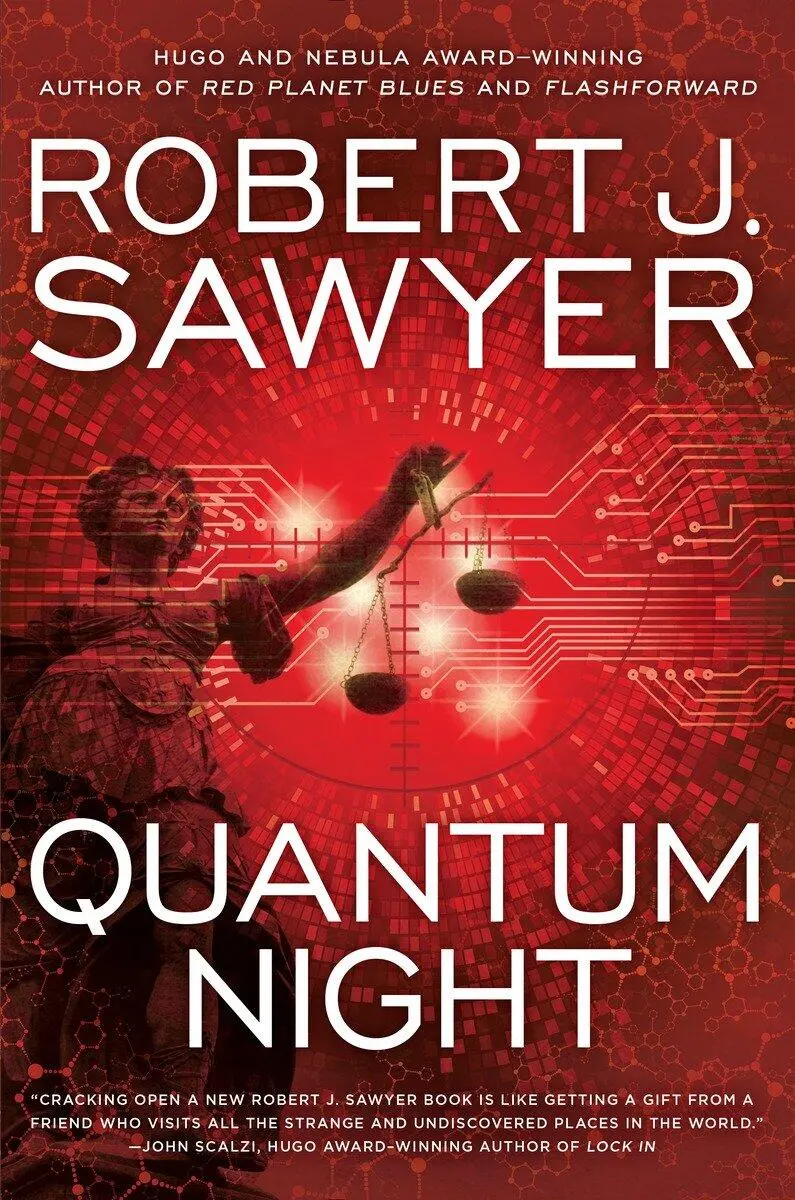
- Название:Quantum Night
- Автор:
- Издательство:Ace Books
- Жанр:
- Год:2016
- ISBN:978-0-425-25683-1
- Рейтинг книги:3 / 5. Голосов: 1
-
Избранное:Добавить в избранное
- Отзывы:
-
Ваша оценка:
Quantum Night: краткое содержание, описание и аннотация
Предлагаем к чтению аннотацию, описание, краткое содержание или предисловие (зависит от того, что написал сам автор книги «Quantum Night»). Если вы не нашли необходимую информацию о книге — напишите в комментариях, мы постараемся отыскать её.
Jim is reunited with Kayla Huron, his forgotten girlfriend from his lost period and now a quantum physicist who has made a stunning discovery about the nature of human consciousness. As a rising tide of violence and hate sweeps across the globe, the psychologist and the physicist combine forces in a race against time to see if they can do the impossible—change human nature—before the entire world descends into darkness.
Quantum Night — читать онлайн бесплатно полную книгу (весь текст) целиком
Ниже представлен текст книги, разбитый по страницам. Система сохранения места последней прочитанной страницы, позволяет с удобством читать онлайн бесплатно книгу «Quantum Night», без необходимости каждый раз заново искать на чём Вы остановились. Поставьте закладку, и сможете в любой момент перейти на страницу, на которой закончили чтение.
Интервал:
Закладка:
“My pleasure.”
“I have the MRI scans from St. Boniface.”
He sounded concerned—and that made me concerned. “Oh, my God. A tumor?”
“No, not a tumor.”
“Then what?”
“It turns out the medical-imaging group at St. Boniface didn’t have to open a new file for you. They already had one.”
“But I’ve never been there—well, except to visit sick friends.”
“Ah, but you were there, in 2001. It seems I’m not the only importunate professor in town. Back then, one Menno Warkentin twisted a few arms and got you in to be scanned, too.”
“Really?”
“Yes.”
My heart was pounding. “And?”
“And my friend at St. Boniface sent that scan along, as well. They normally don’t keep records from that far back, but yours was tagged for retention for research purposes; the radiologist noted he’d never seen anything like it.” He turned to a monitor. “Here you are today, in 2020.” He hit Alt-Tab. “And here you are in 2001.”
I knew the layout of the brain, but I was no expert at reading scans. “Yes?” I said, looking at the older scan.
“Here,” said Namboothiri pointing at a thin hyperintensity line—what one might have taken for a scratch on the film if it hadn’t been a digital image.
“Damage to the amygdala,” I said, stunned.
He pointed to another line. “And the orbitofrontal cortex,” added Namboothiri.
“The paralimbic system,” I said softly.
“Bingo,” said Namboothiri. He pointed to the recent scan. “The encephalomalacia has abated over the years, although the lesions are still present. But the abnormality dates back to at least”—he peered at the bottom left corner of the image—“June fifteenth, 2001.”
“My God. Um, look, could transcranial focused ultrasound create lesions like that? That’s what Menno’s equipment used.”
“TUS? No way. These are more like, I dunno, burns.”
“Shit.”
“Anyway. I thought you’d want to know. I’m going to work with the recent scan, mapping out where to search for your missing memories. Sadly, I do have many other things on my plate, but I’ll get to it as soon as I can.”
I pushed the flat of my hand sharply against the slate-gray door to Menno’s office and it swung open, banging against the wall-mounted stopper. Pax rose up on all fours, and Menno swung around in his brown leather chair. “Who’s there?” he asked, sounding more than a little frightened.
“It’s me,” I said. “Jim Marchuk.”
“Padawan! You startled me. What can I do for you?”
“You’ve already done plenty,” I said, fury in my voice as I closed the door behind me. “I’ve seen the MRI.”
Menno’s broad face often betrayed what he was thinking; I suspect that since going blind, he’d more or less forgotten about trying to control his facial expressions. And so this, naked in front of me, was what someone looked like when, after almost twenty years, they heard the other shoe falling. Still, he made a game attempt: “What MRI?”
“The one done near the end of my dark period, showing the lesions to my paralimbic system.” Normally, by this time, Pax would have curled up at Menno’s feet, but she recognized the anger in my tone: she stood at attention, ears perked, mouth open, teeth exposed.
“Jim…”
“What were you trying to do, for God’s sakes?”
“I’m sorry, Jim. I’m so, so sorry.”
“How many times were you going to use me as an experimental animal?”
“It wasn’t like that, Jim. Not at all.”
“Christ, first you knock me into a coma—”
“I never wanted any harm to come to you, ever.”
“—then you wrecked my paralimbic system. Actual fucking brain damage!”
“I wasn’t trying to hurt you! I was trying to cure you.”
Boisterous students were moving down the corridor. While waiting for them to pass, I digested this. “Cure…?”
“Yes,” said Menno emphatically. “We kept testing you with the Lucidity equipment, hoping to find that your inner voice had come back. A month, two months, three months—it was killing me, what we’d done to you. Of course, there’s more to consciousness than just an inner voice—it’s a whole suite of things—but that was the only aspect we could directly check for. When it’s present, it surely correlates with it being like something to be you, to having first-person, subjective experience. But we’d somehow taken all that away—and I had to try to bring it back.”
“So you carved into my skull?”
“Nothing as dangerous as that. And we succeeded, you know. Your inner voice did come back.”
“The MRI I saw was dated June fifteenth. But I have no recollection of anything until the beginning of July.”
Menno tilted his head, as if thinking. “It was so long ago. I don’t remember. But… but, yeah, now that I think about it, your inner voice didn’t come back right away. It was—God, well, I guess it could have been a couple of weeks later.”
“Damn it, Menno, you want me to go to the dean or to the press first? Or maybe the cops? What the hell did you do to me?”
He was quiet for a long moment, then spread his arms. “Lucidity was a military project, did you know that? We were working on a battlefield microphone. Anyway, that meant we had access to some other classified techniques. The Pentagon was testing a system—they’ve since abandoned it, thank God—using two intersecting laser beams to trigger action potentials. The beams supposedly passed harmlessly through living tissue, and, well, there was a paper out of Russia that suggested an approach related to stimulating the amygdala that I thought just might bring you back, so—”
“Jesus!”
“I was trying to fix things—”
“And instead fucked me up even worse!”
Pax was staring at me, still startled by my anger, but Menno’s voice was calm. “As I said, the laser system didn’t work as advertised. Turned out the damn thing destroyed tissue along the lines of both beams—although fortunately the beams were extremely narrow, and they cauterized the blood vessels. Thank the Lord for neuroplasticity, though; you bounced back from the damage, but…”
“But it was like Phineas Gage,” I said.
“I’m so sorry,” said Menno. “I was trying to help. And, look, Kiehl didn’t publish until five years later; I had no way of knowing.”
I thought about that. Kent Kiehl’s seminal paper “A Cognitive Neuroscience Perspective on Psychopathy: Evidence for Paralimbic System Dysfunction,” had come out in 2006. He demonstrated that damage to what he dubbed the paralimbic portions of the brain—including the amygdala—could cause people to exhibit psychopathic symptoms. Phineas Gage, the Vermont railway worker who, in 1848, had a tamping iron blown straight up through his skull, probably suffered from that sort of damage, turning him from an affable fellow into a manipulative, reckless, irresponsible, promiscuous monster—in other words, a psychopath.
“I’m truly sorry, Jim,” Menno said again.
“Paralimbic damage,” I said, thinking aloud. “But…” I put a hand on my chest, fingers splayed. “My heart…”
“Yes?” said Menno.
My head was swimming. The knifing, the guy with the splayed teeth, the blood freezing on the sidewalk. I remembered it all so clearly. And—
No. Damn it. No. Another old paper came to mind—I’d cited it myself in some of my own publications: Armin Schnider on “Spontaneous Confabulation, Reality Monitoring, and the Limbic System.” Schnider contended that those with anterior limbic damage became absolutely convinced of narratives they’d created to explain events even though they were just making things up.
Читать дальшеИнтервал:
Закладка:
Похожие книги на «Quantum Night»
Представляем Вашему вниманию похожие книги на «Quantum Night» списком для выбора. Мы отобрали схожую по названию и смыслу литературу в надежде предоставить читателям больше вариантов отыскать новые, интересные, ещё непрочитанные произведения.



Обсуждение, отзывы о книге «Quantum Night» и просто собственные мнения читателей. Оставьте ваши комментарии, напишите, что Вы думаете о произведении, его смысле или главных героях. Укажите что конкретно понравилось, а что нет, и почему Вы так считаете.