Paul McAuley - Child of the River
Здесь есть возможность читать онлайн «Paul McAuley - Child of the River» весь текст электронной книги совершенно бесплатно (целиком полную версию без сокращений). В некоторых случаях можно слушать аудио, скачать через торрент в формате fb2 и присутствует краткое содержание. Год выпуска: 1997, ISBN: 1997, Издательство: Gollancz, Жанр: Фантастика и фэнтези, на английском языке. Описание произведения, (предисловие) а так же отзывы посетителей доступны на портале библиотеки ЛибКат.
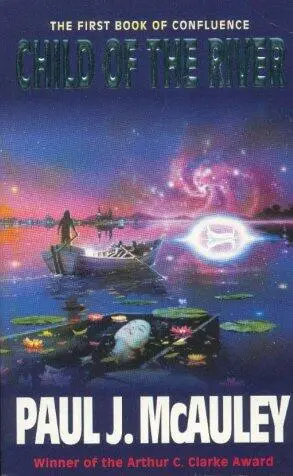
- Название:Child of the River
- Автор:
- Издательство:Gollancz
- Жанр:
- Год:1997
- ISBN:0-575-06427-7
- Рейтинг книги:3 / 5. Голосов: 1
-
Избранное:Добавить в избранное
- Отзывы:
-
Ваша оценка:
Child of the River: краткое содержание, описание и аннотация
Предлагаем к чтению аннотацию, описание, краткое содержание или предисловие (зависит от того, что написал сам автор книги «Child of the River»). Если вы не нашли необходимую информацию о книге — напишите в комментариях, мы постараемся отыскать её.
Child of the River — читать онлайн бесплатно полную книгу (весь текст) целиком
Ниже представлен текст книги, разбитый по страницам. Система сохранения места последней прочитанной страницы, позволяет с удобством читать онлайн бесплатно книгу «Child of the River», без необходимости каждый раз заново искать на чём Вы остановились. Поставьте закладку, и сможете в любой момент перейти на страницу, на которой закончили чтение.
Интервал:
Закладка:
“To, keep out the ghosts.”
“They don’t usually work. That’s what I heard, anyway.”
“Look there. Is that our temple?”
It reared up a few streets ahead, a giant cube built of huge roughly hewn stone blocks stained black with soot, and topped by an onion dome lapped in scuffed gilt tiles.
Pandaras squinted at it, then said, “No, ours has a rounder roof, with a hole in the top of it.”
“Of course! Where the machine fell!”
The Temple of the Black Well had been built long after the feral machine’s fiery fall, but its dome had been left symbolically uncompleted, with the aperture at its apex directly above the deep hole made when the machine had struck the surface of the world and melted a passage in the rock all the way down to the keel. Yama had been told the story by the aspect of a leather merchant who had had his tannery near the site of the temple’s construction. Mysyme, that had been the merchant’s name. He had had two wives and six beautiful daughters, and had done much charitable work amongst the orphaned river-rats of the docks. Mysyme was dead an age past, and Yama had lost interest in the limited responses of his aspect years ago, but now he remembered them all over again. Mysyme’s father had seen the fall of the machine, and had told his son that when it hit, a plume of melted rock had been thrown higher than the atmosphere, while the smoke of secondary fires had darkened the sky above Ys for a decad.
“It’s a little to the left,” Pandaras said, “and maybe ten minutes’ walk. That place with the gold roof is a tomb of a warrior-saint. It’s solid all the way through except for a secret chamber.”
“You are a walking education, Pandaras.”
“I have an uncle who used to live here, and one time I stayed with him. He was on my mother’s side, and this was when my father ran off and my mother went looking for him. She was a year at it, and never found him. And a year is a long time for my people. So she came back and married another man, and when that didn’t work out she married my stepfather. I don’t get on with him, and that’s why I took the job of pot boy, because it came with a room. And then you came along, and here we are.” Pandaras grinned. “For a long time after I left this part of the city, I thought maybe I was haunted. I’d wake up and think I’d been hearing voices, voices that had been telling me things in my sleep. But I haven’t heard them since I met up with you, master. Maybe your bloodline is a cure for ghosts.”
“All my bloodline are ghosts, from the little I have learned,” Yama said.
The Temple of the Black Well stood at the center of a wide, quiet plaza of mossy cobbles. It had been built in the shape of a cross, with a long atrium and short apses; its dome, covered in gold leaf that shone with the last light of the sun, capped the point where the apses intersected the atrium. The temple was clad in lustrous black stone, although here and there parts of the cladding had fallen away to reveal the grayish limestone beneath. Yama and Pandaras walked all the way around the temple and saw no one, and then climbed the long flight of shallow steps and went through the tall narthex.
It was dark inside, but a thick slanted column of reddish light fell through the open apex of the dome at the far end of a long atrium flanked by colonnades. Yama walked toward the light. There was no sign of Tamora or her mysterious contact; the whole temple seemed deserted. The pillars of the colonnades were intricately carved and the ruined mosaics of the floor sketched the outlines of heroic figures. The temple had been splendid once, Yama thought, but now it had the air of a place that was no longer cared for. He thought it an odd choice for a rendezvous—far better for an ambush.
Pandaras clearly felt the same thing, for his sleek head continually turned this way and that as they went down the atrium. The reddish light, alive with swirling motes of dust, fell on a waist-high wall of undressed stone which ringed a wide hole that plunged down into darkness. It was the well, the shaft the fallen machine had melted. The wide coping on top of the wall was covered in the ashy remnants of incense cones, and here and there were offerings of fruit and flowers.
A few joss sticks jammed into cracks in the wall sent up curls of sweet-smelling smoke, but the flowers were shriveled and brown, and the little piles of fruit were spotted with decay.
“Not many come here,” Pandaras said. “The ghost of the machine is powerful, and quick to anger.”
Yama gripped the edge of the coping and looked into the depths of the well. A faint draught of cold, stale air blew up around him from the lightless depths. The walls of the shaft were long glassy flows of once-melted rock, veined with impurities, dwindling away to a vanishing point small as the end of his thumb. It was impossible to tell how deep the well really was, and in a spirit of inquiry Yama dropped a softening pomegranate into the black air.
“That isn’t a good idea,” Pandaras said uneasily.
“I do not think a piece of fruit would wake this particular machine. It fell a long way as I recall—at least, it was two days in falling, and appeared in the sky as a star clothed in burning hair. When it struck the ground, the blow knocked down thousands of houses and caused a wave in the river that washed away much of the city on the far-side shore. And then the sky turned black with smoke from all the fires.”
“There might be other things down there,” Pandaras said. “Bats, for instance. I have a particular loathing of bats.”
Yama said, “I should have thrown a coin. I might have heard it hit.”
But a small part of his mind insisted that the fruit was still falling through black air toward the bottom, two leagues or more to the keel. He and Pandaras walked around the well, but apart from the smoking joss sticks there was no sign that Tamora or anyone else had been there recently, and the hushed air was beginning to feel oppressive, as if it held a note endlessly drawn out just beyond the range of hearing.
Pandaras said, “We should go on, master. She isn’t here.” He added hopefully, “Perhaps she has run off and left us.”
“She made a contract with me. I should think that is a serious thing for someone who lives from one job to the next. We will wait a little longer.” He took out the paper and read it again. “’The man you want—’ I wonder what she meant.”
“It’ll be dark soon.”
Yama smiled, and said, “I believe that you are scared of this place.”
“You might not believe in ghosts, master, but there are many who do—most of the people in the city, I reckon.”
“I might have more cause to believe in ghosts, because I was brought up in the middle of the City of the Dead, but I do not. Just because a lot of people believe in ghosts does not make them real. I might believe that the Preservers have incarnated themselves in river turtles, and I might persuade a million people to believe it, too, but that does not make it true.”
“You shouldn’t make jokes like that,” Pandaras said. “Especially not here.”
“Surely the Preservers will forgive a small joke.”
“There’s many who would take offense on their account,” Pandaras said stubbornly. He had a deep streak of superstition, despite his worldly-wise air. Yama had seen the care with which he washed himself in a ritual pattern after eating and upon waking, the way he crossed his fingers when walking past a shrine—a superstition he shared with the citizens of Aeolis, who believed that it disguised the fact that you had come to a shrine without an offering—and his devotion at prayer. Like the Amnan, who could not or would not read the Puranas and so only knew them secondhand through the preaching of priests and iconoclasts. Pandaras and the countless millions of ordinary folk of Ys believed that the Preservers had undergone a transubstantiation, disappearing not into the Eye but dispersing themselves into every particle of the world which they had made, so that they were everywhere at once, immortal, invisible and, despite their limitless power, quick to judge and requiring constant placation. It was not surprising, then, that Pandaras believed in ghosts and other revenants.
Читать дальшеИнтервал:
Закладка:
Похожие книги на «Child of the River»
Представляем Вашему вниманию похожие книги на «Child of the River» списком для выбора. Мы отобрали схожую по названию и смыслу литературу в надежде предоставить читателям больше вариантов отыскать новые, интересные, ещё непрочитанные произведения.










Обсуждение, отзывы о книге «Child of the River» и просто собственные мнения читателей. Оставьте ваши комментарии, напишите, что Вы думаете о произведении, его смысле или главных героях. Укажите что конкретно понравилось, а что нет, и почему Вы так считаете.