Тед Чан - Exhalation - Stories
Здесь есть возможность читать онлайн «Тед Чан - Exhalation - Stories» весь текст электронной книги совершенно бесплатно (целиком полную версию без сокращений). В некоторых случаях можно слушать аудио, скачать через торрент в формате fb2 и присутствует краткое содержание. Город: New York, Год выпуска: 2019, ISBN: 2019, Издательство: Alfred A. Knopf, Жанр: Фантастика и фэнтези, на английском языке. Описание произведения, (предисловие) а так же отзывы посетителей доступны на портале библиотеки ЛибКат.
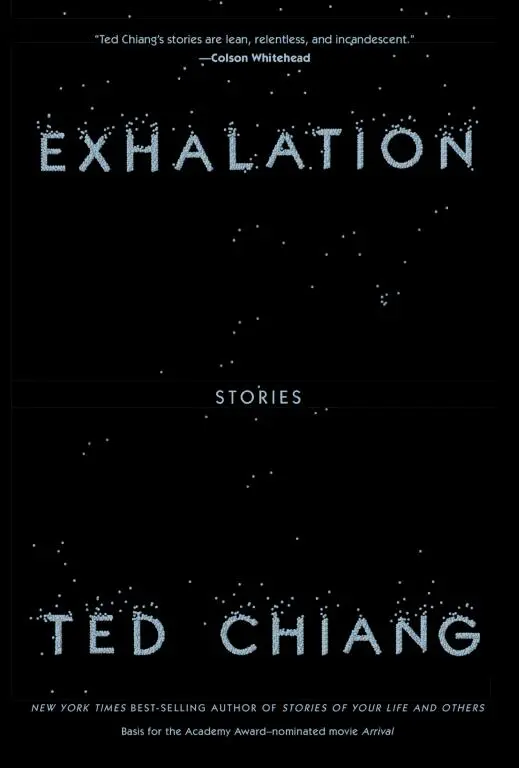
- Название:Exhalation: Stories
- Автор:
- Издательство:Alfred A. Knopf
- Жанр:
- Год:2019
- Город:New York
- ISBN:978-1-10194-788-3
- Рейтинг книги:3 / 5. Голосов: 1
-
Избранное:Добавить в избранное
- Отзывы:
-
Ваша оценка:
Exhalation: Stories: краткое содержание, описание и аннотация
Предлагаем к чтению аннотацию, описание, краткое содержание или предисловие (зависит от того, что написал сам автор книги «Exhalation: Stories»). Если вы не нашли необходимую информацию о книге — напишите в комментариях, мы постараемся отыскать её.
In “The Merchant and the Alchemist’s Gate,” a portal through time forces a fabric seller in ancient Baghdad to grapple with past mistakes and second chances. In “Exhalation,” an alien scientist makes a shocking discovery with ramifications that are literally universal. In “Anxiety Is the Dizziness of Freedom,” the ability to glimpse into alternate universes necessitates a radically new examination of the concepts of choice and free will.
Including stories being published for the first time as well as some of his rare and classic uncollected work, Exhalation is Ted Chiang at his best: profound, sympathetic—revelatory.
Exhalation: Stories — читать онлайн бесплатно полную книгу (весь текст) целиком
Ниже представлен текст книги, разбитый по страницам. Система сохранения места последней прочитанной страницы, позволяет с удобством читать онлайн бесплатно книгу «Exhalation: Stories», без необходимости каждый раз заново искать на чём Вы остановились. Поставьте закладку, и сможете в любой момент перейти на страницу, на которой закончили чтение.
Интервал:
Закладка:
“Fine, let’s suppose you’re right,” says Brauer; he’s clearly indulging her. “How many years would it take to find him? It’s already taken you so long to raise the first generation that the platform they run on has become obsolete. How many generations before you come up with a Turing?”
“We won’t always be restricted to running them in real time. At some point there’ll be enough digients to form a self-sufficient population, and then they won’t be dependent on human interaction. We could run a society of them at hothouse speeds without any risk of them going feral, and see what they produce.” Ana’s actually far from confident that this scenario would produce a Turing, but she’s practiced this argument enough times to sound like she believes it.
Brauer isn’t convinced, though. “Talk about a risky investment. You’re showing us a handful of teenagers and asking us to pay for their education in the hopes that when they’re adults, they’ll found a nation that will produce geniuses. Pardon me if I think there are better ways we could spend our money.”
“But think about what you’re getting. The other owners and I have devoted years of our attention to raising these digients. Porting Neuroblast is cheap compared with what it’d cost to hire people to do that for another genome. And the potential payoff is exactly what your company’s been looking for: programming geniuses working at high speed, bootstrapping themselves to superhuman intelligence. If these digients can invent games now, just imagine what their descendants could do. And you’d make money off every one of them.”
Brauer is about to reply when Pearson interjects, “Is that why you want Neuroblast ported? To see what superintelligent digients might invent one day?”
Ana sees Pearson scrutinizing her and decides there’s no point in trying to lie. “No,” she says. “What I want is for Jax to have a chance at a fuller life.”
Pearson nods. “You’d like Jax to be a corporation one day, right? Have some sort of legal personhood?”
“Yes, I would.”
“And I’ll bet Jax wants the same thing, right? To be incorporated?”
“For the most part, yes.”
Pearson nods again, his suspicions confirmed. “That’s a deal breaker for us. It’s nice that they’re fun to talk to, but all the attention you’ve given your digients has encouraged them to think of themselves as persons.”
“Why is that a deal breaker?” But she knows the answer already.
“We aren’t looking for superintelligent employees, we’re looking for superintelligent products. You’re offering us the former, and I can’t blame you; no one can spend as many years as you have teaching a digient and still think of it as a product. But our business isn’t based on that kind of sentiment.”
Ana has been pretending it wasn’t there, but now Pearson has stated it baldly: the fundamental incompatibility between Exponential’s goals and hers. They want something that responds like a person, but isn’t owed the same obligations as a person, and that’s something she can’t give them.
No one can give it to them, because it’s an impossibility. The years she spent raising Jax didn’t just make him fun to talk to, didn’t just provide him with hobbies and a sense of humor. They were what gave him all the attributes Exponential is looking for: fluency at navigating the real world, creativity at solving new problems, judgment you could entrust with an important decision. Every quality that made a person more valuable than a database was a product of experience.
She wants to tell them that Blue Gamma was more right than it knew: experience isn’t merely the best teacher; it’s the only teacher. If she’s learned anything raising Jax, it’s that there are no shortcuts; if you want to create the common sense that comes from twenty years of being in the world, you need to devote twenty years to the task. You can’t assemble an equivalent collection of heuristics in less time; experience is algorithmically incompressible.
And even though it’s possible to take a snapshot of all that experience and duplicate it ad infinitum, even though it’s possible to sell copies cheaply or give them away for free, each of the resulting digients would still have lived a lifetime. Each one would have once seen the world with new eyes, have had hopes fulfilled and hopes dashed, have learned how it felt to tell a lie and how it felt to be told one.
Which means each one would deserve some respect. Respect that Exponential can’t afford to give.
Ana makes one final attempt. “These digients could still make money for you as employees. You could—”
Pearson shakes his head. “I appreciate what you’re trying to do, and I wish you the best of luck, but it’s not a good match for Exponential. If these digients were going to be products, the potential profits might be worth the risk. But if all they’re going to be is employees, that’s a different situation; we can’t justify such a large investment for so little return.”
Of course not, she thinks. Who could? Only someone who’s a fanatic, someone who’s motivated by love. Someone like her.
Ana is sending a message to Derek about the failed meeting with Exponential when the robot body comes to life. “How meeting go?” asks Jax, but he can read her expression well enough to answer the question himself. “Is my fault? They not like what I show them?”
“No, you did great, Jax. They just don’t like digients; I made a mistake in thinking I could change their minds.”
“Worth trying,” says Jax.
“I suppose it was.”
“You okay?”
“I’ll be fine,” she assures him. Jax gives her a hug and then walks the body back to the charging platform and returns to Data Earth.
Sitting at her desk, staring at a blank screen, Ana contemplates the user group’s remaining options. As far as she can tell, there’s only one: working for Polytope and trying to convince them that the Neuroblast engine is worth porting. All she has to do is wear the InstantRapport patch and join their experiment in industrialized caregiving.
Whatever else one might say about Polytope, the company understands the value of real-time interaction in a way that Exponential does not. Sophonce digients might be content to be left alone in a hothouse, but that’s not a viable shortcut if you want them to become productive individuals. Someone is going to have to spend time with them, and Polytope recognizes that.
Her objection is to Polytope’s strategy for getting people to spend that time. Blue Gamma’s strategy had been to make the digients lovable, while Polytope is starting with unlovable digients and using pharmaceuticals to make people love them. It seems clear to her that Blue Gamma’s approach was the right one, not just more ethical but more effective.
Indeed, maybe it was too effective, considering the situation she’s in now: she’s faced with the biggest expense of her entire life, and it’s for her digient. It’s not what anyone at Blue Gamma expected, all those years ago, but perhaps they should have. The idea of love with no strings attached is as much a fantasy as what Binary Desire is selling. Loving someone means making sacrifices for them.
Which is the only reason Ana’s considering working for Polytope. Under any other circumstances, she’d be insulted by the offer of a job that required the use of InstantRapport: she has as much experience working with digients as anyone in the world, yet Polytope is implying that she can’t be an effective trainer without pharmaceutical intervention. Training digients—like training animals—is a job, and a professional can do her job without having to be in love with a particular assignment.
Читать дальшеИнтервал:
Закладка:
Похожие книги на «Exhalation: Stories»
Представляем Вашему вниманию похожие книги на «Exhalation: Stories» списком для выбора. Мы отобрали схожую по названию и смыслу литературу в надежде предоставить читателям больше вариантов отыскать новые, интересные, ещё непрочитанные произведения.








Обсуждение, отзывы о книге «Exhalation: Stories» и просто собственные мнения читателей. Оставьте ваши комментарии, напишите, что Вы думаете о произведении, его смысле или главных героях. Укажите что конкретно понравилось, а что нет, и почему Вы так считаете.