Тед Чан - Exhalation - Stories
Здесь есть возможность читать онлайн «Тед Чан - Exhalation - Stories» весь текст электронной книги совершенно бесплатно (целиком полную версию без сокращений). В некоторых случаях можно слушать аудио, скачать через торрент в формате fb2 и присутствует краткое содержание. Город: New York, Год выпуска: 2019, ISBN: 2019, Издательство: Alfred A. Knopf, Жанр: Фантастика и фэнтези, на английском языке. Описание произведения, (предисловие) а так же отзывы посетителей доступны на портале библиотеки ЛибКат.
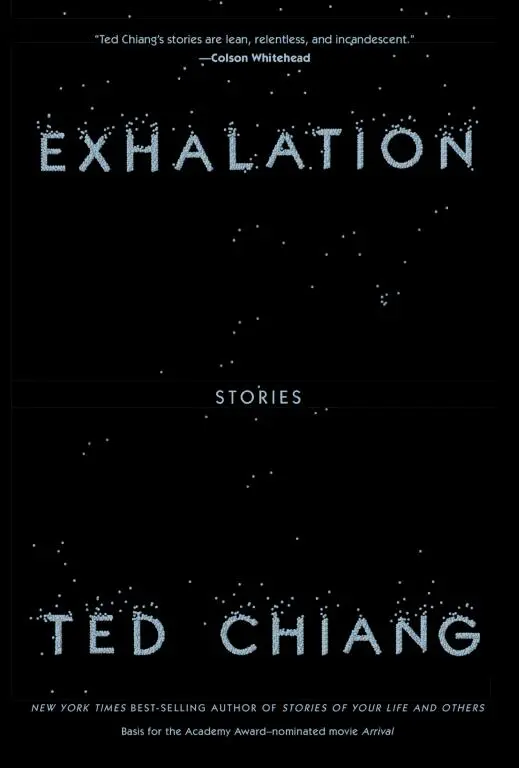
- Название:Exhalation: Stories
- Автор:
- Издательство:Alfred A. Knopf
- Жанр:
- Год:2019
- Город:New York
- ISBN:978-1-10194-788-3
- Рейтинг книги:3 / 5. Голосов: 1
-
Избранное:Добавить в избранное
- Отзывы:
-
Ваша оценка:
Exhalation: Stories: краткое содержание, описание и аннотация
Предлагаем к чтению аннотацию, описание, краткое содержание или предисловие (зависит от того, что написал сам автор книги «Exhalation: Stories»). Если вы не нашли необходимую информацию о книге — напишите в комментариях, мы постараемся отыскать её.
In “The Merchant and the Alchemist’s Gate,” a portal through time forces a fabric seller in ancient Baghdad to grapple with past mistakes and second chances. In “Exhalation,” an alien scientist makes a shocking discovery with ramifications that are literally universal. In “Anxiety Is the Dizziness of Freedom,” the ability to glimpse into alternate universes necessitates a radically new examination of the concepts of choice and free will.
Including stories being published for the first time as well as some of his rare and classic uncollected work, Exhalation is Ted Chiang at his best: profound, sympathetic—revelatory.
Exhalation: Stories — читать онлайн бесплатно полную книгу (весь текст) целиком
Ниже представлен текст книги, разбитый по страницам. Система сохранения места последней прочитанной страницы, позволяет с удобством читать онлайн бесплатно книгу «Exhalation: Stories», без необходимости каждый раз заново искать на чём Вы остановились. Поставьте закладку, и сможете в любой момент перейти на страницу, на которой закончили чтение.
Интервал:
Закладка:
“But it’s not real,” Ana blurts out, and immediately regrets it.
It’s precisely the opening Chase was looking for. “How is it not?” she asks. “Your feelings for your digients are real; their feelings for you are real. If you and your digient can have a nonsexual connection that’s real, why should a sexual connection between a human and a digient be any less real?”
Ana’s at a loss for words momentarily, and Derek steps in. “We could argue philosophy forever,” he says. “The bottom line is we didn’t spend years raising our digients to have them become sex toys.”
“I realize that,” says Chase. “And making this deal won’t prevent copies of your digients from going on to other things. But right now your digients, amazing as they are, have no marketable job skills, and you can’t predict when they’ll get any. How else are you going to raise the money you need?”
How many women have asked themselves the same question, Ana wonders. “So it’s the oldest profession.”
“That’s one way to put it, but let me again point out that the digients won’t be subjected to any coercion, not even economic coercion. If we wanted to sell faked sexual desire, there are cheaper ways we could do it. The whole point of this enterprise is to create an alternative to fake desire. We believe that sex is better when both parties enjoy it; better as an experience, and better for society.”
“That all sounds very noble. What about people who are into sexual torture?”
“We don’t condone any nonconsensual sex acts, and that includes sex with digients. The contract I’ve sent you guarantees that Binary Desire will retain the circuit breakers that Blue Gamma initially installed, enforced with state-of-the-art access control. As I said, we believe sex is better when both parties enjoy it. We’re committed to that.”
“You approve, correct?” Felix says to the group. “They anticipate all possibilities.”
Several of the user-group members glare at him, and even Chase’s expression indicates that she’d rather do without Felix’s help.
“I know that this wasn’t what you were hoping for when you began looking for investors,” says Chase. “But if you can see past your initial reaction, I think you’ll agree that what we’re proposing will be to everyone’s advantage.”
“We’ll think about it and get back to you,” says Derek.
“Thank you for listening to my presentation,” says Chase. A window pops up on-screen, indicating that the funds have been released from escrow. “Let me say one last thing. If you’re approached by another company, be sure to look at the fine print. It will probably include a clause that our lawyers wanted us to include, one that gives them the right to resell your digients to another company, with the circuit breakers disabled. I expect you know what that means?”
Ana nods; it meant that the digients might get resold to a company like Edgeplayer for use as torture victims. “Yes, we do.”
“Binary Desire overruled our lawyers’ recommendation on that. Our contract guarantees that the digients won’t be used for anything but noncoercive sex, ever. See if anyone else will make you that same guarantee.”
“Thank you,” says Ana. “We’ll be in touch.”
Ana went into the meeting with Binary Desire with the attitude that it was purely pro forma, a way to make some money by listening to a sales pitch. Now, having heard the pitch, she finds that she’s thinking about it a lot.
She hasn’t paid attention to the world of virtual sex since she was in college, when a college boyfriend spent a semester abroad. They bought the peripherals together before he left, discreet hard-shell accessories with hilarious silicone interiors, and digitally locked each device with the other’s serial number, a fidelity guarantee for their virtual genitals. Their first few sessions were unexpectedly fun, but it didn’t take long for the novelty to wear off and the shortcomings of the technology to become blatant. Sex without kissing was woefully incomplete, and she missed having her face an inch away from his, feeling the weight of his body, smelling his musk; seeing each other on a video screen couldn’t replace that, no matter how close the camera was. Her skin hungered for his in a way that no peripheral could satisfy; by semester’s end she felt like she was going to burst at the seams. The technology has undoubtedly improved since then, but it’s still an impoverished medium for intimacy.
Ana remembers how much of a difference it made the first time she saw Jax wearing a physical body. If a digient were inhabiting a doll, would that make the idea of sex more appealing? No. She’s had her face right up against Jax’s face, cleaning smudges off his lenses or inspecting scratches, and it’s nothing like being close to a person; with a digient there’s no feeling of a personal space being entered, not even the trust signified when a dog lets you rub its belly. At Blue Gamma they’d chosen not to put that kind of physical self-protectiveness into the digients—it didn’t make sense for their product—but what does physical intimacy mean if there aren’t those barriers to overcome? She doesn’t doubt that it’s possible to give a digient an arousal response close enough to human that both parties’ mirror neurons would kick in. But could Binary Desire teach a digient about the vulnerability that came with being naked, and what you were telling someone with your willingness to be naked in their presence?
But maybe none of that matters. Ana replays the recording of the videoconference, listens to Chase saying that it’s a new frontier, sex with a nonhuman partner. It’s not supposed to be the same as sex with another person, it’ll be a different kind of sex, and maybe it’ll be accompanied by a different kind of intimacy.
She thinks of an incident that took place when she worked at the zoo, when one of the female orangutans passed away. Everyone was heartbroken, but the orangutan’s favorite trainer was particularly inconsolable. Eventually he confessed that he’d been having sex with her, and shortly afterward the zoo fired him. Ana was shocked, of course, but even more so because he wasn’t the creepy pervert she imagined a zoophile would be; his grief was as deep and genuine as that of anyone who had lost a lover. He’d been married once, too, which surprised her; she’d assumed such people couldn’t get a date, but then she realized she was buying into the stereotype about zookeepers: that they spent time with animals because they couldn’t get along with people. As she did at the time, Ana again tries to pin down exactly why nonsexual relationships with animals can be healthy while sexual ones can’t, why the limited consent that animals can give is sufficient to keep them as pets yet not to have sex with them. Again she can’t articulate an argument that isn’t rooted in personal distaste, and she’s not sure that’s a good enough reason.
As for the question of digients having sex with each other, the topic has occasionally been discussed in the past, and Ana has always felt that the owners are fortunate not to have to deal with it, because sexual maturity is when a lot of animals become difficult to handle. There isn’t even the guilt that might be associated with neutering Jax surgically, because she’s not depriving him of a fundamental aspect of his nature. But now there’s a thread on the discussion forum that is making her reconsider things:
From: Helen Costas
I don’t like the idea of anyone having sex with my digient, but then I remember that parents never want to think about their kids having sex, either.
From: Maria Zheng
That’s a false analogy. Parents can’t stop their children from becoming sexual, but we can. There’s no intrinsic need for digients to emulate that aspect of human development. Don’t go overboard with the anthropomorphic projection.
Читать дальшеИнтервал:
Закладка:
Похожие книги на «Exhalation: Stories»
Представляем Вашему вниманию похожие книги на «Exhalation: Stories» списком для выбора. Мы отобрали схожую по названию и смыслу литературу в надежде предоставить читателям больше вариантов отыскать новые, интересные, ещё непрочитанные произведения.








Обсуждение, отзывы о книге «Exhalation: Stories» и просто собственные мнения читателей. Оставьте ваши комментарии, напишите, что Вы думаете о произведении, его смысле или главных героях. Укажите что конкретно понравилось, а что нет, и почему Вы так считаете.