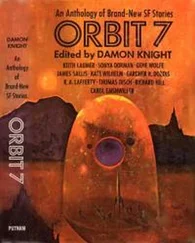
Orbit 2
Здесь есть возможность читать онлайн «Orbit 2» весь текст электронной книги совершенно бесплатно (целиком полную версию без сокращений). В некоторых случаях можно слушать аудио, скачать через торрент в формате fb2 и присутствует краткое содержание. Год выпуска: 1967, Издательство: Berkley Medallion, Жанр: Фантастика и фэнтези, на английском языке. Описание произведения, (предисловие) а так же отзывы посетителей доступны на портале библиотеки ЛибКат.
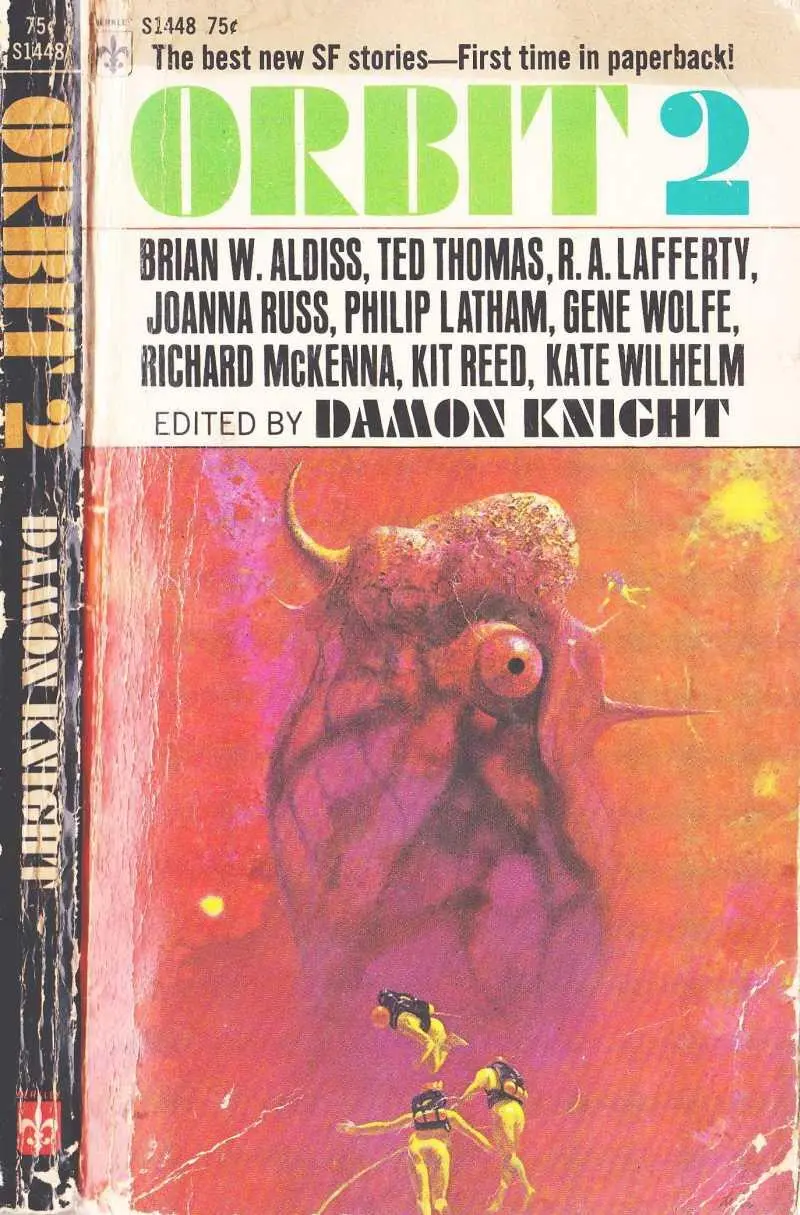
- Название:Orbit 2
- Автор:
- Издательство:Berkley Medallion
- Жанр:
- Год:1967
- ISBN:нет данных
- Рейтинг книги:3 / 5. Голосов: 1
-
Избранное:Добавить в избранное
- Отзывы:
-
Ваша оценка:
Orbit 2: краткое содержание, описание и аннотация
Предлагаем к чтению аннотацию, описание, краткое содержание или предисловие (зависит от того, что написал сам автор книги «Orbit 2»). Если вы не нашли необходимую информацию о книге — напишите в комментариях, мы постараемся отыскать её.
For each new volume, editor Damon Knight invites contributions from established SF authors as well as from new writers, and selects the best of the hundreds of submitted manuscripts.
Damon Knight is founder and first president of Science Fiction Writers of America, author of five SF novels, four collections of short stories and has edited fourteen SF anthologies.
Orbit 2 — читать онлайн бесплатно полную книгу (весь текст) целиком
Ниже представлен текст книги, разбитый по страницам. Система сохранения места последней прочитанной страницы, позволяет с удобством читать онлайн бесплатно книгу «Orbit 2», без необходимости каждый раз заново искать на чём Вы остановились. Поставьте закладку, и сможете в любой момент перейти на страницу, на которой закончили чтение.
Интервал:
Закладка:
“The machines will hunt them all down in time.”
“Don’t be so sure of that. They’re worse at detecting a werewolf than a man is.”
“I suppose you realize that’s social criticism, Cyfal?”
Cyfal pulled a long sour face and discourteously switched on his wristphone. After a moment, Balank did the same. The operator came up at once, and he asked to be switched to the news satellite.
He wanted to see something fresh on the current time exploration project, but there was nothing new on the files. He was advised to dial back in an hour. Looking over at Cyfal, he saw the.timber officer had tuned to a dance show of some sort; the cavorting figures in the little projection were badly distorted from this angle. He rose and went to the door of the hut.
The trundler stood outside, ever alert, ignoring him. An untrustworthy light lay over the clearing. Deep twilight reigned, shot through by the rays of the newly risen moon; he was surprised how fast the day had drained away.
Suddenly, he was conscious of himself as an entity, living, with a limited span of life, much of which had already drained away unregarded. The moment of introspection was so uncharacteristic of him that he was frightened. He told himself it was high time he traced down the werewolf and got back to the city: too much solitude was making him morbid.
As he stood there, he heard Cyfal come up behind. The man said, “I’m sorry if I was surly when I was so genuinely glad to see you. It’s just that I’m not used to the way city people think. You mustn’t take offense— I’m afraid you might even think I’m a werewolf myself.”
“That’s foolish! We took a blood spec on you as soon as you were within sighting distance.” For all that, he realized that Cyfal made him uneasy. Going to where the trundler guarded the door, he took up his laser gun and slipped it under his arm. “Just in case,” he said.
“Of course. You think he’s around — Gondalug, the werewolf? Maybe following you instead of you following him?”
“As you said, it’s full moon. Besides, he hasn’t eaten in days. They won’t touch synthfoods once the lycanthropic gene asserts itself, you know.”
“That’s why they eat humans occasionally?” Cyfal stood silent for a moment, then added, “But they are a part of the human race — that is, if you regard them as men who change into wolves rather than wolves who change into men. I mean, they’re nearer relations to us than animals or machines are.”
“Not than machines!” Balank said in a shocked voice. “How could we survive without the machines?”
Ignoring that, Cyfal said, “To my mind, humans are turning into machines. Myself, I’d rather turn into a werewolf.”
Somewhere in the trees, a cry of pain sounded and was repeated.
“Night owl,” Cyfal said. The sound brought him back to the present, and he begged Balank to come in and shut the door. He brought out some wine, which they warmed, salted, and drank together.
“The sun’s my clock,” he said, when they had been chatting for a while. “I shall turn in soon. You’ll sleep too?”
“I don’t sleep — I’ve a fresher.”
“I never had the operation. Are you moving on? Look, are you planning to leave me here all alone, the night of the full moon?” He grabbed Balank’s sleeve and then withdrew his hand.
“If Gondalug’s about, I want to kill him tonight. I must get back to the city.” But he saw that Cyfal was frightened and took pity on the little man. “But in fact I could manage an hour’s freshing — I’ve had none for three days.”
“You’ll take it here?”
“Sure, get your head down — but you’re armed, aren’t you?”
“It doesn’t always do you any good.”
While the little man prepared his bunk, Balank switched on his phone again. The news feature was ready and came up almost at once. Again Balank was plunged into a remote and terrible future.
The machines had managed to push their time exploration some eight million million years ahead, and there a deviation in the quanta of the electromagnetic spectrum had halted their advance. The reason for this was so far obscure and lay in the changing nature of the sun, which strongly influenced the time structure of its own minute comer of the galaxy.
Balank was curious to find if the machines had resolved the problem. It appeared that they had not, for the main news of the day was that Platform One had decided that operations should now be confined to the span of time already opened up. Platform One was the name of the machine civilization, many hundreds of centuries ahead in time, which had first pushed through the time barrier and contacted all machine-ruled civilizations before its own epoch.
What a disappointment that only the electronic senses of machines could shuttle in time! Balank would greatly have liked to visit one of the giant cities of the remote future.
The compensation was that the explorers sent back video pictures of that world to their own day. These alien landscapes produced in Balank a tremendous hunger for more; he looked in whenever he could. Even on the trail of the werewolf, which absorbed almost all his faculties, he had dialed for every possible picture of that inaccessible and terrific reality that lay distantly on the same time stratum which contained his own world.
As the first transmissions took on cubic content, Balank heard a noise outside the hut, and was instantly on his feet. Grabbing the gun, he opened the door and peered out, his left hand on the door jamb, his wristset still working.
The trundler sat outside, its senses ever-functioning, fixing him with an indicator as if in unfriendly greeting. A leaf or two drifted down from the trees; it was never absolutely silent here, as it could be in the cities at night; there was always something living or dying in the unmapped woods. As he turned his gaze through the darkness — but of course the trundler — and the werewolf, it was said — saw much more clearly in this situation than he did — his vision was obscured by the representation of the future palely gleaming at his cuff. Two phases of the same world were in juxtaposition, one standing on its side, promising an environment where different senses would be needed to survive.
Satisfied, although still wary, Balank shut the door and went to sit down and study the transmission. When it was over, he dialed a repeat. Catching his absorption, Cyfal from his bunk dialed the same program.
Above the icy deserts of Earth a blue sun shone, too small to show a disc, and from this chip of light came all terrestrial change. Its light was bright as full-moon’s light, and scarcely warmer. Only a few strange and stunted types of vegetation stretched up from the mountains toward it. All the old primitive kinds of flora had vanished long ago. Trees, for so many epochs one of the sovereign forms of Earth, had gone. Animals had gone. Birds had vanished from the skies. In the mountainous seas, very few life-forms protracted their existence.
New forces had inherited this later Earth. This was the time of the majestic auroras, of the near absolute-zero nights, of the years-long blizzards.
But there were cities still, their lights burning brighter than the chilly sun; and there were the machines.
The machines of this distant age were monstrous and complex things, slow and armored, resembling most the dinosaurs that had filled one hour of the Earth’s dawn. They foraged over the bleak landscape on their own ineluctable errands. They climbed into space, building there monstrous webbed arms that stretched far from Earth’s orbit, to scoop in energy and confront the poor fish sun with a vast trawler net of magnetic force.
In the natural course of its evolution, the sun had developed into its white dwarf stage. Its phase as a yellow star, when it supported vertebrate life, was a brief one, now passed through. Now it moved toward its prime season, still far ahead, when it would enter the main period of its life and become a red dwarf star. Then it would be mature, then it would itself be invested with an awareness countless times greater than any minor consciousnesses it nourished now. As the machines clad in their homed exoskeletons climbed near it, the sun had entered a period of quiescence to be measured in billions of years, and cast over its third planet the light of a perpetual full moon.
Читать дальшеИнтервал:
Закладка:
Похожие книги на «Orbit 2»
Представляем Вашему вниманию похожие книги на «Orbit 2» списком для выбора. Мы отобрали схожую по названию и смыслу литературу в надежде предоставить читателям больше вариантов отыскать новые, интересные, ещё непрочитанные произведения.


Обсуждение, отзывы о книге «Orbit 2» и просто собственные мнения читателей. Оставьте ваши комментарии, напишите, что Вы думаете о произведении, его смысле или главных героях. Укажите что конкретно понравилось, а что нет, и почему Вы так считаете.