Orbit 2
Здесь есть возможность читать онлайн «Orbit 2» весь текст электронной книги совершенно бесплатно (целиком полную версию без сокращений). В некоторых случаях можно слушать аудио, скачать через торрент в формате fb2 и присутствует краткое содержание. Год выпуска: 1967, Издательство: Berkley Medallion, Жанр: Фантастика и фэнтези, на английском языке. Описание произведения, (предисловие) а так же отзывы посетителей доступны на портале библиотеки ЛибКат.
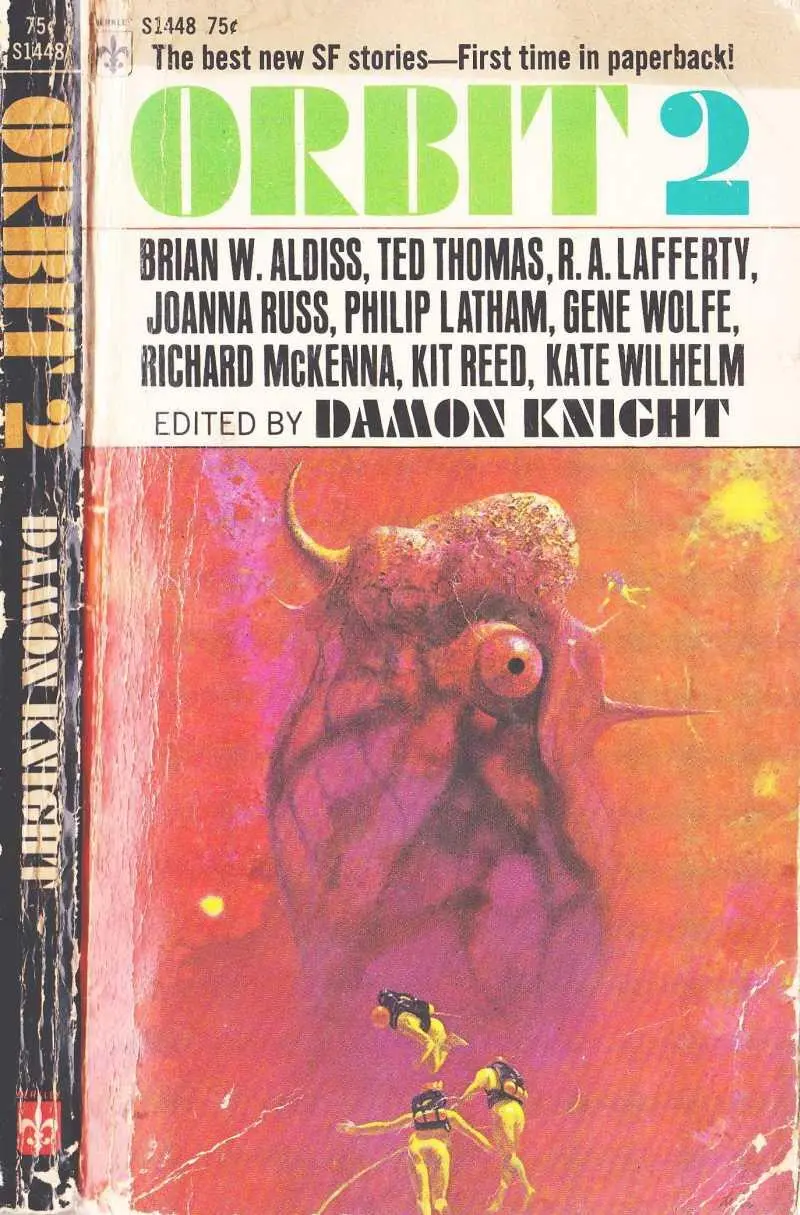
- Название:Orbit 2
- Автор:
- Издательство:Berkley Medallion
- Жанр:
- Год:1967
- ISBN:нет данных
- Рейтинг книги:3 / 5. Голосов: 1
-
Избранное:Добавить в избранное
- Отзывы:
-
Ваша оценка:
Orbit 2: краткое содержание, описание и аннотация
Предлагаем к чтению аннотацию, описание, краткое содержание или предисловие (зависит от того, что написал сам автор книги «Orbit 2»). Если вы не нашли необходимую информацию о книге — напишите в комментариях, мы постараемся отыскать её.
For each new volume, editor Damon Knight invites contributions from established SF authors as well as from new writers, and selects the best of the hundreds of submitted manuscripts.
Damon Knight is founder and first president of Science Fiction Writers of America, author of five SF novels, four collections of short stories and has edited fourteen SF anthologies.
Orbit 2 — читать онлайн бесплатно полную книгу (весь текст) целиком
Ниже представлен текст книги, разбитый по страницам. Система сохранения места последней прочитанной страницы, позволяет с удобством читать онлайн бесплатно книгу «Orbit 2», без необходимости каждый раз заново искать на чём Вы остановились. Поставьте закладку, и сможете в любой момент перейти на страницу, на которой закончили чтение.
Интервал:
Закладка:
You had to plug in; everybody that mattered was plugged in. It was our bond, our solace and our power, and it wasn’t a matter of being distracted, or occupying time. The sound was what mattered, that and the fact that fat or thin, asleep or awake, you were important when you plugged in, and you knew that through fire and flood and adversity, through contumely and hard times there was this single bond, this common heritage; strong or weak, eternally gifted or wretched and ill-loved, we were all plugged in.
Tommy, beautiful Tommy Fango, the others paled to nothing next to him. Everybody heard him in those days; they played him two or three times an hour but you never knew when it would be so you were plugged in and listening hard every living moment; you ate, you slept, you drew breath for the moment when they would put on one of Tommy’s records, you waited for his voice to fill the room. Cold cuts and cupcakes and game hens came and went during that period in my life, but one thing was constant; I always had a cream pie thawing and when they played the first bars of “When a Widow” and Tommy’s voice first flexed and uncurled, I was ready, Iwould eat the cream pie during Tommy’s midnight show. The whole world waited in those days; we waited through endless sunlight, through nights of drumbeats and monotony, we all waited for Tommy Fango’s records, and we waited for that whole unbroken hour of Tommy, his midnight show. He came on live at midnight in those days; he sang, broadcasting from the Hotel Riverside, and that was beautiful, but more important, he talked, and while he was talking he made everything all right. Nobody was lonely when Tommy talked; he brought us all together on that midnight show, he talked and made us powerful, he talked and finally he sang. You have to imagine what it was like, me in the night, Tommy, the pie. In a while I would go to a place where I had to live on Tommy and only Tommy, to a time when hearing Tommy would bring back the pie, all the poor lost pies. .
Tommy’s records, his show, the pie. . that was perhaps the happiest period of my life. I would sit and listen and I would eat and eat and eat. So great was my bliss that it became torture to put away the food at daybreak; it grew harder and harder for me to hide the cartons and the cans and the bottles, all the residue of my happiness. Perhaps a bit of bacon fell into the register; perhaps an egg rolled under the bed and began to smell. All right, perhaps I did become careless, continuing my revels into the morning, or I may have been thoughtless enough to leave a jelly roll unfinished on the rug. I became aware that they were watching, lurking just outside my door, plotting as I ate. In time they broke in on me, weeping and pleading, lamenting over every ice cream carton and crumb of pie; then they threatened. Finally they restored the food they had taken from me in the daytime, thinking to curtail my eating at night. Folly. By that time I needed it all, I shut myself in with it and would not listen. I ignored their cries of hurt pride, their outpourings of wounded vanity, their puny little threats. Even if I had listened, I could not have forestalled what happened next.
I was so happy that last day. There was a Smithfield ham, mine, and I remember a jar of cherry preserves, mine, and I remember bacon, pale and white on Italian bread. I remember sounds downstairs and before I could take warning, an assault, a company of uniformed attendants, the sting of a hypodermic gun. Then the ten of them closed in and grappled me into a sling, or net, and heaving and straining, they bore me down the stairs. I’ll never forgive you, I cried, as they bundled me into the ambulance. I’ll never forgive you, I bellowed as my mother in a last betrayal took away my radio, and I cried out one last time, as my father removed a hambone from my breast: I’ll never forgive you, And I never have.
It is painful to describe what happened next. I remember three days of horror and agony, of being too weak, finally, to cry out or claw the walls. Then at last I was quiet and they moved me into a sunny, pastel, chintz-bedizened room. I remember that there were flowers on the dresser and someone watching me.
“What are you in for?” she said.
I could barely speak for weakness. “Despair.”
“Hell with that,” she said, chewing. “You’re in for food.”
“What are you eating?” I tried to raise my head.
“Chewing. Inside of the mouth. It helps.”
“I’m going to die.”
“Everybody thinks that at first. I did.” She tilted her head in an attitude of grace. “You know, this is a very exclusive school.”
Her name was Ramona and as I wept silently, she filled me in. This was a last resort for the few who could afford to send their children here. They prettied it up with a schedule of therapy, exercise, massage; we would wear dainty pink smocks and talk of art and theater; from time to time we would attend classes in elocution and hygiene. Our parents would say with pride that we were away at Faircrest, an elegant finishing school; we knew better — it was a prison and we were being starved.
“It’s a world I never made,” said Ramona, and I knew that her parents were to blame, even as mine were. Her mother liked to take the children into hotels and casinos, wearing her thin daughters like a garland of jewels. Her father followed the sun on his private yacht, with the pennants flying and his children on the fantail, lithe and tanned. He would pat his flat, tanned belly and look at Ramona in disgust. When it was no longer possible to hide her, he gave in to blind pride. One night they came in a launch and took her away. She had been here six months now, and had lost almost a hundred pounds. She must have been monumental in her prime; she was still huge.
“We live from day to day,” she said. “But you don’t know the worst.”
“My radio,” I said in a spasm of fear. “They took away my radio.”
“There is a reason,” she said. “They call it therapy.”
I was mumbling in my throat, in a minute I would scream.
“Wait.” With ceremony, she pushed aside a picture and touched a tiny switch and then, like sweet balm for my panic, Tommy’s voice flowed into the room.
When I was quiet she said, “You only hear him once a day.”
“No.”
“But you can hear him any time you want to. You hear him when you need him most.”
But we were missing the first few bars and so we shut up and listened, and after “When a Widow” was over we sat quietly for a moment, her resigned, me weeping, and then Ramona threw another switch and the Sound filtered into the room, and it was almost like being plugged in.
“Try not to think about it.”
“I'll die.”
“If you think about it you will die. You have to learn to use it instead. In a minute they will come with lunch,” Ramona said and as The Screamers sang sweet background, she went on in a monotone: “A chop. One lousy chop with a piece of lettuce and maybe some gluten bread. I pretend it’s a leg of lamb, that works if you eat very, very slowly and think about Tommy the whole time; then if you look at your picture of Tommy you can turn the lettuce into anything you want, Caesar salad or a whole smorgasbord, and if you say his name over and over you can pretend a whole bombe or torte if you want to and.
“I’m going to pretend a ham and kidney pie and a watermelon filled with chopped fruits and Tommy and I are in the Rainbow Room and we’re going to finish up with Fudge Royale…” I almost drowned in my own saliva; in the background I could almost hear Tommy and I could hear Ramona saying, “Capon, Tommy would like capon, canard a l’orange, Napoleons, tomorrow we will save Tommy for lunch and listen while we eat. and I thought about that, I thought about listening and imagining whole cream pies and I went on, “. . lemon pie, rice pudding, a whole Edam cheese. . I think I’m going to live.”
Читать дальшеИнтервал:
Закладка:
Похожие книги на «Orbit 2»
Представляем Вашему вниманию похожие книги на «Orbit 2» списком для выбора. Мы отобрали схожую по названию и смыслу литературу в надежде предоставить читателям больше вариантов отыскать новые, интересные, ещё непрочитанные произведения.



Обсуждение, отзывы о книге «Orbit 2» и просто собственные мнения читателей. Оставьте ваши комментарии, напишите, что Вы думаете о произведении, его смысле или главных героях. Укажите что конкретно понравилось, а что нет, и почему Вы так считаете.