Orbit 2
Здесь есть возможность читать онлайн «Orbit 2» весь текст электронной книги совершенно бесплатно (целиком полную версию без сокращений). В некоторых случаях можно слушать аудио, скачать через торрент в формате fb2 и присутствует краткое содержание. Год выпуска: 1967, Издательство: Berkley Medallion, Жанр: Фантастика и фэнтези, на английском языке. Описание произведения, (предисловие) а так же отзывы посетителей доступны на портале библиотеки ЛибКат.
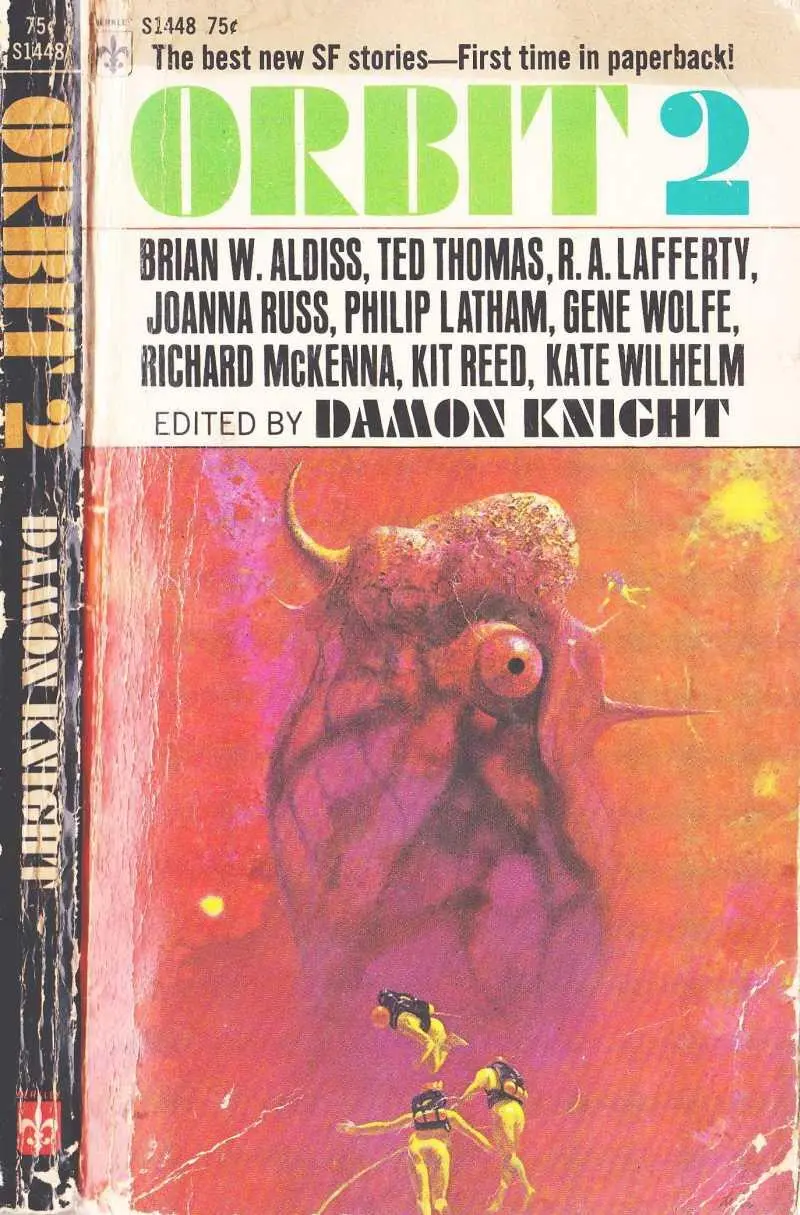
- Название:Orbit 2
- Автор:
- Издательство:Berkley Medallion
- Жанр:
- Год:1967
- ISBN:нет данных
- Рейтинг книги:3 / 5. Голосов: 1
-
Избранное:Добавить в избранное
- Отзывы:
-
Ваша оценка:
Orbit 2: краткое содержание, описание и аннотация
Предлагаем к чтению аннотацию, описание, краткое содержание или предисловие (зависит от того, что написал сам автор книги «Orbit 2»). Если вы не нашли необходимую информацию о книге — напишите в комментариях, мы постараемся отыскать её.
For each new volume, editor Damon Knight invites contributions from established SF authors as well as from new writers, and selects the best of the hundreds of submitted manuscripts.
Damon Knight is founder and first president of Science Fiction Writers of America, author of five SF novels, four collections of short stories and has edited fourteen SF anthologies.
Orbit 2 — читать онлайн бесплатно полную книгу (весь текст) целиком
Ниже представлен текст книги, разбитый по страницам. Система сохранения места последней прочитанной страницы, позволяет с удобством читать онлайн бесплатно книгу «Orbit 2», без необходимости каждый раз заново искать на чём Вы остановились. Поставьте закладку, и сможете в любой момент перейти на страницу, на которой закончили чтение.
Интервал:
Закладка:
In the seventh year before the time of which we speak, this woman, a neat, level-browed, governessy person called Alyx, had come to the City of Ourdh as part of a religious delegation from the hills intended to convert the dissolute citizens to the ways of virtue and the one true God, a Bang tree of awful majesty. But Alyx, a young woman of an intellectual bent, had not been in Ourdh two months when she decided that the religion of Yp (as the hill god was called) was a disastrous piece of nonsense, and that deceiving a young woman in matters of such importance was a piece of thoughtlessness for which it would take some weeks of hard, concentrated thought to think up a proper reprisal. In due time the police chased Alyx’s coreligionists down the Street of Heaven and Hell and out the swamp gate to be bitten by the mosquitoes that lie in wait among the reeds, and Alyx — with a shrug of contempt — took up a modest living as pick-lock, a profession that gratified her sense of subtlety. It provided her with a living, a craft and a society. Much of the wealth of this richest and vilest of cities stuck to her fingers but most of it dropped off again, for she was not much awed by the things of this world. Going their legal or illegal ways in this seventh year after her arrival, citizens of Ourdh saw only a woman with short, black hair and a sprinkling of freckles across her milky nose; but Alyx had ambitions of becoming a Destiny. She was thirty (a dangerous time for men and women alike) when this story begins. Yp moved in his mysterious ways, Alyx entered the employ of the Lady Edarra, and Ourdh saw neither of them again — for a while.
Alyx was walking with a friend down the Street of Conspicuous Display one sultry summer’s morning when she perceived a young woman, dressed like a jeweler’s tray and surmounted with a great coil of red hair, waving to her from the table of a wayside garden-terrace.
“Wonderful are the ways of Yp,” she remarked, for although she no longer accorded that deity any respect, yet her habits of speech remained. “There sits a redheaded young woman of no more than seventeen years and with the best skin imaginable, and yet she powders her face.”
“Wonderful indeed,” said her friend. Then he raised one finger and went his way, a discretion much admired in Ourdh. The young lady, who had been drumming her fingers on the tabletop and frowning like a fury, waved again and stamped one foot.
“I want to talk to you,” she said sharply. “Can’t you hear me?”
“I have six ears,” said Alyx, the courteous reply in such a situation. She sat down and the waiter handed her the bill of fare.
“You are not listening to me,” said the lady.
“I do not listen with my eyes,” said Alyx.
“Those who do not listen with their eyes as well as their ears,” said the lady sharply, “can be made to regret it!”
“Those,” said Alyx, “who on a fine summer’s morning threaten their fellow-creatures in any way, absurdly or otherwise, both mar the serenity of the day and break the peace of Yp, who,” she said, “is mighty.”
“You are impossible!” cried the lady. “Impossible!” and she bounced up and down in her seat with rage, fixing her fierce brown eyes on Alyx. “Death!” she cried. “Death and bones!” and that was a ridiculous thing to say at eleven in the morning by the side of the most wealthy and luxurious street in Ourdh, for such a street is one of the pleasantest places in the world if you do not watch the beggars. The lady, insensible to all this bounty, jumped to her feet and glared at the little pick-lock; then, composing herself with an effort (she clenched both hands and gritted her teeth like a person in the worst throes of marsh fever), she said — calmly—
“I want to leave Ourdh.”
“Many do,” said Alyx, courteously.
“I require a companion.”
“A lady’s maid?” suggested Alyx. The lady jumped once in her seat as if her anger must have an outlet somehow; then she clenched her hands and gritted her teeth with doubled vigor.
“I must have protection,” she snapped.
“Ah?”
“I’ll pay!” (This was almost a shriek.) “How?” said Alyx, who had her doubts.
“None of your business,” said the lady.
“If I’m to serve you, everything’s my business. Tell me. All right, how much?”
The lady named a figure, reluctantly.
“Not enough,” said Alyx. “Particularly not knowing how. Or why. And why protection? From whom? When?” The lady jumped to her feet. “By water?” continued Alyx imperturbably. “By land? On foot? How far? You must understand, little one—”
“Little one!” cried the lady, her mouth dropping open. “Little one!”
“If you and I are to do business—”
“I’ll have you thrashed—” gasped the lady, out of breath, “I’ll have you so—”
“And let the world know your plans?” said Alyx, leaning forward with one hand under her chin. The lady stared, and bit her lip, and backed up, and then she hastily grabbed her skirts as if they were sacks of potatoes and ran off, ribbons fluttering behind her. Wine-colored ribbons, thought Alyx, with red hair; that's clever. She ordered brandy and filled her glass, peering curiously into it where the hot, midmorning sun of Ourdh suffused into a winy glow, a sparkling, trembling, streaky mass of floating brightness. To (she said to herself with immense good humor) all the young ladies in the world, “And,” she added softly, “great quantities of money.”
At night Ourdh is a suburb of the Pit, or that steamy, muddy bank where the gods kneel eternally, making man; though the lights of the city never show fairer than then. At night the rich wake up and the poor sink into a distressed sleep, and everyone takes to the flat, whitewashed roofs. Under the light of gold lamps the wealthy converse, sliding across one another, silky but never vulgar; at night Ya, the courtesan with the gold breasts (very good for the jaded taste) and Garh the pirate, red-bearded, with his carefully cultivated stoop, and many many others, all ascend the broad, white steps to someone’s roof. Each step carries a lamp, each lamp sheds a blurry radiance on a tray, each tray is crowded with sticky, pleated, salt, sweet. . Alyx ascended, dreaming of snow. She was there on business. Indeed the sky was overcast that night, but a downpour would not drive the guests indoors; a striped silk awning with gold fringes would be unrolled over their heads, and while the fringes became matted and wet and water spouted into the garden below, ladies would put out their hands (or their heads — but that took a brave lady on account of the coiffure) outside the awning and squeal as they were soaked by the warm, mild, neutral rain of Ourdh. Thunder was another matter. Alyx remembered hill storms with gravel hissing down the gullies of streams and paths turned to cold mud. She met the dowager in charge and that ponderous lady said:
“Here she is.”
It was Edarra, sulky and seventeen, knotting a silk handkerchief in a wet wad in her hand and wearing a sparkling blue-and-green bib.
“That’s the necklace,” said the dowager. “Don’t let it out of your sight.”
“I see,” said Alyx, passing her hand over her eyes.
When they were left alone, Edarra fastened her fierce eyes on Alyx and hissed, “Traitor!”
“What for?” said Alyx.
“Traitor! Traitor! Traitor!” shouted the girl. The nearest guests turned to listen and then turned away, bored.
“You grow dull,” said Alyx, and she leaned lightly on the roof-rail to watch the company. There was the sound of angry stirrings and rustlings behind her. Then the girl said in a low voice (between her teeth), “Tonight someone is going to steal this necklace.”
Читать дальшеИнтервал:
Закладка:
Похожие книги на «Orbit 2»
Представляем Вашему вниманию похожие книги на «Orbit 2» списком для выбора. Мы отобрали схожую по названию и смыслу литературу в надежде предоставить читателям больше вариантов отыскать новые, интересные, ещё непрочитанные произведения.




Обсуждение, отзывы о книге «Orbit 2» и просто собственные мнения читателей. Оставьте ваши комментарии, напишите, что Вы думаете о произведении, его смысле или главных героях. Укажите что конкретно понравилось, а что нет, и почему Вы так считаете.