Elliot Ackerman - 2034
Здесь есть возможность читать онлайн «Elliot Ackerman - 2034» весь текст электронной книги совершенно бесплатно (целиком полную версию без сокращений). В некоторых случаях можно слушать аудио, скачать через торрент в формате fb2 и присутствует краткое содержание. Город: New York, Год выпуска: 2021, ISBN: 2021, Издательство: Penguin Press, Жанр: Фантастика и фэнтези, prose_military, на английском языке. Описание произведения, (предисловие) а так же отзывы посетителей доступны на портале библиотеки ЛибКат.
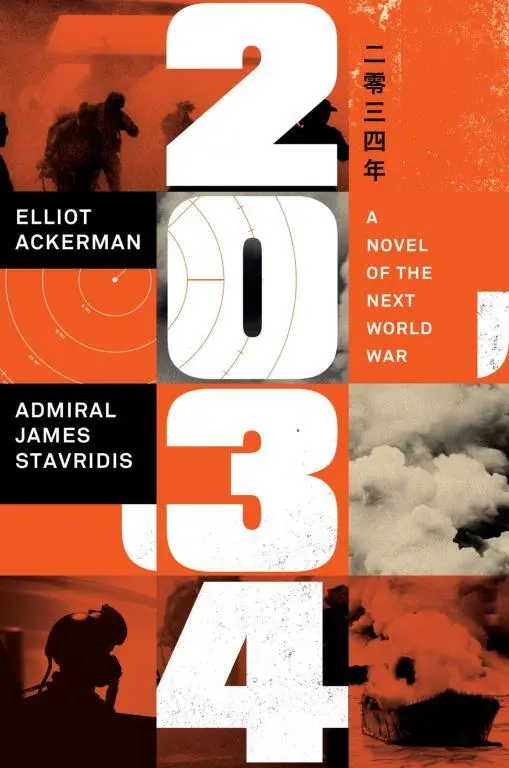
- Название:2034
- Автор:
- Издательство:Penguin Press
- Жанр:
- Год:2021
- Город:New York
- ISBN:978-1-98488-125-0
- Рейтинг книги:4 / 5. Голосов: 2
-
Избранное:Добавить в избранное
- Отзывы:
-
Ваша оценка:
2034: краткое содержание, описание и аннотация
Предлагаем к чтению аннотацию, описание, краткое содержание или предисловие (зависит от того, что написал сам автор книги «2034»). Если вы не нашли необходимую информацию о книге — напишите в комментариях, мы постараемся отыскать её.
, conducting a routine freedom of navigation patrol in the South China Sea when her ship detects an unflagged trawler in clear distress, smoke billowing from its bridge. On that same day, US Marine aviator Major Chris “Wedge” Mitchell is flying an F-35E Lightning over the Strait of Hormuz, testing a new stealth technology as he flirts with Iranian airspace. By the end of that day, Wedge will be an Iranian prisoner, and Sarah Hunt’s destroyer will lie at the bottom of the sea, sunk by the Chinese Navy. Iran and China have clearly coordinated their moves, which involve the use of powerful new forms of cyber weaponry that render US ships and planes defenseless. In a single day, America’s faith in its military’s strategic pre-eminence is in tatters. A new, terrifying era is at hand.
So begins a disturbingly plausible work of speculative fiction, co-authored by an award-winning novelist and decorated Marine veteran and the former commander of NATO, a legendary admiral who has spent much of his career strategically out maneuvering America’s most tenacious adversaries. Written with a powerful blend of geopolitical sophistication and literary, human empathy,
takes us inside the minds of a global cast of characters—Americans, Chinese, Iranians, Russians, Indians—as a series of arrogant miscalculations on all sides leads the world into an intensifying international storm. In the end, China and the United States will have paid a staggering cost, one that forever alters the global balance of power.
Everything in 2034 is an imaginative extrapolation from present-day facts on the ground combined with the authors’ years working at the highest and most classified levels of national security. Sometimes it takes a brilliant work of fiction to illuminate the most dire of warnings: 2034 is all too close at hand, and this cautionary tale presents the reader a dark yet possible future that we must do all we can to avoid.
2034 — читать онлайн бесплатно полную книгу (весь текст) целиком
Ниже представлен текст книги, разбитый по страницам. Система сохранения места последней прочитанной страницы, позволяет с удобством читать онлайн бесплатно книгу «2034», без необходимости каждый раз заново искать на чём Вы остановились. Поставьте закладку, и сможете в любой момент перейти на страницу, на которой закончили чтение.
Интервал:
Закладка:
The unanticipated event was a phone call to Lin Bao that came in from the South Sea Fleet Headquarters in Zhanjiang. That morning, a reconnaissance drone had spotted “a significant American naval force” sailing southward at approximately twelve knots toward the Spratly Islands, along a route that was often used for their so-called “freedom of navigation patrols.” Immediately after the drone observed the American ships, communications between it and the South Sea Fleet Headquarters cut off. It was the commander of the South Sea Fleet himself who had contacted the Central Military Commission. His question was simple: should he risk sending out another drone?
Before Lin Bao could offer a thought on the matter, there was a slight commotion in his workspace as Minister Chiang entered. The mid-level officers and junior sailors who served as clerks sprung to attention as the minister breezed past them, while Lin Bao himself stood, clutching his telephone’s receiver. He began to explain the situation, but Minister Chiang raised his outstretched palm, as if to save him the trouble. He already knew about the drone and what it’d seen. And he already knew his response, snatching the telephone’s receiver so that now Lin Bao was only privy to one side of the conversation.
“Yes… yes…” muttered Minister Chiang impatiently into the line. “I’ve already received those reports.”
Then the inaudible response.
“No,” answered Minister Chiang, “another flight is out of the question.”
Again, the inaudible response.
“Because you’ll lose that flight as well,” Minister Chiang replied tersely. “We’re preparing your orders now and will have them out within the hour. I’d recommend you recall all personnel on shore leave or otherwise. Plan to be busy.” Minister Chiang hung up. He took a single, exasperated breath. His shoulders slumped forward as if he were profoundly tired. He was like a father whose child has, once again, bitterly disappointed him. Then he looked up and with a transformed expression, as if energized for whatever task lay ahead, ordered Lin Bao to follow him.
They walked briskly through the vast corridors of the Defense Ministry, a small retinue of Minister Chiang’s staff trailing behind. Lin Bao wasn’t certain what Minister Chiang’s countermove would be if it wasn’t the deployment of another reconnaissance drone. They reached the same windowless conference room where they’d first met.
Minister Chiang assumed his position at the head of the table, leaning backward in his cushioned swivel chair, his palms resting on his chest, his fingers laced together. “I suspected this was what the Americans would do,” he began. “It is disappointingly predictable….” One of the underlings on Minister Chiang’s staff was setting up the secure video teleconference, and Lin Bao felt certain he knew with whom they’d soon be speaking. “By my estimation, the Americans have sent two carrier battle groups—the Ford and the Miller would be my guess—to sail right through our South China Sea. They are doing this for one reason and one reason alone: to prove that they still can. Yes, this provocation is certainly predictable. For decades, they have sent their ‘freedom of navigation patrols’ through our waters despite our protests. For just as long they have refused to recognize our claim over Chinese Taipei and insulted us in the UN with their insistence on calling it Taiwan. All the while we’ve endured these provocations. The country of Clint Eastwood, of Dwayne Johnson, of LeBron James, it can’t imagine a nation like ours would submit to such humiliations for any other reason but weakness….
“But our strength is what it has always been—our judicious patience. The Americans are incapable of behaving patiently. They change their government and their policies as often as the seasons. Their dysfunctional civil discourse is unable to deliver an international strategy that endures for more than a handful of years. They’re governed by their emotions, by their blithe morality and belief in their precious indispensability. This is a fine disposition for a nation known for making movies, but not for a nation to survive as we have through the millennia…. And where will America be after today? I believe in a thousand years it won’t even be remembered as a country. It will simply be remembered as a moment. A fleeting moment.”
Minister Chiang sat with his palms on the table, waiting. Across from him was the video teleconference, which hadn’t yet established its secure connection. He stared at the blank screen. His concentration was intense, as if willing an image of his own future to appear. And then the screen turned on. Ma Qiang stood on the bridge of the Zheng He , exactly as he’d done six weeks before. The only difference was the yellow, gold, and red ribbon with a star in its center fastened above the pocket of his fire-resistant coveralls: the Order of August First.
“Admiral Ma Qiang,” the minister began formally, “a reconnaissance flight from our South Sea Fleet has gone missing approximately three hundred nautical miles east of your current position.” Ma Qiang straightened up in the frame, his jaw set. It was obvious he understood the implications of such a disappearance. The minister continued, “Our entire constellation of satellites are now under your command. The Central Military Commission grants you all contingent authorizations.”
Ma Qiang nodded his head slowly, as if in deference to the great scope of the mission he was now set upon, which Lin Bao implicitly understood was no less than the destruction of two US carrier battle groups.
“Good luck.”
Ma Qiang nodded once again.
The connection switched off and the screen went blank. Although the conference room was far from empty, with various staff members entering and exiting, it was only Lin Bao and Minister Chiang sitting at the table. The minister stroked his smooth round chin, and for the first time that morning Lin Bao detected a hint of uncertainty in his expression.
“Don’t look at me like that,” said Minister Chiang.
Lin Bao averted his eyes. Perhaps his expression had betrayed his thoughts, which were that he was observing a man who had condemned thousands of other men to their deaths. Did any of them really think that their navy, despite its advanced cyber capability, was up to the task of destroying two US carrier battle groups? The Gerald R. Ford and Doris Miller sailed with a combined force of forty vessels. Destroyers armed with hypersonic missiles. Utterly silent attack submarines. Semisubmersible frigates. Guided missile cruisers with small, unmanned targeting drones and long-range land-attack hypersonic missiles. Each possessed the latest technology manned by the world’s most highly trained crews, all of it watched over by a vast constellation of satellites with deep offensive and defensive cyber capabilities. Nobody knew this better than Lin Bao, whose entire career had centered on his understanding of the United States Navy. He also understood the United States itself, the nation’s character. It was woefully misguided for the leaders of his country to believe diplomatic niceties could de-escalate a crisis in which one of their allies had taken an American pilot prisoner and in which their own navy had destroyed three American ships. Did leaders like Minister Chiang really believe that the Americans would simply cede freedom of navigation in the South China Sea? American morality, that slippery sensibility, which had so often led that country astray, would demand a response. Their reaction of returning with two carrier battle groups was completely predictable.
Minister Chiang insisted that Lin Bao sit beside him while all through that day a procession of subordinates entered and exited the conference room, receiving orders, issuing updates. The morning extended into the afternoon. The plan took shape. The Zheng He maneuvered into a blocking position south of the Spratly Island Chain, deploying in attack formation toward the last recorded position of the Ford and Miller. The American carrier battle groups would in all likelihood be able to get off a single salvo of weaponry before the Zheng He could disable their guidance systems. After that, the proverbial elephant would be blind. The American smart weapons would no longer be smart, not even dumb; they’d be brain-dead. Then the Zheng He , along with three surface action groups, would strike the Ford and Miller .
Читать дальшеИнтервал:
Закладка:
Похожие книги на «2034»
Представляем Вашему вниманию похожие книги на «2034» списком для выбора. Мы отобрали схожую по названию и смыслу литературу в надежде предоставить читателям больше вариантов отыскать новые, интересные, ещё непрочитанные произведения.












Обсуждение, отзывы о книге «2034» и просто собственные мнения читателей. Оставьте ваши комментарии, напишите, что Вы думаете о произведении, его смысле или главных героях. Укажите что конкретно понравилось, а что нет, и почему Вы так считаете.