Elliot Ackerman - 2034
Здесь есть возможность читать онлайн «Elliot Ackerman - 2034» весь текст электронной книги совершенно бесплатно (целиком полную версию без сокращений). В некоторых случаях можно слушать аудио, скачать через торрент в формате fb2 и присутствует краткое содержание. Город: New York, Год выпуска: 2021, ISBN: 2021, Издательство: Penguin Press, Жанр: Фантастика и фэнтези, prose_military, на английском языке. Описание произведения, (предисловие) а так же отзывы посетителей доступны на портале библиотеки ЛибКат.
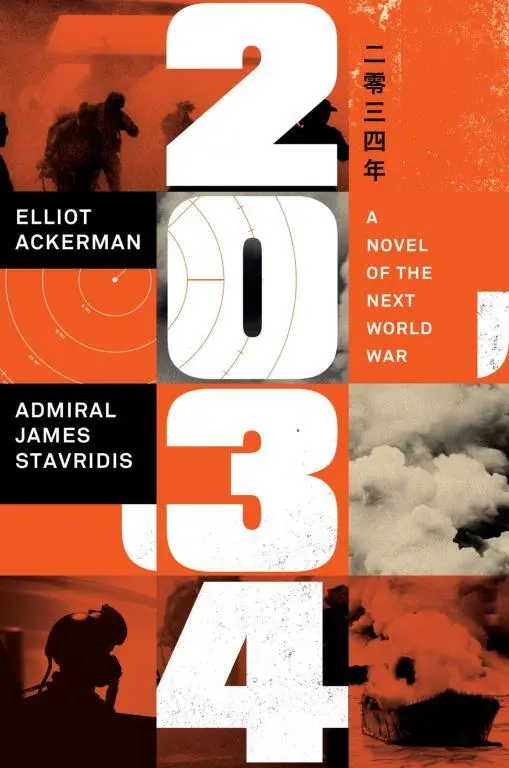
- Название:2034
- Автор:
- Издательство:Penguin Press
- Жанр:
- Год:2021
- Город:New York
- ISBN:978-1-98488-125-0
- Рейтинг книги:4 / 5. Голосов: 2
-
Избранное:Добавить в избранное
- Отзывы:
-
Ваша оценка:
2034: краткое содержание, описание и аннотация
Предлагаем к чтению аннотацию, описание, краткое содержание или предисловие (зависит от того, что написал сам автор книги «2034»). Если вы не нашли необходимую информацию о книге — напишите в комментариях, мы постараемся отыскать её.
, conducting a routine freedom of navigation patrol in the South China Sea when her ship detects an unflagged trawler in clear distress, smoke billowing from its bridge. On that same day, US Marine aviator Major Chris “Wedge” Mitchell is flying an F-35E Lightning over the Strait of Hormuz, testing a new stealth technology as he flirts with Iranian airspace. By the end of that day, Wedge will be an Iranian prisoner, and Sarah Hunt’s destroyer will lie at the bottom of the sea, sunk by the Chinese Navy. Iran and China have clearly coordinated their moves, which involve the use of powerful new forms of cyber weaponry that render US ships and planes defenseless. In a single day, America’s faith in its military’s strategic pre-eminence is in tatters. A new, terrifying era is at hand.
So begins a disturbingly plausible work of speculative fiction, co-authored by an award-winning novelist and decorated Marine veteran and the former commander of NATO, a legendary admiral who has spent much of his career strategically out maneuvering America’s most tenacious adversaries. Written with a powerful blend of geopolitical sophistication and literary, human empathy,
takes us inside the minds of a global cast of characters—Americans, Chinese, Iranians, Russians, Indians—as a series of arrogant miscalculations on all sides leads the world into an intensifying international storm. In the end, China and the United States will have paid a staggering cost, one that forever alters the global balance of power.
Everything in 2034 is an imaginative extrapolation from present-day facts on the ground combined with the authors’ years working at the highest and most classified levels of national security. Sometimes it takes a brilliant work of fiction to illuminate the most dire of warnings: 2034 is all too close at hand, and this cautionary tale presents the reader a dark yet possible future that we must do all we can to avoid.
2034 — читать онлайн бесплатно полную книгу (весь текст) целиком
Ниже представлен текст книги, разбитый по страницам. Система сохранения места последней прочитанной страницы, позволяет с удобством читать онлайн бесплатно книгу «2034», без необходимости каждый раз заново искать на чём Вы остановились. Поставьте закладку, и сможете в любой момент перейти на страницу, на которой закончили чтение.
Интервал:
Закладка:
No one stopped by.
The phone never rang.
It was only him.
So the weeks passed, until one morning he noticed that the single road that bordered his property was filled with military transports, even the occasional tracked vehicle. Their exhausts belched smoke. Beyond the line of trees that partially screened his house he could see them stuck in a traffic jam of their own creation as officers and noncommissioned officers barked orders at their drivers, trying to move things along. They seemed in a frenzy to reach their destination. Later that morning, as Farshad was leisurely filling a notebook with his memories, the phone rang, startling him so much that his pen skipped across the page.
“Hello,” he answered.
“Is this Brigadier Qassem Farshad?” came a voice he didn’t recognize.
“Who is this?”
The voice introduced itself quickly, as though its name were designed to be forgotten, and then informed the brigadier that the General Staff of the Armed Forces had ordered a mobilization of retired and reserve officers. Farshad was then given the address of a mustering office. The building was in a nondescript part of Isfahan, far from the military’s power centers in Tehran where he’d spent much of his career. Farshad finished transcribing the particulars of where he was to report, leaving his notes on a scrap of paper. He felt tempted to ask the voice for details about whatever incident had precipitated this mobilization, but he decided against it. He thought that he knew, or at least had an instinct. When Farshad asked if there was anything else, the voice said no, and wished him well.
Farshad set down the phone. He had a radio upstairs. He could’ve turned it on to find out specifically what had happened, but he didn’t want to, at least not yet. It was midday and he wanted to pack up his lunch, take his walk, and sit beneath his tree, as had become his custom. Farshad knew that if he didn’t report for duty there’d be no recourse. No one would dare say he hadn’t done enough for the Islamic Republic. A few weeks ago, his choice would’ve been an easy one; he would’ve packed his things and happily marched off to another war. But, surprisingly enough to him, he had come to appreciate this quieter life. He had even begun to imagine that he might settle here, in the country, with some measure of contentment.
He left the house for his walk.
His stride was loose, his pace quick.
Down the dirt-packed roads, past the fields of wildflowers, across the footbridge that traversed a stream of glacial melt, he walked and walked, much farther than he usually would on such a morning. Each breath filled his lungs and he felt strong, even at peace. He had no obligation to follow the orders given by the voice on the phone, at least no moral obligation. He had done enough. And if he died old in his bed, far greater soldiers than him had met that same humble fate. War had taken everything from him—first his father, and eventually his mother, who never recovered from that loss—and all that remained was this land that had belonged to his family. Why should war take this last measure of peace from him?
By the time Farshad reached his familiar tree, he was famished. He’d hiked nearly twice his usual distance. It was the first time in a long time that he could remember having such an appetite. With his back against the trunk of the tree, he ate. He savored each bite, angling his head upward as the blotchy sunlight filtered through the canopy of branches and fell onto his smiling face.
He was finished with his meal and on the cusp of a nap when the familiar pair of squirrels approached. He could feel the one, darker squirrel brush against his leg. When he opened his eyes, it was right there while the other, smaller squirrel, the female with the snow-white tail, lingered not far behind, watching. Farshad felt badly that he had no scrap of food to offer them. He brushed a few breadcrumbs off his shirt and placed them in his palm; it was the best he could do. The darker squirrel came closer than he had ever come before, perching on Farshad’s wrist while he dipped his head into Farshad’s cupped palm. Farshad was amazed. He didn’t think it possible that anything, particularly a squirrel, could be so unafraid of him, so trusting.
In his amazement, Farshad didn’t notice that the dark squirrel was hardly satisfied by meager crumbs. When the squirrel finished his little mouthful of food, he twitched his head toward Farshad and then, realizing that nothing else would be offered, sunk his teeth into Farshad’s palm.
Farshad didn’t flinch. He didn’t curse and drop the squirrel or clutch his palm to his chest. His reaction was different, but similarly reflexive. He snatched the dark squirrel around the body and squeezed. The squirrel’s mate, who had been waiting at a more cautious distance, began to run in frantic circles. Farshad squeezed harder. He couldn’t stop, even had he wanted to. And a part of him did want to stop, the same part of him that wanted to stay here, under this tree. Nevertheless, he squeezed so hard that his own blood, the blood from the bite, began to seep out from between his fingers. The dark squirrel’s body struggled and twitched.
Until it didn’t—until to Farshad it felt as though he were squeezing an empty sponge. He stood and dropped the dead squirrel by the roots of the tree.
Its mate ran to it and glanced up at Farshad, who looked over his shoulder in the direction from which he’d come. He walked slowly back to the house, back to the slip of paper with an address on it.

06:37 April 23, 2034 (GMT+8)
Beijing
Lin Bao’s new job, as the deputy commander for naval operations to the Central Military Commission, was a bureaucratic morass. Although the ministry was on a war footing, it only increased the intensity and frequency of the interminable staff meetings he needed to attend. Lin Bao often saw Minister Chiang at these meetings, but the minister had never again brought up Lin Bao’s request for command of the Zheng He , let alone any command. And Lin Bao had no license to raise the topic. On the surface his job was suitable and important, but privately he sensed that he was a long way from a return to sea duty. Ever since the Zheng He Carrier Battle Group’s great victory over the Americans, a panic had begun to grow within Lin Bao.
He couldn’t pinpoint it to one thing, but rather to a collection of annoyances, the mundane trivialities that can, at times, make life unbearable. As the military attaché to the United States, his position had been singular and of the greatest import. Now, while his nation faced its greatest military crisis in a generation, he was stuck commuting each morning to the Defense Ministry. He no longer had the driver he’d enjoyed in Washington. When his wife needed the car to drop their daughter at school, he was forced to carpool into work. Sandwiched in the back seat of a minivan between two short officers who spoke of nothing but basketball and whose careers had dead-ended long ago, he could not imagine ever standing on the bridge of his own carrier.
These weeks had brought only exaltation for Ma Qiang. It had been announced that for his actions he would receive the Order of August First, the greatest possible military honor. Once the award was conferred on Ma Qiang, Lin Bao knew it was highly unlikely that he would ever take command of the Zheng He . Whatever disappointment he felt was, however, tempered by his appreciation that their recent undertaking against the Americans had initiated events beyond any one person’s control.
And so Lin Bao continued his staff work. He continued to carpool into the ministry with officers he deemed inferior to himself. He never again brought up his ambition for command to Minister Chiang, and he could feel the mundane ferocity of time passing. Until it was soon interrupted—as it always is—by an unanticipated event.
Читать дальшеИнтервал:
Закладка:
Похожие книги на «2034»
Представляем Вашему вниманию похожие книги на «2034» списком для выбора. Мы отобрали схожую по названию и смыслу литературу в надежде предоставить читателям больше вариантов отыскать новые, интересные, ещё непрочитанные произведения.










Обсуждение, отзывы о книге «2034» и просто собственные мнения читателей. Оставьте ваши комментарии, напишите, что Вы думаете о произведении, его смысле или главных героях. Укажите что конкретно понравилось, а что нет, и почему Вы так считаете.