Ross King - Ex Libris
Здесь есть возможность читать онлайн «Ross King - Ex Libris» весь текст электронной книги совершенно бесплатно (целиком полную версию без сокращений). В некоторых случаях можно слушать аудио, скачать через торрент в формате fb2 и присутствует краткое содержание. Жанр: Фантастика и фэнтези, на английском языке. Описание произведения, (предисловие) а так же отзывы посетителей доступны на портале библиотеки ЛибКат.
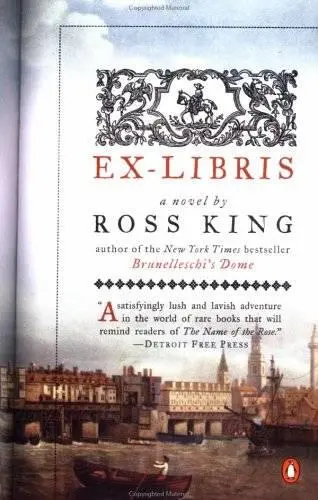
- Название:Ex Libris
- Автор:
- Жанр:
- Год:неизвестен
- ISBN:нет данных
- Рейтинг книги:3 / 5. Голосов: 1
-
Избранное:Добавить в избранное
- Отзывы:
-
Ваша оценка:
Ex Libris: краткое содержание, описание и аннотация
Предлагаем к чтению аннотацию, описание, краткое содержание или предисловие (зависит от того, что написал сам автор книги «Ex Libris»). Если вы не нашли необходимую информацию о книге — напишите в комментариях, мы постараемся отыскать её.
Ex Libris — читать онлайн бесплатно полную книгу (весь текст) целиком
Ниже представлен текст книги, разбитый по страницам. Система сохранения места последней прочитанной страницы, позволяет с удобством читать онлайн бесплатно книгу «Ex Libris», без необходимости каждый раз заново искать на чём Вы остановились. Поставьте закладку, и сможете в любой момент перейти на страницу, на которой закончили чтение.
Интервал:
Закладка:
I arrived in the Rolls Chapel that morning, still in disguise, after a fruitless trip to Pulteney House, which had looked dark and deserted. I explained my mission to a clerk seated at a desk by the baptismal font, who informed me with a sneer that what I wanted was impossible, for all of the clerks superintending the Close Rolls were, I must understand, very busy at the minute. No one could requite my desire, he explained, for another few days at least.
'The Act of Indemnity and Oblivion,' he explained with a shrug of his narrow shoulders.
'I beg your pardon?'
'The land settlements,' he said in a tone of derisive hauteur. 'The clerks are researching land entitlements so the estates confiscated by Parliament can be restored to their rightful owners.'
'But that's why I'm here!'
'Is it, indeed?' He peered over the edge of his desk, giving me a frank scrutiny from head to toe, quite rightly sceptical, I suppose, that a person of such a humble and even shabby aspect could have any possible connection with an aristocratic estate, confiscated or not. 'Well, you will just have to wait your turn like everyone else.' He nodded at the slumping gallery of Cavaliers. Then slowly his eyes returned to me. 'Unless, that is, of course…'
The fellow had coughed delicately into his tiny lace-beruffed hand and tossed a furtive glance in the direction of the chancel. With a mental sigh I reached for a shilling. I knew, of course, that greed was essential to a lawyer's craft, but I had not realised that the vice had filtered down to their clerks as well. When the coin was granted only a dubious glance I was forced to add another. Both coins were conjured into thin air. He returned his gaze to the papers on his desk.
'Be seated over there, please.'
Then, for a whole hour, nothing. Two suits were heard in the chancel and their plaintiffs dismissed. Clerks and lawyers shuffled to and fro, rootling among the volumes on the pews or in the vestry to my right. The brilliant garden of light crept slowly across the flagstones until it almost reached the toes of my boots, which, as of old, were tapping impatiently at the padded prie-dieu on the floor in front of me. At last I heard my name called and, looking up, saw a clerk, a thin young fellow, standing in the tiny door to the bell-tower.
'You may see the enrolments now, if you please,' the clerk at the desk informed me. 'Mr. Spicer will show you the way.'
The climb was a difficult one. There was no hand-rail other than a frayed rope, and so narrow was the stairwell that my shoulder rubbed against the sandstone newel at every step. I twisted round it and ascended in pursuit of the nimble Mr. Spicer, but after a dozen steps I imagined the tons of stone pressing in upon me and felt the same freezing tremors of panic as in my priest-hole a few days earlier. I have always detested enclosed spaces, which remind me, I suppose, of that eternal confinement shortly to claim me. To make matters worse, young Mr. Spicer saw no need for a candle, and so I was forced to wriggle upwards through a musty darkness relieved only by the occasional arrow-slit window.
Panting heavily, I reached the top at last to find Spicer waiting in a small hexagonal room. I realised at once why he had not lit a candle on the way up, for the room was stacked with sheaves of parchment, some of which had been sewn head to foot and rolled into fat spools several feet in diameter. Scattered about, and so numerous that they took up most of the floor space, were dozens of wooden boxes from which protruded even more parchments, some of them sallowed, others new.
My eyes flitted over the rolls and boxes, over the parchment tags with their bright seals of wax hanging down like tassels. It was the world of my father the scrivener. But I was intrigued by the sight for a quite different reason, for I knew that the answer to my persecutor's identity would be here among these documents. How many documents had I studied thus far in search of answers? Rate-books, patents, parish registers, auction catalogues, editions of the Corpus hermeticum and tales of Raleigh's voyage-all of which had led me further and further astray. But now at long last I was about to discover the truth. It would be inscribed here, I knew, somewhere among these parchments.
'Every last will, patent, writ and charter in the country is enrolled here,' Spicer was explaining with some pride as he caught my transfixed gaze. 'These documents are the overflow from the crypt and vestry. In the crypt there are already more than 75,000 parchments of them on something like a thousand rolls.'
He picked his way to his desk and stooped to scrape open a deep drawer, from which he removed, with an exaggerated grunt, an enormous folio bound in leather. It must have been a good foot thick.
'I am a busy man,' he sighed, taking his seat, 'as I hope you will appreciate. So if you wouldn't mind…'
'Yes, yes. Of course. I shall come straight to the business.' I stepped forward, leaning on my stick. 'I'm in search of a title deed.'
'You and everyone else,' he muttered under his breath. Then with a creak of leather he opened the cover of the cartulary and took up his magnifying lens. 'Very well. A title deed.' He licked his thumb and riffled through the heavy pages. 'What year was it enrolled? The season would be helpful too, if you can. Summer? Autumn?'
'Ah, well… now there, I fear, is the rub.' I attempted an ingratiating smile. 'I'm not quite certain when the transaction took place.'
'Is that so. Well, what is the name of the purchaser, might I ask?'
'Another rub, I fear.' I hoisted my smile a little higher. 'That is precisely what I'm hoping to find, you see-the name of whoever owns the property.'
'But you have no date of purchase? Not even a rough guess? No? Well then,' he said through pursed, renunciatory lips as I shook my head, 'you have rather put the cart before the ass, if you don't mind me saying so. You must know one or the other, the name or the date. Surely you can understand that.' The enormous cover, held ajar, creaked again and then fell shut with a gentle thud. 'As I say, Mr. Inchbold, I am a busy man.' He was stooped over again, replacing the cartulary in its drawer. 'I trust you can find your own way down the stairs.'
'No-wait.' I was not going to be dismissed that easily. 'I have a name for you,' I said. 'Two names, if you please.'
Yet Spicer was unable to find mention in his book of any property in Huntingdonshire belonging to either Sir Richard Overstreet-the first name I had him search for among the tidy columns that ran up and down the rag-paper pages-or Henry Monboddo. However, he eventually discovered in his cartulary a record for a property in the name of someone named not Henry, but Isabella, Monboddo. Almost an hour had passed by this time. I was leaning forward, trying to read upside-down the print that someone, one of Mr. Spicer's predecessors, had inscribed in a neat chancery hand. The house was a jointure, he explained in a bored monotone, settled on Isabella by her husband who was named-yes, yes-Henry Monboddo. He bent forward with his nose pressed to the reading-glass. A freehold estate named Wembish Park.
'That's it,' I stammered. 'Yes, that's-'
'The jointure was granted,' he continued as if oblivious, 'in a will made by Henry Monboddo in the year 1630. Since then it has been compounded by Parliament, later confiscated, then restored to its owner under the terms of the Act of Indemnity and Oblivion.'
'Restored to Isabella Monboddo?'
'That is correct. She is described as the relict of Henry Monboddo.'
'The relict? But when did Monboddo die?'
'These are not parish records, Mr. Inchbold. The cartulary does not tell us such things.'
'Of course,' I murmured placatingly. I was trying to make sense of the information. Monboddo dead? Did Alethea not know? I leaned forward even further. 'So… Isabella Monboddo is the owner of the estate?'
Читать дальшеИнтервал:
Закладка:
Похожие книги на «Ex Libris»
Представляем Вашему вниманию похожие книги на «Ex Libris» списком для выбора. Мы отобрали схожую по названию и смыслу литературу в надежде предоставить читателям больше вариантов отыскать новые, интересные, ещё непрочитанные произведения.









Обсуждение, отзывы о книге «Ex Libris» и просто собственные мнения читателей. Оставьте ваши комментарии, напишите, что Вы думаете о произведении, его смысле или главных героях. Укажите что конкретно понравилось, а что нет, и почему Вы так считаете.