Robert Sawyer - Frameshift
Здесь есть возможность читать онлайн «Robert Sawyer - Frameshift» весь текст электронной книги совершенно бесплатно (целиком полную версию без сокращений). В некоторых случаях можно слушать аудио, скачать через торрент в формате fb2 и присутствует краткое содержание. Год выпуска: 1998, ISBN: 1998, Издательство: Tor Science Fiction, Жанр: Фантастика и фэнтези, на английском языке. Описание произведения, (предисловие) а так же отзывы посетителей доступны на портале библиотеки ЛибКат.
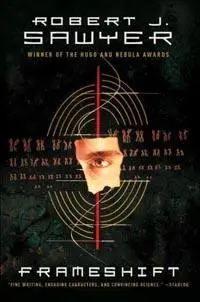
- Название:Frameshift
- Автор:
- Издательство:Tor Science Fiction
- Жанр:
- Год:1998
- ISBN:0-812-57108-8
- Рейтинг книги:4 / 5. Голосов: 1
-
Избранное:Добавить в избранное
- Отзывы:
-
Ваша оценка:
Frameshift: краткое содержание, описание и аннотация
Предлагаем к чтению аннотацию, описание, краткое содержание или предисловие (зависит от того, что написал сам автор книги «Frameshift»). Если вы не нашли необходимую информацию о книге — напишите в комментариях, мы постараемся отыскать её.
Frameshift — читать онлайн бесплатно полную книгу (весь текст) целиком
Ниже представлен текст книги, разбитый по страницам. Система сохранения места последней прочитанной страницы, позволяет с удобством читать онлайн бесплатно книгу «Frameshift», без необходимости каждый раз заново искать на чём Вы остановились. Поставьте закладку, и сможете в любой момент перейти на страницу, на которой закончили чтение.
Интервал:
Закладка:
CCA form 16, or 4,096 nucleotides; and the CCG form moved it l6, or 3 4
65,536 nucleotides.
Other synonyms performed different jobs: GAA and GAG both made glutamine, but they also set the direction of the splicing cursor’s movement. GAG set it moving to the “left” (in the direction leading from the three-prime carbon to the five-prime carbon in each deoxyribose), and GAA set it moving to the “right” (the five-prime to three-prime direction).
Meanwhile, TTT, which made phenylalanine, coded for a nucleotide insertion, while its synonym TTC was the instruction for a nucleotide deletion. And the four codons that made threonine — ACA, ACC, ACG, and ACT — indicated by their final letter which nucleotide would be inserted at the splicing cursor.
The coding based on synonyms moved the cursor, but the timing of when frameshifts would be invoked was governed by certain of the seemingly endless stuttering sequences in the junk DNA. On the smaller scale of the individual, it had already been demonstrated that the number of CAG stutters set the age at which Huntington’s would first manifest itself, and, as Pierre had pointed out to Molly, the number of repeats does change from generation to generation in a phenomenon called “anticipation” — an ironically prophetic name given what Pierre and Shari’s model showed.
Indeed, the computer simulation suggested promising lines of research into manipulating genetic timers — research that ultimately might cure Huntington’s and related ailments. Certainly, no sudden breakthrough was likely, but, at a guess, inside a decade, controlling individual aberrant genetic timers might be possible. It had come full circle: by deliberately choosing not to pursue Huntington’s research, Pierre might have, in fact, made the discovery that would eventually lead to a cure for the disease.
If that had been all that his research suggested, he might have been pleased intellectually, but still profoundly sad, crushed by the cruel irony: after all, anything but an immediate cure would be too late to help Pierre Jacques Tardivel.
But Pierre didn’t feel sadness. On the contrary, he was elated, for the genetic timers pointed to something beyond his personal problems, beyond the problems — however real, however poignant — of the one in ten thousand people who had Huntington’s. The timers pointed to a truth, a fundamental revelation, that affected every one of the five billion human beings now alive, every one of the billions who had come before, and every one of all the untold trillions of humans yet to be born.
According to the simulation, the DNA timers, incrementing generation by generation through genetic anticipation, could go off across whole populations almost simultaneously. The multiregionalists were more right than they’d ever guessed: Pierre’s research proved that preprogrammed evolutionary steps could take place across vast groups of beings all at once.
A quote came to Pierre, from — of course — a Nobel laureate. The French philosopher Henri Bergson had written in his 1907 work Creative Evolution that “the present contains nothing more than the past, and what is found in the effect was already in the cause.” The junk DNA was a language, just as that article Shari had found had suggested: the language in which the master plan for life had been written by its designer. Pierre’s heart was pounding with excitement, and adrenaline was coursing through his system, but finally he drifted off to sleep, the printout still resting on his chest, dreaming of the hand of God.
Molly pushed the office door open and barged in. “Dr. Klimus, I—”
“Molly, I’m very busy—”
“Too busy to talk about Myra Tottenham?”
Klimus looked up. Somebody else was passing by in the corridor. “Close the door.”
Molly did so and sat down. “Shari Cohen and I have just spent a day at Stanford going through Myra’s papers; they’ve got stacks of them in their archives.”
Klimus managed a weak grin. “Universities love paper.”
“Indeed they do. Myra Tottenham was working on ways to speed up nucleotide sequencing when she died.”
“Was she?” said Klimus. “I really don’t know what this has to do—”
“It has everything to do with you, Burian. Her technique — involving specialized restriction enzymes — was years ahead of what others were doing.”
“What does a psychologist possibly know about DNA research?”
“Not much. But Shari tells me that what she was doing was close to what we now call the Klimus Technique — the very same technique for which you won the Nobel Prize. We looked through your old papers at Stanford, too. You were flailing about in completely the wrong direction, trying to use direct ion-charging of nucleotides as a sorting technique—”
“It would have worked—”
“Would have worked in a universe where free hydrogen didn’t bond to everything in sight. But here it was a blind alley — a blind alley you didn’t abandon until just after Myra Tottenham died.”
There was a long, long pause. Finally: “The Nobel committee is very reluctant to award prizes posthumously,” said Klimus, as if that justified everything.
Molly crossed her arms in front of her chest. “I want your notebooks on Amanda. And I want your word that you will never try to see her again.”
“Ms. Bond—”
“Amanda is my daughter — mine and Pierre’s. In every way that matters, that’s the whole and complete truth. You will never bother us again.”
“But—”
“No buts. Give me the notebooks now.”
“I — I need some time to get them all together.”
“Time to photocopy them, you mean. Not on your life. I’ll go with you wherever you want in order to get them, but I’m not letting you out of my sight until I’ve found and burned them all.”
Klimus sat still for several seconds, thinking. The only sound was the soft whir of an electric clock. “You are one hard bitch,” he said at last, opening his lower-left desk drawer and pulling out a dozen small spiral-bound notebooks.
“No, I’m not,” said Molly, gathering them up. “I’m simply my daughter’s mother.”
Four months had passed. As she walked slowly across the lab, Shari Cohen looked like she’d rather be anywhere else in the world. Pierre was sitting on a lab stool. “Pierre,” she said, “I — I don’t know how to tell you this, but your most recent test results are…” She looked away. “I’m sorry, Pierre, but they’re wrong.”
Pierre lifted a shaking arm. “Wrong?”
“You botched the fractionation. I’m afraid I’m going to have to redo it.”
Pierre nodded. “I’m sorry. I — I get confused sometimes.”
Shari nodded as well. Her upper lip was trembling. “I know.” She was quiet for a long, long time. Then: “Maybe it’s time, Pierre, for you—”
“No.” He said it as firmly as he could. He held his trembling hands out in front of him, as if to ward off her words. “No, don’t ask me to stop coming into the lab.” He exhaled in a long, shuddery sigh. “Maybe you’re right — maybe I can’t do the complex stuff anymore. But you have to let me help.”
“I can carry on our work,” Shari said. “I can finish our paper.” She smiled. Their paper would blow people’s socks off. “They’ll remember you,
Pierre — not just in the same breath as Crick and Watson, but as Darwin, too. He told us where we came from, and you’ve told us where we’re going.”
She paused, contemplating. Pierre’s most recent discovery — probably, it was sad to say, his final discovery — was the DNA sequence that apparently governed the lowering of the hyoid bone in the throat, a sequence that was shifted out in Hapless Hannah’s DNA, but shifted in within that of Homo sapiens sapiens . And he’d shown Shari a DNA sample with the telepathic frameshift shifted in, although she didn’t know to whom it belonged, and only half believed Pierre’s assertions about what it was for.
Читать дальшеИнтервал:
Закладка:
Похожие книги на «Frameshift»
Представляем Вашему вниманию похожие книги на «Frameshift» списком для выбора. Мы отобрали схожую по названию и смыслу литературу в надежде предоставить читателям больше вариантов отыскать новые, интересные, ещё непрочитанные произведения.

Обсуждение, отзывы о книге «Frameshift» и просто собственные мнения читателей. Оставьте ваши комментарии, напишите, что Вы думаете о произведении, его смысле или главных героях. Укажите что конкретно понравилось, а что нет, и почему Вы так считаете.