Robert Sawyer - Frameshift
Здесь есть возможность читать онлайн «Robert Sawyer - Frameshift» весь текст электронной книги совершенно бесплатно (целиком полную версию без сокращений). В некоторых случаях можно слушать аудио, скачать через торрент в формате fb2 и присутствует краткое содержание. Год выпуска: 1998, ISBN: 1998, Издательство: Tor Science Fiction, Жанр: Фантастика и фэнтези, на английском языке. Описание произведения, (предисловие) а так же отзывы посетителей доступны на портале библиотеки ЛибКат.
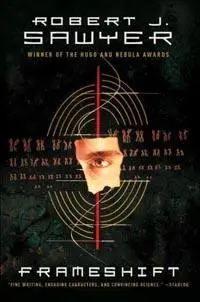
- Название:Frameshift
- Автор:
- Издательство:Tor Science Fiction
- Жанр:
- Год:1998
- ISBN:0-812-57108-8
- Рейтинг книги:4 / 5. Голосов: 1
-
Избранное:Добавить в избранное
- Отзывы:
-
Ваша оценка:
Frameshift: краткое содержание, описание и аннотация
Предлагаем к чтению аннотацию, описание, краткое содержание или предисловие (зависит от того, что написал сам автор книги «Frameshift»). Если вы не нашли необходимую информацию о книге — напишите в комментариях, мы постараемся отыскать её.
Frameshift — читать онлайн бесплатно полную книгу (весь текст) целиком
Ниже представлен текст книги, разбитый по страницам. Система сохранения места последней прочитанной страницы, позволяет с удобством читать онлайн бесплатно книгу «Frameshift», без необходимости каждый раз заново искать на чём Вы остановились. Поставьте закладку, и сможете в любой момент перейти на страницу, на которой закончили чтение.
Интервал:
Закладка:
It hit with a horrible clanging sound. The helicopter began vibrating, tipping toward the building, and—
—the blades touched glass, sending a shower of sparkling shards down toward the ground below—
—and then the blades began slicing through the metal frame of the curtain wall between two windows, dicing the metal into small fragments, sparks flying everywhere as each successive pass brought the blades into contact at a slightly different angle.
The copter was traveling forward now, and the rotor disk hit the wall between adjacent offices, the tips of the blades splintering the redwood paneling with a buzz-saw sound, then digging into the concrete firewall behind. The tips of the rotor were immediately ground off, and more and more of them sheared away with each revolution, the blades shortening, metal bits flying like confetti.
Then the jagged edge of the rotor dug into the concrete, sending powdery chunks of it airborne until, with a shriek of tortured metal, the rotor came to a dead halt.
The copter tipped forward again, the bird itself now rotating slowly clockwise, its tail rotor swinging into the side of the building, more windows shattering and office furniture splintering.
The copter’s turbines were screaming; smoke poured from the engine compartment and flames shot from the exhausts. The cockpit tipped forward, and the whole vehicle began to drop, story after story after story.
Pierre could see people far below scattering, trying to get out of its way.
Pierre heard footfalls, all but drowned out by the thunder of the police copter. Avi was running across the rooftop.
Sousa’s chopper continued to fall, almost as if in slow motion, its foreshortened blades now revolving lamely, providing a small amount of lift. It passed floor after floor, diminishing in apparent size, until—
Hitting the pavement like an egg, metal and glass splashing everywhere —
—and then, like a flower opening, flames expanding outward from the crash as the copter’s fuel exploded. Soon a pillar of black smoke rose up to the fortieth floor and beyond.
The SFPD copter circled around, surveying the scene, then descended for a landing in the far parking lot.
Pierre looked down at the inferno below, ringed by spectators, illuminated by low, red sunlight and roaring flames reflecting off the windows, and by revolving lights on the police cars. At long, long last, Ivan Grozny was dead.
Pierre staggered back a step, turned around, and collapsed in agony against the short wall around the roof’s edge.
“Are you okay?” asked Avi, leaning in to look at him after seeing his fill of the carnage below.
Pierre’s hands were on his shattered knee again. The pain was incredible, like daggers being jackhammered into his leg. Wincing, he shook his head.
Avi flipped open his cellular phone. “Meyer here. We need medics on the roof right away.”
Another OSI agent appeared from the stairwell — but this one wasn’t out of breath. He jogged over to Avi and Pierre. “We’ve got one of the elevators working again,” he said. “They were all locked off on the fortieth floor, but with the fireman’s key we were able to reactivate one of them once we pried its door open.”
“What happened?” asked Avi.
The agent glanced briefly at Pierre, then looked back at Avi. “It seems a crowbar was dropped from up here into the blades of the helicopter. It caused it to crash.”
Avi nodded and then waved the agent away. When they were alone, he leaned in to Pierre, holding Pierre’s shoulders with his arms. “Did you drop the crowbar?”
Pierre said nothing.
Avi exhaled. “Damn it, Pierre — we don’t cut corners in the OSI. Not anymore. Danielson hadn’t even been charged yet.”
Pierre shrugged slightly. ‘“Justice,”’ he said, his breath coming out raggedly as he quoted another Nobel laureate — at that precise moment, he couldn’t remember which one — ‘“is always delayed and finally done only by mistake.’” He took his right hand off his knee and held it up in the air.
Although they were sheltered from the wind here by the low wall, his arm moved back and forth as if blown by a breeze only it could feel. “Blame it,” said Pierre, “on my Huntington’s.”
Avi’s eyes narrowed and then he nodded, turned, and leaned back against the wall, exhausted not just by the climb but also by years of chasing Ivans and Adolphs and Heinrichs. He closed his eyes and exhaled slowly, waiting for the medics to arrive.
Chapter 42
As soon as visiting hours began, Molly came into Pierre’s room at San Francisco General Hospital. Pierre looked up at her from the bed. The left side of his face was bandaged, and his legs were in traction.
“Hi, honey,” said Molly.
“Hi, sweetheart,” said Pierre. He gestured at all the equipment hooked up to him. “After you left yesterday, somebody said my total hospital bill is going to be in the neighborhood of two hundred thousand dollars.” He managed a grin. “I’m sure glad Tiffany talked me into the Gold Plan.”
“I brought you a newspaper,” said Molly, pulling a copy of the San Francisco Chronicle out of the canvas bag she was carrying.
“Thanks, but I don’t feel much like reading.”
Molly said, “Then let me read it to you. There’s a front-page story by that man we met, Barnaby Lincoln.”
“Really?”
“Uh-huh.” She cleared her throat. “ ‘Officials from the California State Insurance Board, escorted by eight state troopers, today seized control of Condor Health Insurance, Inc., of San Francisco, in the wake of startling revelations made last week. ”Condor is out of business, as of today,“ said Clark Finchurst, State Insurance Commissioner. ”The industry’s emergency fund, which was established to handle such things, will take care of current claims until Condor’s policies can be handed over in an orderly fashion to other insurers.“ ’ ”
“All right!” said Pierre.
“It says there’s going to be a full inquiry. Craig Bullen is cooperating with the authorities.”
“Good for him.”
“Oh, and I picked up that printout you wanted.” She took a two-inch-thick pile of fanfold computer paper out of her bag and placed it on the table beside his bed.
“Thanks,” said Pierre.
Molly sat down on the edge of the bed and took one of Pierre’s dancing hands in hers. “I love you,” she said.
“And I love you, too,” said Pierre, squeezing her hand. “I love you more than words can say.”
Pierre lay in his hospital bed that night. His six minutes of CPU time on LBNL’s Cray supercomputer had at last become available, and the simulation he and Shari had coded had finally been run. Pierre started wading through the 384 pages of printout.
When he was done, he operated the hand control that lowered the motorized back of his bed. He stared at the ceiling.
It made sense. It all fit.
The existence of codon synonyms did indeed allow additional information to be superimposed on the standard A, C, G, T genetic code.
Yes, AAA and AAG both made lysine, but the AAA form also coded a zero into what Shari had already dubbed, in a note jotted in the margin, “the gatekeeper function,” which governed the correction or invocation of frameshift mutations. Meanwhile, the AAG version coded a one.
But that was just the tip of the iceberg. There were four valid codons that made proline: CCA, CCC, CCG, and CCT. For these, the final letter indicated a base-sixteen order of magnitude shift of the splicing cursor, which marked the position where a nucleotide would be added or deleted from the DNA, causing a frameshift. The CCT form moved the cursor sixteen nucleotides; the CCC form moved it 16, or 256 nucleotides; the 2
Читать дальшеИнтервал:
Закладка:
Похожие книги на «Frameshift»
Представляем Вашему вниманию похожие книги на «Frameshift» списком для выбора. Мы отобрали схожую по названию и смыслу литературу в надежде предоставить читателям больше вариантов отыскать новые, интересные, ещё непрочитанные произведения.

Обсуждение, отзывы о книге «Frameshift» и просто собственные мнения читателей. Оставьте ваши комментарии, напишите, что Вы думаете о произведении, его смысле или главных героях. Укажите что конкретно понравилось, а что нет, и почему Вы так считаете.