Robert Sawyer - Frameshift
Здесь есть возможность читать онлайн «Robert Sawyer - Frameshift» весь текст электронной книги совершенно бесплатно (целиком полную версию без сокращений). В некоторых случаях можно слушать аудио, скачать через торрент в формате fb2 и присутствует краткое содержание. Год выпуска: 1998, ISBN: 1998, Издательство: Tor Science Fiction, Жанр: Фантастика и фэнтези, на английском языке. Описание произведения, (предисловие) а так же отзывы посетителей доступны на портале библиотеки ЛибКат.
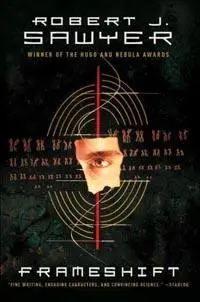
- Название:Frameshift
- Автор:
- Издательство:Tor Science Fiction
- Жанр:
- Год:1998
- ISBN:0-812-57108-8
- Рейтинг книги:4 / 5. Голосов: 1
-
Избранное:Добавить в избранное
- Отзывы:
-
Ваша оценка:
Frameshift: краткое содержание, описание и аннотация
Предлагаем к чтению аннотацию, описание, краткое содержание или предисловие (зависит от того, что написал сам автор книги «Frameshift»). Если вы не нашли необходимую информацию о книге — напишите в комментариях, мы постараемся отыскать её.
Frameshift — читать онлайн бесплатно полную книгу (весь текст) целиком
Ниже представлен текст книги, разбитый по страницам. Система сохранения места последней прочитанной страницы, позволяет с удобством читать онлайн бесплатно книгу «Frameshift», без необходимости каждый раз заново искать на чём Вы остановились. Поставьте закладку, и сможете в любой момент перейти на страницу, на которой закончили чтение.
Интервал:
Закладка:
Pierre nodded slowly, thinking it over. “Okay,” he said at last. “Let’s do it. How do I proceed?”
Molly reached for the phone. “First, we call my broker.”
Pierre pointed at the clock. “Surely she won’t be in this late.”
Molly smiled indulgently. “It may be eight p.m. here, but it’s noon in Tokyo. Laurie has a lot of clients who like to play the Nikkei. She could very well still be in.” Molly touched a speed-dial key. She was obviously very much into this; she had mentioned her investments in the past, but Pierre had never quite realized just how conversant she was with the field.
“Hello,” she said into the handset. “Laurie Lee, please.” A pause. “Hi, Laurie. It’s Molly Bond. Fine, thanks. No, not for me — for my husband. I told him you were the best in the business.” Laughter. “That’s right; anyway, can you take care of him, please? Thanks. His name is Pierre Tardivel; here he is.”
She held the handset out for Pierre. He hesitated for a moment, then brought it to his ear. “Hello, Ms. Lee.”
Her voice was high-pitched, but not grating. “Hello, Pierre. What can I do for you?”
“Well, I’d like to set up an account so that I can buy some stock.”
“Very good, very good. Let me just get a few personal details…”
She asked for information about his employer, and for his Social Security number (which Pierre had to consult his wallet to determine, having only recently received it).
“Okay,” said Laurie. “You’re all set. Was there anything you wanted me to buy for you now?”
Pierre swallowed. “Yes. A hundred shares of Condor Health Insurance, please.”
“They’re on the California Stock Exchange; I won’t be able to place the order until tomorrow. But as soon as the exchange opens, I’ll get you one hundred C-H-I Class B.” Pierre could hear keyclicks. “You know, that’s an excellent choice, Pierre. A very excellent choice. Not only has that stock been doing well on its own — it’s very close to its all-time high, which was set just two weeks ago — but it’s also done significantly better than its competition in the past year. I’ll send you confirmation of the purchase in the mail.”
Pierre thanked her and hung up, feeling quite the entrepreneur.
Three weeks later, Pierre was working in his lab. The phone rang. “ Allo? ”
“Hi, Pierre. It’s Helen Kawabata at the SFPD.”
“Helen, hi! I’d been wondering what had become of you.”
“Sony, but we’ve been swamped by that serial-killer case. Anyway, I’ve finally got together some tissue samples for you.”
“Thank you! How many did you get?”
“A hundred and seventeen—”
“That’s terrific!”
“Well, they’re not all from SF; my lab does forensics work on a contract basis for some of the surrounding communities, as well. And some of the samples are several years old.”
“But they’re all unsolved murders?”
“That’s right.”
“That’s great, Helen. Thanks so much! When can I come and get them?”
“Oh, whenever—”
“I’m on my way.”
Pierre picked up the samples, brought them back to LBNL, and turned them over to Shari Cohen and five other grad students; there were always plenty around. Through the polymerase chain reaction, the students would produce copies of each set of DNA, then test the material for thirty-five different major genetic disorders Pierre had specified.
That evening, as he was leaving building 74, Pierre passed Klimus in a corridor. He responded to Klimus’s curt “Good night” with a soft “ Auf Wiedersehen,” but the old man didn’t seem to hear.
Chapter 30
While he waited for the grad students to report back on the samples Helen Kawabata had provided, Pierre mapped out all the cytosines in the portion of Molly’s DNA that contained the code for the telepathy neurotransmitter. He then crunched the numbers backward and forward, looking for a pattern. He’d wanted to crack the hypothesized code that cytosine methylation represented, and he could think of no more interesting stretch of DNA to work on than that part of Molly’s chromosome thirteen.
And at last he succeeded.
It was incredible. But if he could verify it, if he could prove it empirically—
It would change everything.
According to his model, cytosine-methylation states provided a checksum — a mathematical test for whether the string of DNA had been copied exactly. It tolerated errors in some parts of the DNA strand (although those errors tended to render the DNA garbled and useless, anyway), but in others — notably right around the telepathy frameshift — it would allow no errors, invoking some sort of enzymatic correction mechanism as soon as copying was initiated. The cytosine-methylation checksum served almost as a guardian . The code to synthesize the special neurotransmitter was there, all right, but it was deactivated, and almost any attempt to activate it was reversed the first time the DNA was copied.
Pierre stared out the lab window, contemplating it all.
If a frameshift in a protected region occurred by accident due to a random addition or loss of a base pair from the chromosome, the cytosine-methylation checksum saw to it that any future copies — including those used in eggs or sperm — were corrected, preventing the error in coding from being passed on to the next generation. Molly’s parents had not been telepaths, nor was her sister, nor would any of her children be.
Pierre understood what it meant, but was still shocked. The implications were staggering: a built-in mechanism existed to correct frameshifts, a built-in way of keeping certain fully functional bits of the genetic code from becoming active.
Somehow, the enzymatic regulator had failed to work during the development of Molly’s own body. Perhaps that had been due to some drug — prescription or illegal — Molly’s mother had been using while pregnant with Molly, or to some nutrient missing from Molly’s mother’s diet. There were so many variables, and it was so long ago, that it would likely be impossible to duplicate the biochemical conditions under which Molly had developed between her conception and birth. But whatever had happened then had allowed the expression of something that was — the anthropomorphic language kept springing to Pierre’s mind, despite his efforts to avoid it — that was designed to remain hidden.
A Saturday afternoon in June. The doorbell rang.
“Who could that be?” said Pierre to little Amanda, who was sitting in his lap. “Who could that be?” He made his voice high and soft, the exaggerated tones generations of parents have used when talking to their babies. Meanwhile, Molly got up and went to the door. She checked the peephole, then opened the door, revealing Ingrid and Sven Lagerkvist, and their little boy, Erik.
“Look who’s here!” said Pierre, still baby-talking to Amanda. “Why, look who’s here! It’s Erik. See, it’s Erik.”
Amanda smiled.
Sven was carrying a large wrapped gift. He kissed Molly on the cheek, handed the gift to her, and came into the living room.
Molly placed the package on the pine coffee table. She then came over to Pierre and took Amanda from him. Although Pierre loved holding his daughter in his arms while sitting in a chair, he’d given up walking and carrying her after almost dropping her a few weeks before.
Molly carried Amanda into the middle of the room and set her down on the carpet near the coffee table. Sven, holding Erik’s chubby little hand, led him across the living room to where Amanda was.
“Manda,” said Erik in his soft, slurred way. As was typical of those with Down’s syndrome, Erik’s tongue stuck partway out of his mouth when he wasn’t speaking.
Читать дальшеИнтервал:
Закладка:
Похожие книги на «Frameshift»
Представляем Вашему вниманию похожие книги на «Frameshift» списком для выбора. Мы отобрали схожую по названию и смыслу литературу в надежде предоставить читателям больше вариантов отыскать новые, интересные, ещё непрочитанные произведения.





Обсуждение, отзывы о книге «Frameshift» и просто собственные мнения читателей. Оставьте ваши комментарии, напишите, что Вы думаете о произведении, его смысле или главных героях. Укажите что конкретно понравилось, а что нет, и почему Вы так считаете.