Robert Sawyer - Frameshift
Здесь есть возможность читать онлайн «Robert Sawyer - Frameshift» весь текст электронной книги совершенно бесплатно (целиком полную версию без сокращений). В некоторых случаях можно слушать аудио, скачать через торрент в формате fb2 и присутствует краткое содержание. Год выпуска: 1998, ISBN: 1998, Издательство: Tor Science Fiction, Жанр: Фантастика и фэнтези, на английском языке. Описание произведения, (предисловие) а так же отзывы посетителей доступны на портале библиотеки ЛибКат.
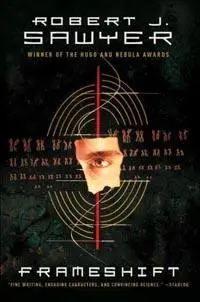
- Название:Frameshift
- Автор:
- Издательство:Tor Science Fiction
- Жанр:
- Год:1998
- ISBN:0-812-57108-8
- Рейтинг книги:4 / 5. Голосов: 1
-
Избранное:Добавить в избранное
- Отзывы:
-
Ваша оценка:
Frameshift: краткое содержание, описание и аннотация
Предлагаем к чтению аннотацию, описание, краткое содержание или предисловие (зависит от того, что написал сам автор книги «Frameshift»). Если вы не нашли необходимую информацию о книге — напишите в комментариях, мы постараемся отыскать её.
Frameshift — читать онлайн бесплатно полную книгу (весь текст) целиком
Ниже представлен текст книги, разбитый по страницам. Система сохранения места последней прочитанной страницы, позволяет с удобством читать онлайн бесплатно книгу «Frameshift», без необходимости каждый раз заново искать на чём Вы остановились. Поставьте закладку, и сможете в любой момент перейти на страницу, на которой закончили чтение.
Интервал:
Закладка:
“You’re welcome,” said Pierre. Every now and then, he tried to respond to a “thank you” with a California “uh-huh,” but he had never felt comfortable with it. Still, his smile was a bit sheepish. “I’m afraid I have another favor to ask.”
Helen’s smile faded just enough to convey that she felt the books were now balanced: she’d done him one favor, and he’d repaid it with lunch and a tour of LBNL. She did not look entirely ready to help him again.
“I went to a Huntington’s support-group meeting several months ago, here in San Francisco. They told me three people who belonged to their group had died in the last two years.”
“Well,” said Helen gently, “it is a fatal condition.”
“They didn’t die from Huntington’s. They were murdered.”
“Oh.”
“Would the police have done any special investigations of that?”
“Three people belonging to a single group getting killed? Sure, we’d have checked that out.”
“I’m the fourth, in a way.”
“Because you went to one meeting? What were you doing, giving a talk on genetics?”
“I have Huntington’s, Helen.”
“Oh.” She looked away. “I’m sorry. I’d…”
“You’d noticed my hands shaking when I gave you the tour of my lab.”
She nodded. “I — I’d thought you’d had too much to drink at lunch.” A pause. “I’m sorry.”
Pierre shrugged. “Me, too.”
“So you think somebody has something against Huntington’s sufferers?”
“It could be that, or…”
“Or what?”
“Well, I know this sounds crazy, but the person could actually think they’re doing the Huntington’s sufferers a favor.”
Helen’s thin eyebrows rose. “What?”
“There was a famous case in Toronto in the early 1980s. It was everywhere in the Canadian media. You know the Hospital for Sick Children?”
“Sure.”
“In 1980 and ‘81, a dozen babies were murdered in the hospital’s cardiac ward. They were all given overdoses of digoxin. A nurse named Susan Nelles was charged in the case, but she was exonerated. The case was never solved, but the most popular theory is that someone on the hospital’s staff was killing the babies out of a misguided sense of mercy.
They all had congenital heart conditions, and one might have concluded they were going to lead short, agony-filled lives anyway, so someone put them out of their misery.”
“And you think that’s what’s happening to the people in your Huntington’s group?”
“It’s one possibility.”
“But the guy who tried to kill you — what’s his name… ?”
“Hanratty. Chuck Hanratty.”
“Right. Wasn’t Hanratty a neo-Nazi? Hardly the type known for humanitarian gestures — if you could even call something like this humanitarian.”
“No, but he was doing the job on orders from somebody else.”
“I don’t remember seeing anything about that in the report on the case.”
“I — I’m just speculating.”
“Mercy killings,” said Helen, trying the idea on for size. “It’s an interesting angle.”
“And, well, I don’t think it’s just Huntington’s sufferers. Joan Dawson — she was the secretary for the Human Genome Center — was murdered, too. The police said the same kind of knife that was used in the attack on me was also used in killing her. She was an elderly diabetic, and she was going blind.”
“So you think your angel of mercy is offing anyone who is suffering because of a genetic disorder?”
‘Maybe.“
“But how would this person find out? Who would know about you and — what’s her name? — Joan?”
“Someone we both worked with — and someone who had also spoken to the Huntington’s group.”
“And is there such a person?”
“Yes.”
“Who?”
“I’d rather not say — not until I’m sure.”
“But—”
“How long do you keep tissue samples from autopsies?”
“Depends. Years, anyway. You know how court cases drag on. Why?”
“So you’d have samples from various unsolved murders committed in the last couple of years?”
“If an autopsy was ordered — we don’t always do one; they’re expensive.
And if the case is still unsolved. Sure, samples would still be around somewhere.”
“Can I get access to them?”
“Whatever for?”
“To see if some of them might have been misguided mercy killings, too.”
“Pierre, I don’t mean to be harsh, but, well…”
“What?”
“Well — Huntington’s. It does affect the mind, right? Are you sure you’re not just being paranoid?”
Pierre started to protest, but then just shrugged. “Maybe. I don’t know.
But you can help me find out. I only need tiny samples. Just enough to get a complete set of chromosomes.”
She thought for a moment. “You ask for the damnedest things, you know.”
“Please,” said Pierre.
“Well, tell you what: I can get you the ones we’ve got here. But I’m not going to go calling around to other labs; that would raise too many eyebrows.”
“Thank you,” said Pierre. “Thank you. Can you make sure that Bryan Proctor is included?”
“Who?”
“That superintendent who was murdered by Chuck Hanratty.”
“Oh, yeah.” Helen moved over to her computer, tapped some keys. “No can do,” she said after a moment. “Says here a tenant heard the gunshot that killed him. That fixed the time of death exactly, so we didn’t take any tissue samples.”
“Damn. Still, I’ll take anything else you can get for me.”
“All right — but you owe me big-time. How many samples do you need?”
“As many as I can possibly get.” He paused, wondering how much he should take Helen into his confidence. He didn’t want to say too much, but, dammit, he did need her help. “The person I have in mind is also under investigation by the Department of Justice for being a suspected Nazi war criminal, and—”
“No shit?”
“No — which explains the neo-Nazi connection. And, well, if he murdered thousands fifty years ago, he may very well have ordered a lot more than just the handful we know about murdered today.”
Helen thought about it for a moment, then shrugged. “I’ll see what I can do. But, look, it’s almost Christmas, and that’s our busiest time for crime, I’m afraid. You’re going to have to be patient.”
Pierre knew better than to push. “Thank you,” he said.
Helen nodded. “Uh-huh.”
Pierre hurried in the back door of the house. He’d given up fighting the steps to the front door a couple of weeks before. It was 5:35 p.m., and he went straight for the couch, scooping up the remote and turning on the TV. “Molly!” he shouted. “Come quickly!”
Molly appeared, holding baby Amanda, who, at eight months, had acquired even more rich brown hair. “What is it?”
“I heard just as I was leaving work that the piece on Felix Sousa is on
Hard Copy tonight. I thought I’d be home in time, but there was an accident on Cedar.”
A commercial for Chrysler minivans was coming to an end. The Hard Copy spinning typewriter ball flew out at them, making that annoying t hunk-thunk ! as it did so; then the host, a pretty blonde named Terry Murphy, appeared. “Welcome back,” she said. “Are blacks inferior to whites? A new study says yes, and our Wendy Di Maio is on the story.
Wendy?”
Molly sat down next to Pierre on the couch, holding Amanda against her shoulder.
The image changed to some historical footage of the UCB courtyard behind Sather Gate, with longhaired flower children strolling by and a bare-chested hippie sitting under a tree, strumming a guitar.
Читать дальшеИнтервал:
Закладка:
Похожие книги на «Frameshift»
Представляем Вашему вниманию похожие книги на «Frameshift» списком для выбора. Мы отобрали схожую по названию и смыслу литературу в надежде предоставить читателям больше вариантов отыскать новые, интересные, ещё непрочитанные произведения.




Обсуждение, отзывы о книге «Frameshift» и просто собственные мнения читателей. Оставьте ваши комментарии, напишите, что Вы думаете о произведении, его смысле или главных героях. Укажите что конкретно понравилось, а что нет, и почему Вы так считаете.