Charles Sheffield - Starfire
Здесь есть возможность читать онлайн «Charles Sheffield - Starfire» весь текст электронной книги совершенно бесплатно (целиком полную версию без сокращений). В некоторых случаях можно слушать аудио, скачать через торрент в формате fb2 и присутствует краткое содержание. Год выпуска: 2000, ISBN: 2000, Издательство: Bantam Spectra, Жанр: Фантастика и фэнтези, на английском языке. Описание произведения, (предисловие) а так же отзывы посетителей доступны на портале библиотеки ЛибКат.
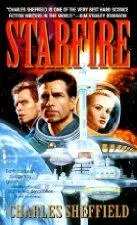
- Название:Starfire
- Автор:
- Издательство:Bantam Spectra
- Жанр:
- Год:2000
- ISBN:0553577395
- Рейтинг книги:3 / 5. Голосов: 1
-
Избранное:Добавить в избранное
- Отзывы:
-
Ваша оценка:
Starfire: краткое содержание, описание и аннотация
Предлагаем к чтению аннотацию, описание, краткое содержание или предисловие (зависит от того, что написал сам автор книги «Starfire»). Если вы не нашли необходимую информацию о книге — напишите в комментариях, мы постараемся отыскать её.
,
subjects planet Earth to yet another cosmic blast from the Alpha Centauri supernova. But while the blast that hit Earth in
simply cooked the Southern hemisphere and knocked out unshielded technology with a flash of gamma rays, this wave promises to do some real damage, with a sleet of trillion-nuclei bundles moving at one-tenth the speed of light.
Warned by the first catastrophe, Earth began building an electromagnetic shield out of the orbiting
station to divert the incoming apocalypse. But not only will the storm come earlier than expected, the carnage may be worse than anyone imagined — preliminary data shows that the supernova was no accident, and that the wave of particles may in fact be a beam. Crackerjack hard-SF author Charles Sheffield brings back much of the cast of
for this suspenseful, well-paced follow-up, the two most satisfying returnees being sociopath-savant Oliver Guest and his former patient Seth Parsigian. In the book’s subplot, the brilliant Guest and gruff Parsigian must team up to solve a string of grisly child murders on
that threatens to push the shield project even further behind schedule.
Starfire — читать онлайн бесплатно полную книгу (весь текст) целиком
Ниже представлен текст книги, разбитый по страницам. Система сохранения места последней прочитанной страницы, позволяет с удобством читать онлайн бесплатно книгу «Starfire», без необходимости каждый раз заново искать на чём Вы остановились. Поставьте закладку, и сможете в любой момент перейти на страницу, на которой закончили чтение.
Интервал:
Закладка:
“Ten percent get through?” Jessie Kahn reacted at once. “What does that mean for Earth?”
“The most you can say is that it’s better than a hundred percent. But it will mean the immediate loss of the ionosphere, the later loss of the ozone layer, massive heat imbalance between the Northern and Southern Hemispheres — which means freak weather — and a radio communications blackout. It could be as bad as the original Alpha C effects in 2026, but of course we’ll be a lot better prepared for it.”
“How long do we have?” Lauren Stansfield was making notes in her usual tidy fashion. She was as gray-faced and weary as anyone, but somehow, even though John had called the meeting without warning, she was carefully dressed and wearing makeup.
“That’s another bit of bad news. Another Sniffer was launched two weeks ago on a crash basis. It can’t do detailed analysis, but it reports that the big slug of particle bundles will hit in twenty-six days.”
“Then we must keep going.” Torrance Harbish spoke with force and conviction. “Look at the alternative. The old shield won’t work, we know that. Even if it’s not going to be perfect, we must have the new defense system. We’re wasting time. We should leave here and work harder than ever.”
“I hear you, Torrance. But I’m going to demand some more of your time. I didn’t call you together just to pass on bad news.” John glanced at each person in turn. “There’s another reason for this meeting. Every one of you has a first-rate intellect. I want the benefit of those. You’re all tired, but I called us together because we need ideas.”
“I don’t know about the first-rate intellect bit.” It was Will Davis. “You’ve already had my two cents’ worth, boyo, but I’ll say it again for the benefit of everyone. We charge ahead with the new defense, even though it won’t be perfect. And we tell Earth to get ready for trouble.”
Amanda Corrigan added, “More than trouble, Will — disaster. I’ve got my whole family down there. Look, this isn’t my area of expertise, so maybe it’s a dumb question. But why can’t we beef up the strength of the low-intensity field?”
“Will?” John didn’t want to talk; he wanted to listen.
Davis nodded and turned to Amanda Corrigan. “We could. But that’s not the problem. The field isn’t generated from a single point; it’s done with a distributed array of tuned oscillators. Even when the oscillator phases are matched as well as possible, you get regions where the contributions from different sources reinforce each other, and others where they tend to cancel.”
Amanda was frowning, more than ever like a puzzled teenager. John asked, “Do you get it?”
“I don’t think so. I guess I’m dumb.”
“No. You’re just tired.”
“That too. So what if the fields cancel in places?”
“Will?”
Davis nodded. “Think of it as a three-dimensional interference pattern. The particle bundles will be coming in at random, so some of them will slide through along paths where the field cancels. If they don’t encounter enough field to generate a signal, we don’t detect them. If we don’t know they’re there, we can’t zap them with a stronger pulse and direct them away. So they make it all the way, and hit Earth.”
“Increasing the strength of the low-intensity field won’t solve the problem?”
“No. We’d still have dead spots.”
“Can’t you do something to average the field?” Jessie asked. “If you could make it more uniform, the low points would disappear.”
Will Davis shrugged. “You can fiddle with the oscillator strengths. But it’s like working with an air mattress. If you push it down in once place, it bulges up higher somewhere else.”
“What about putting something out in space?” Jessie was young, but she could be dogged when she had an idea in her head. “Couldn’t a superconducting mesh average the field?”
“It could.” Davis raised his eyebrows. “Have to be twenty thousand kilometers across, mind you, and thirty thousand kilometers out beyond Cusp Station. We could make something like that — if we had a few years. How long did you say we have, John?”
“Twenty-six days before the main hit. But Amanda and Jessie have the right idea. Keep thinking.”
Advice easier to give than to follow. In the long silence that followed, John glanced from one perplexed face to the next. He was asking his engineering team for a miracle.
The person who eventually spoke was not one of his team. Star Vjansander had been nudging Wilmer Oldfield, muttering to him, and blowing out her round cheeks. Now she frowned at Wilmer and said, “What was it that feller Colombo said in our first meeting out here, about Missus Hommit going ter see a mountain?”
It was blank stares all round, until Wilmer said mildly, “Not Ma Hommit, you softheaded git. Mahomet.”
“Yeah, that one. I’m rotten with names. If the mountain wouldn’t go to Mahomet, he’d have to go ter the mountain.” She nodded to John, as though confirming something he had said. “So that’s what yer have to do.”
“Star, you’re jumping so far ahead you’re falling all over yourself. You always do.” Wilmer turned to Will Davis. “How close to finished was the old shield?”
“Ninety percent plus. All the structure and stability was done, but we were still missing batches of sensors.” Davis shook his head. “Seven years of my life in that bloody thing, and it’s useless. Ah, well. Easy come, easy—”
“Don’t give up on it.” Wilmer went on, slowly and thoughtfully. “It’s useless as a shield, but it’s covered with a superconducting mesh. That’s what was going to divert the particles when we thought they were coming in as single nuclei. The mesh isn’t enough to deal with the bundles, they’re too massive. But could it do what Jessie said, and average the detection field that we create?”
It was like the promise of reinforcements to a tired army. John saw the engineers straighten up in their seats. “Can it, Will?”
“It could, very easily. But the shield is in the wrong place. To average the detection field, the shield would have to move thirty thousand kilometers farther out. That’s not impossible, but the structure is so fragile and so finely balanced that the operation would take a few months. We don’t have months. We have just a few weeks.”
“I know.” Star was bobbing up and down in her chair. “I know. That’s why I said what I did. Yer don’t take the mountain ter what’s-’is-name, you leave the mountain where it is.”
“Shut up, Star. You’ll give people headaches.” Wilmer reached out and pushed her back into her seat. “Just keep quiet, and let me explain your idea.”
“I’ve heard you explain things before. Yer’ll bore ’em to death, you old fart.”
Wilmer took no notice. He went on in his unhurried way, “She’s bright, you see, but when she gets excited she gibbers like a monkey. Here is the position, as I understand it. The old space shield is no use as a shield anymore, because it’s far too fragile to divert the high-mass particle bundles. However, it would serve perfectly to average the low-intensity field that detects those bundles. Unfortunately, it is in the wrong place relative to Cusp Station, where you have installed the generators for high-energy pulses that can divert particle bundles away from Earth. To serve that purpose, the shield would have to be moved thirty thousand kilometers away from Cusp Station, in the direction of Alpha Centauri, since that is where the particle storm is coming from. However, the shield is so delicate that such movement would have to be done very slowly, at minuscule acceleration. It therefore appears that we have reached a solution too late. The particle storm will be here before the shield can be relocated.
Читать дальшеИнтервал:
Закладка:
Похожие книги на «Starfire»
Представляем Вашему вниманию похожие книги на «Starfire» списком для выбора. Мы отобрали схожую по названию и смыслу литературу в надежде предоставить читателям больше вариантов отыскать новые, интересные, ещё непрочитанные произведения.


Обсуждение, отзывы о книге «Starfire» и просто собственные мнения читателей. Оставьте ваши комментарии, напишите, что Вы думаете о произведении, его смысле или главных героях. Укажите что конкретно понравилось, а что нет, и почему Вы так считаете.