Charles Sheffield - Starfire
Здесь есть возможность читать онлайн «Charles Sheffield - Starfire» весь текст электронной книги совершенно бесплатно (целиком полную версию без сокращений). В некоторых случаях можно слушать аудио, скачать через торрент в формате fb2 и присутствует краткое содержание. Год выпуска: 2000, ISBN: 2000, Издательство: Bantam Spectra, Жанр: Фантастика и фэнтези, на английском языке. Описание произведения, (предисловие) а так же отзывы посетителей доступны на портале библиотеки ЛибКат.
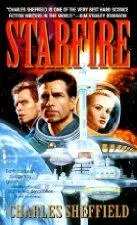
- Название:Starfire
- Автор:
- Издательство:Bantam Spectra
- Жанр:
- Год:2000
- ISBN:0553577395
- Рейтинг книги:3 / 5. Голосов: 1
-
Избранное:Добавить в избранное
- Отзывы:
-
Ваша оценка:
Starfire: краткое содержание, описание и аннотация
Предлагаем к чтению аннотацию, описание, краткое содержание или предисловие (зависит от того, что написал сам автор книги «Starfire»). Если вы не нашли необходимую информацию о книге — напишите в комментариях, мы постараемся отыскать её.
,
subjects planet Earth to yet another cosmic blast from the Alpha Centauri supernova. But while the blast that hit Earth in
simply cooked the Southern hemisphere and knocked out unshielded technology with a flash of gamma rays, this wave promises to do some real damage, with a sleet of trillion-nuclei bundles moving at one-tenth the speed of light.
Warned by the first catastrophe, Earth began building an electromagnetic shield out of the orbiting
station to divert the incoming apocalypse. But not only will the storm come earlier than expected, the carnage may be worse than anyone imagined — preliminary data shows that the supernova was no accident, and that the wave of particles may in fact be a beam. Crackerjack hard-SF author Charles Sheffield brings back much of the cast of
for this suspenseful, well-paced follow-up, the two most satisfying returnees being sociopath-savant Oliver Guest and his former patient Seth Parsigian. In the book’s subplot, the brilliant Guest and gruff Parsigian must team up to solve a string of grisly child murders on
that threatens to push the shield project even further behind schedule.
Starfire — читать онлайн бесплатно полную книгу (весь текст) целиком
Ниже представлен текст книги, разбитый по страницам. Система сохранения места последней прочитанной страницы, позволяет с удобством читать онлайн бесплатно книгу «Starfire», без необходимости каждый раз заново искать на чём Вы остановились. Поставьте закладку, и сможете в любой момент перейти на страницу, на которой закончили чтение.
Интервал:
Закладка:
“What the fuck are you playing at?” Gordy’s voice rasped at once out of the set. “I knew you were in your goddamn office, your secretary told me. Why didn’t you pick up?”
“Gordy, I was in my office because I had a meeting here. I had to get rid of the other person. This is supposed to be a private, dedicated line for the two of us. Do you want others listening?”
“I want action. When you hear what I have to say, so will you. Get ready to crap in your pants.”
Nick listened to the rapid-fire summary of Gordy’s conversation with Maddy Wheatstone. At the end of it he said, “I agree, it sounds bad. Will Wheatstone talk?”
“No. She’s no dummy, and I’ve been grooming her for a top Argos Group position for nine years. Right now she has the hots for Hyslop, but deep down she knows that once she gets over him she’ll want her old job back.”
“You have more faith in that than I do.”
“Because I’m smarter than you. Even if Maddy did talk, all she has is hearsay. Right now we have to worry about the source, the one who dug into the records.”
“She refused to tell you who that was?”
“Of course she did. You fucking half-wit, why do you think I’m calling you?”
Im proper. Un subtle. Wholly un civilized. But accurate, since only a half-wit would ever have become involved with Gordy Rolfe.
“I have no idea who Maddy Wheatstone was referring to.”
“But you can find out.”
“How?”
“Call your stooge, Bozo Colombo. The person we need must have been digging into the data bases that deal with Argos Group transactions. Unless Sky City is screwed up beyond belief, the retrieval systems will hold a record of every inquiry. Tell Colombo we need names, everybody who’s been into the records in the past few weeks. Have his technical staff make a list.”
“And do what with it? I’ve told you before, Bruno Colombo has his limits. So do I.”
“You’re spineless, Lopez. You’re just as bad as your stooge.” Rolfe’s voice changed to become a broad imitation of Nick’s deeper one. ” ’Bruno Colombo has his limits. So do I.’ ” Rolfe’s raspy tone became flat and expressionless. “Well, I don’t. You get me the list. I’ll take it from there.”
“And do what?”
“Never you mind. All you have to do is sit on your ass in New Rio and keep your mouth closed. I assume you’re at least capable of that.”
“Suppose it’s one of my people, Gordy?”
“Suppose it is?”
“I could buy them off. That would be easier than anything else.”
“And be sure they stayed bought? We’ve had this conversation before. I say, let’s go for a permanent solution. Remember, I told you it would have been easier to get rid of Hyslop, and you wouldn’t let me?”
“But I was right. I said we might need Hyslop, and we did.”
“No. You did. I didn’t. I don’t give a flying fuck if the space shield works, or if it turns out to be a space sieve and everybody on the surface of Earth fries. And I’m not interested in a discussion; I want action. Tell Bruno Colombo to get his ass in gear and send you that list. Soon.”
“You’re not thinking—” Nick found he was speaking into a dead line. He replaced the telcom set, more upset than he wanted to admit.
And more perplexed. You went through life in public office, laying claim to high morality when you knew quite well that at heart you were totally immoral. You were well acquainted with the majority of the seven deadly sins. Certainly pride, anger, and greed had their place in your life. You could claim a lifelong familiarity with and affection for lust.
And then, at an age when a man ought to know himself, you discovered that your immorality had its limits.
Gordy Rolfe was right. Compared with the overlord of the Argos Group, Nick Lopez was a spineless stooge unwilling to follow through on the consequences of his own actions. If it came to a shoot-out with Gordy, Nick had the terrible conviction that he would lose.
Well, you did your best. A man was only as wicked as a man could stand to be. Nick turned his thoughts to the coming evening with Martin Oliveira, and felt comforted.
25
John Hyslop surveyed the assembled group. If only they were mountaineers as well as engineers!
When you were climbing the highest peaks of Earth you had to make a lot of technical decisions: from which side and along which path you would attempt to scale the mountain; where you would establish base camp; how much time you allot to the adjustment of the climber’s body to extreme altitude; how much equipment you would carry; and when and where you would use oxygen. Would you even use oxygen at all?
Important decisions. Each could be the difference between life and death. But none of them was the toughest and the most controversial.
That problem came on the final day of the ascent. You were close to the summit, you were weary, your body was so starved of oxygen that your brain was on autopilot and your feet felt like lead. You had come to within a thousand — maybe five hundred — feet of planting a flag at the top. Now you had to make the hardest call of all: Did you keep climbing the final ridge to the mountain-top that you seemed so clearly able to reach? Or, with the goal so visible and so tempting, did you recognize that a descent must follow an ascent? You had to decide, very quickly, if you had enough time and daylight and strength to continue to the top, and after that return to base.
The team leader made the call. If you decided that the wise choice was to retreat, you gave the word to turn around and expected a monstrous amount of grumbling when you got back to base camp. But the team respected your decision during the climb. There could be only one boss.
John was about to make a similarly tough decision. He examined the group one by one. They had the worn-down pallor of people who worked too hard and slept too little, but in mountain-climbing terms they were not on the final leg of the ascent. They had hardly reached base camp. Sky City was flying steadily on toward Cusp Station, but the journey was barely past its halfway point.
How was the group likely to react to the news that their efforts were useless?
Wilmer Oldfield and Star Vjansander were not engineers. They would presumably go along with John’s judgment. The same was true of Seth Parsigian and Maddy Wheatstone. He caught her eye, received a dazzling smile in return, and looked away.
Will Davis would be all right, too. He was the one who had brought the word to John, and he would be ready with his own supporting arguments. Amanda Corrigan would not argue; she was obsessed with her own problems of computer access and use. Jessie Kahn was probably too junior to question him.
That left Lauren Stansfield and Torrance Harbish. Both sometimes had strong opinions, and both were unpredictable. You never knew what thoughts ran behind Lauren’s amber eyes or Torrance’s dark countenance.
Everyone was staring at John. It was time to take the plunge.
“I have news, and it’s not good. We can’t go ahead with the new particle defense scheme.” That certainly had their attention. “Not, at least, the way we planned it. The problem lies in particle bundle detection. We intended to generate a low-intensity wide-angle field, so that each incoming bundle would interact with the field and generate a traveling EM wave of its own. We would pick up that signal and use it to calculate the bundle trajectory. Then we could deflect the bundle away from Earth with a direct and stronger beam.
“It sounds practical, even easy. But the first part won’t work. We have no way to generate a field complete enough to allow us to track every bundle.” John nodded at Will Davis. “Will did the calculations, and he’ll be happy to go over them with you. It looks like maybe ten percent of the bundles will escape detection.”
Читать дальшеИнтервал:
Закладка:
Похожие книги на «Starfire»
Представляем Вашему вниманию похожие книги на «Starfire» списком для выбора. Мы отобрали схожую по названию и смыслу литературу в надежде предоставить читателям больше вариантов отыскать новые, интересные, ещё непрочитанные произведения.

Обсуждение, отзывы о книге «Starfire» и просто собственные мнения читателей. Оставьте ваши комментарии, напишите, что Вы думаете о произведении, его смысле или главных героях. Укажите что конкретно понравилось, а что нет, и почему Вы так считаете.