Charles Sheffield - Starfire
Здесь есть возможность читать онлайн «Charles Sheffield - Starfire» весь текст электронной книги совершенно бесплатно (целиком полную версию без сокращений). В некоторых случаях можно слушать аудио, скачать через торрент в формате fb2 и присутствует краткое содержание. Год выпуска: 2000, ISBN: 2000, Издательство: Bantam Spectra, Жанр: Фантастика и фэнтези, на английском языке. Описание произведения, (предисловие) а так же отзывы посетителей доступны на портале библиотеки ЛибКат.
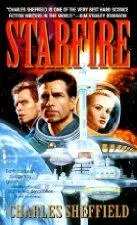
- Название:Starfire
- Автор:
- Издательство:Bantam Spectra
- Жанр:
- Год:2000
- ISBN:0553577395
- Рейтинг книги:3 / 5. Голосов: 1
-
Избранное:Добавить в избранное
- Отзывы:
-
Ваша оценка:
Starfire: краткое содержание, описание и аннотация
Предлагаем к чтению аннотацию, описание, краткое содержание или предисловие (зависит от того, что написал сам автор книги «Starfire»). Если вы не нашли необходимую информацию о книге — напишите в комментариях, мы постараемся отыскать её.
,
subjects planet Earth to yet another cosmic blast from the Alpha Centauri supernova. But while the blast that hit Earth in
simply cooked the Southern hemisphere and knocked out unshielded technology with a flash of gamma rays, this wave promises to do some real damage, with a sleet of trillion-nuclei bundles moving at one-tenth the speed of light.
Warned by the first catastrophe, Earth began building an electromagnetic shield out of the orbiting
station to divert the incoming apocalypse. But not only will the storm come earlier than expected, the carnage may be worse than anyone imagined — preliminary data shows that the supernova was no accident, and that the wave of particles may in fact be a beam. Crackerjack hard-SF author Charles Sheffield brings back much of the cast of
for this suspenseful, well-paced follow-up, the two most satisfying returnees being sociopath-savant Oliver Guest and his former patient Seth Parsigian. In the book’s subplot, the brilliant Guest and gruff Parsigian must team up to solve a string of grisly child murders on
that threatens to push the shield project even further behind schedule.
Starfire — читать онлайн бесплатно полную книгу (весь текст) целиком
Ниже представлен текст книги, разбитый по страницам. Система сохранения места последней прочитанной страницы, позволяет с удобством читать онлайн бесплатно книгу «Starfire», без необходимости каждый раз заново искать на чём Вы остановились. Поставьте закладку, и сможете в любой момент перейти на страницу, на которой закончили чтение.
Интервал:
Закладка:
“I’m inclined to agree. But an associate insisted on a direct line between us, person to person. So now we have one.” Lopez nodded to the photograph on the wall behind Celine. “I saw you studying him. You know who he is, don’t you?”
“I think so, but he looks so young. It’s Lyndon Baines Johnson, isn’t it? President Johnson.”
“No. It’s LBJ all right, but that’s Senator Johnson, before he became President. The person you are looking at was a much greater and wiser man than President Johnson.”
“I didn’t know you were an admirer of LBJ.” Celine was genuinely astonished. Nick Lopez was not the person to have pictures of personal idols on the office wall.
“I’m not his admirer.” Nick came to stand beside her and studied the picture. “He’s there to remind me of something important. LBJ knew how to run the U.S. Senate better than anybody, ever. He could squeeze and coax and reward and punish, and he got just about anything he wanted. Then he became President, and he was a disaster. His ego was too big. He wouldn’t admit when he was wrong. He got stuck in a war that he couldn’t control, and now people look back on him as one of the worst U.S. Presidents. I keep him there because I believe that you can learn more from failure than you can from success. LBJ sent my grandfather off to war, and killed him. So I hate the son of a bitch. But I also know that he was once a great, great Senator. Past success doesn’t guarantee future success, and you can do one thing very well and another very badly.” Lopez stared at Celine, who was smiling. “Which part do you think is funny?”
“None of it. I smile because I’m like you. I keep a holo display just for me in the corner of the Oval Office.”
“The way that Saul Steinmetz had one of Disraeli? But I’ve never seen yours.”
“You never will. I only turn it on when I’m alone, and I don’t show it to anyone. I daren’t. Want to make a guess as to who it is?”
“Well, with those rules it can’t be Saul, though I know he’s your hero.” Nick puffed out his cheeks and frowned in thought. “I’ll skip the obvious guesses, because you wouldn’t hide any of the Presidents. I’ll bite. Who?”
“I have a hologram of Adolf Hitler.”
“Hitler! Why not Pontius Pilate? That’s heavy stuff.” Lopez wandered over to the desk and sat at the chair behind it. He placed his elbows on the uncluttered top and cupped his chin in his hands. “Not my guess as to your first choice — or your second, third, or fiftieth.”
“Want to know why he’s there?”
“No. Not yet. Let me think. Isn’t that what you want me to do?” He sat silent, staring straight ahead. Celine caught a glimpse of another Nick Lopez, a man as concentrated and tightly focused as Wilmer Oldfield.
“Obviously it’s not because you admire him,” he said after a few seconds. The telcom unit on the desk was beeping again, but he ignored it. “And my picture of Lyndon Johnson must have something to do with it. He’s there to remind you that you must never forget something. But what? All right. I give up.”
“It’s not as direct a reminder as yours. Hitler’s my symbol for the analogy between today and the state of the world a hundred and twenty years ago. In the 1920s, everyone knew that they had been through a terrible disaster. The world war had been frightful, but they had survived and it was over and everything was peaceful. The ’war to end wars,’ they called it, and it seemed part of the past. Only a few people recognized that there was trouble ahead. Hitler was ahead, just a few years away. But most people took no notice of the danger signals. They didn’t prepare for trouble until it was too late.”
Lopez had walked across to stand by the desk. He had his hand poised over the telcom unit, but he did not touch it. He said, “The supernova was our First World War. We survived it. Now we’re between disasters, but most people don’t understand how much trouble we’re in. Half of them don’t even believe in the particle storm. We have the equivalent of a Second World War in our future. Right?”
“We do. We have to learn from history.”
” ’Ancestral voices prophesying war.’ ” Lopez nodded and pressed the telcom switch. “Yes?”
“The other visitors from the United States are here.”
“Bring them in.” Lopez raised an eyebrow at Celine. “Visitors? More than one?”
“I don’t know.” Celine stared blankly at Lopez, then toward the half-open door. “It should just be Wilmer. Unless — he’d better not, I told him—”
She was speechless. The open doorway was empty no longer. A black hand had appeared around the edge of the door. It was followed a moment later by a black, grinning face.
Celine realized again what she had first learned thirty-odd years ago: What you told Wilmer to do and what Wilmer did were not always the same.
14
Nick Lopez had a reputation of being a bad listener, someone who in the middle of a meeting would fiddle with papers, start reading an unrelated document, or even leave and not return. Celine found it hard to match that to Saul Steinmetz’s comment that Nick had possessed the most subtle and complex mind in Washington. Now, half an hour into the meeting, she thought she could reconcile the two.
Nick had received Wilmer Oldfield and Astarte Vjansander politely. He seemed secretly pleased by Celine’s irritation at Astarte’s presence. When the introductions were over he sat down at once, nodded to the newcomers, and said, “Your ball. Talk.”
Apparently Wilmer and Astarte had agreed in advance that Wilmer would be the spokesman. Being Wilmer, he of course favored completeness over brevity. Celine watched and listened as he carefully explained two different types of supernova, and how the Alpha Centauri binary system, according to long-established theories, could not possibly belong to either class. He pointed out, as though it were news to Nick Lopez, that Alpha Centauri had in fact become a supernova; then that no one had been able to explain how this might happen until recently; but now a new theory, based on original work by Astarte as modified by Wilmer, provided a full explanation.
Wilmer outlined the new ideas and defined the pattern of compressions that must have been applied to Alpha Centauri A, the larger star of the system, to induce a supernova explosion. He spoke clearly, but certainly not simply. Celine had to concentrate to follow, and she had heard it several times before. While he spoke Astarte sat cross-legged on the floor, grinned up at Nick Lopez, and unselfconsciously scratched her belly and bare thighs.
Nick did not seem upset at that. He listened closely to Wilmer’s every word, and when Wilmer talked of stellar resonance Nick nodded as though that idea was no more than common sense. He did not fidget, and he ignored the occasional beeping of the telcom unit. Twice he asked for additional details. Once he asked that a subtle point be repeated.
Celine decided that Saul was right. Nick Lopez was very smart. But in nine meetings out of ten he was bored, and that was when he wandered off to do other things.
Wilmer had reached the most controversial point in the presentation, the one that the Cabinet officers and government research heads had rejected out of hand. “So the compressive pulses couldn’t have occurred naturally,” he said. “They were induced by some other agent. That, and the fact that the directions of both the gamma-ray beam and the particle storm precisely intersect the solar system, indicate that the geometry for this event was arranged .”
“Arranged?” Lopez was frowning.
“Deliberately contrived. It didn’t just happen.”
Читать дальшеИнтервал:
Закладка:
Похожие книги на «Starfire»
Представляем Вашему вниманию похожие книги на «Starfire» списком для выбора. Мы отобрали схожую по названию и смыслу литературу в надежде предоставить читателям больше вариантов отыскать новые, интересные, ещё непрочитанные произведения.

Обсуждение, отзывы о книге «Starfire» и просто собственные мнения читателей. Оставьте ваши комментарии, напишите, что Вы думаете о произведении, его смысле или главных героях. Укажите что конкретно понравилось, а что нет, и почему Вы так считаете.