Charles Sheffield - Starfire
Здесь есть возможность читать онлайн «Charles Sheffield - Starfire» весь текст электронной книги совершенно бесплатно (целиком полную версию без сокращений). В некоторых случаях можно слушать аудио, скачать через торрент в формате fb2 и присутствует краткое содержание. Год выпуска: 2000, ISBN: 2000, Издательство: Bantam Spectra, Жанр: Фантастика и фэнтези, на английском языке. Описание произведения, (предисловие) а так же отзывы посетителей доступны на портале библиотеки ЛибКат.
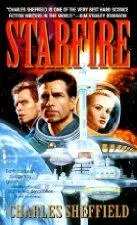
- Название:Starfire
- Автор:
- Издательство:Bantam Spectra
- Жанр:
- Год:2000
- ISBN:0553577395
- Рейтинг книги:3 / 5. Голосов: 1
-
Избранное:Добавить в избранное
- Отзывы:
-
Ваша оценка:
Starfire: краткое содержание, описание и аннотация
Предлагаем к чтению аннотацию, описание, краткое содержание или предисловие (зависит от того, что написал сам автор книги «Starfire»). Если вы не нашли необходимую информацию о книге — напишите в комментариях, мы постараемся отыскать её.
,
subjects planet Earth to yet another cosmic blast from the Alpha Centauri supernova. But while the blast that hit Earth in
simply cooked the Southern hemisphere and knocked out unshielded technology with a flash of gamma rays, this wave promises to do some real damage, with a sleet of trillion-nuclei bundles moving at one-tenth the speed of light.
Warned by the first catastrophe, Earth began building an electromagnetic shield out of the orbiting
station to divert the incoming apocalypse. But not only will the storm come earlier than expected, the carnage may be worse than anyone imagined — preliminary data shows that the supernova was no accident, and that the wave of particles may in fact be a beam. Crackerjack hard-SF author Charles Sheffield brings back much of the cast of
for this suspenseful, well-paced follow-up, the two most satisfying returnees being sociopath-savant Oliver Guest and his former patient Seth Parsigian. In the book’s subplot, the brilliant Guest and gruff Parsigian must team up to solve a string of grisly child murders on
that threatens to push the shield project even further behind schedule.
Starfire — читать онлайн бесплатно полную книгу (весь текст) целиком
Ниже представлен текст книги, разбитый по страницам. Система сохранения места последней прочитанной страницы, позволяет с удобством читать онлайн бесплатно книгу «Starfire», без необходимости каждый раз заново искать на чём Вы остановились. Поставьте закладку, и сможете в любой момент перейти на страницу, на которой закончили чтение.
Интервал:
Закладка:
The Sniffer was well equipped to analyze time series data. It was clear that the arrival times of groups of nuclei of different species were tightly correlated. Those groups were also very large, usually containing trillions of separate nuclei. The time pattern was seldom repeated, but the number of a particular type of nucleus contained within a single cluster was usually the same.
Sniffer-B pondered the problem at a thousand billion cycles a second as it flew on through the incident flux. It held in its general data base enough information to realize that the external world was not composed of one-dimensional entities. The data series that it was observing was a projection onto a single dimension — time — of three-dimensional structures. The Sniffer also had information on organic chemistry, enough to infer how a complex structure, such as a molecule, would appear if projected onto any given axis in space. Varying the axis of projection would give patterns characteristic of the molecule, patterns that looked different from each other but in which the number of a particular kind of atom would always be the same.
The Sniffer struggled with the problem of reconstructing the spatial configuration of the clusters that its sensors were observing. It made the working assumption that the structure was always the same, but might be arriving at the sensors at any angle.
Sniffer-B tried, and tried, and failed. It knew that it needed a method for the inference of spatial structures applicable to the clusters of nuclei, but the closest relevant technique — the theory of molecular crystallography — had seemed to the Sniffer’s makers far beyond the set of applications likely to be useful in the interstellar environment.
The Sniffer did not know how to stop trying. It continued with its ceaseless ferment of computation long after the main flux of particles had passed. Only when all systems were powered down for the long interstellar cruise did the analysis process suspend.
It would start up again one more time, when arrival at Alpha Centauri triggered a last flurry of futile activity. The Sniffer would never know that the puzzle racking its circuits had been solved, within days of its receipt on Earth, by the slow and inefficient organic computers of its makers.
13
Nick Lopez was waiting for Celine when Suborbital One touched down at the New Rio port. As they taxied in she saw him waiting on the tarmac. His broad, simple face and warm, welcoming smile made her think, not for the first time, I’m the President, but he’s the politician.
How could you dislike somebody so cheerful and so positive? How could you resist that sunny smile? When you were with him, you couldn’t. Only when you went away and read the thirty-year catalog of suspicions and rumors and unsuccessful charges against him did the doubts come back.
“Good flight, Madam President?” He engulfed her hand in his warm brown paw as she reached the bottom of the glide stair, and grinned down at her from his thirty-centimeter height advantage.
Celine shrugged. The plane had squeaked in under the nose of a July storm racing in from the northwest, and during the final approach a bout of turbulence had been too much for the stabilizers. “You know what they say — if you can walk away from a landing, it was a good flight. Actually, I’ve known better. But we had to do our final approach from the south because of the weather. And I wondered, are those new beaches that I saw?”
“Under construction.” Nick fell into step beside her. “New beaches, but with the old names. Copacabana, Ipanema, Leblon, Gavea. Don’t you just love them, the dreams from the past? Though of course, I don’t plan to visit the new beaches; they’re for the younger generation.”
Celine was not so sure. Nick’s file was a thick one. Long before the supernova, U.S. Senator Nick Lopez had been a frequent visitor to the Rio de Janeiro beaches. He had not been above bringing his young male pickups back to Washington and showing them off around the halls of Congress. Now he wore his trademark hairstyle, a shaped high pompadour, deliberately gray, but he was in excellent physical shape. It would be no surprise if he still followed his old habits. It was Nick, after all, who had decided that the main headquarters for the World Protection Federation would be in New Rio.
Still, no one could argue with his logic. New Rio had space available, and lots of it. The old line “And I alone lived on to tell the tale” applied literally to Joachim Salazar, an inhabitant of the old city of Rio de Janeiro. After the supernova, rain had fallen continuously and torrentially in the Serra dos Orgaos, the mountains to the west of Rio; rain from March 2 to September 5, one hundred and eighty-eight days and nights. At the end of that time the city was gone. The great bridge across the harbor had been riven from its supports and lay on the bed of Guanabara Bay. The airport on Ilha do Governador had disappeared, along with the island itself. The famous beaches south of Rio, Copacabana and Ipanema and the others, had vanished.
So had Rio’s seven million residents. The post-supernova surveys found no trace of them. Only Joachim Salazar survived. Huddled inside an inverted mobile home, he had washed out to sea on a vast slurry of mud and water surging into the Atlantic between Sugarloaf Mountain and the Parrot’s Beak promontory. He had floated in the open ocean for thirty-nine days and been picked up, dehydrated and demented, six hundred miles out to sea. Salazar’s memories, such as they were, provided the only record of the last days of Rio.
Guanabara Bay, the splendid natural harbor north of Rio, remained in altered form after the floodwaters receded. Where better, then, to make a fresh start and build the wonderful New Rio, a fitting headquarters for the World Protection Federation?
That had been Nick Lopez’s argument. Celine had not been deeply into politics at the time, but she could not remember any opposition to Nick’s idea. Only recently had she come to realize that Lopez was, for all practical purposes, the final authority on everything that happened in New Rio.
“What’s the population now?” It seemed to Celine that there were fewer people around than she remembered on her last trip.
“About one hundred thousand.” They had reached the limo, and Nick opened the door for her. “The road northwest is finished, and the interior is once more accessible. Lots of space to fill.”
That was an understatement. Celine had seen the satellite maps, old and new. Brasilia was gone; Manaos was gone. Eight million square kilometers of Brazil’s heartland lay empty.
“The inland region is a big draw for young people,” Nick went on. “I don’t mind that at all. New Rio is close to the right size.”
The right size? Celine thought. He means the controllable size. I bet no one realized at the beginning that this was going to become Nick Lopez’s private domain.
Sometimes, struggling to serve a hundred and fifty million people in fifty-three states scattered over ten million square kilometers, Celine wondered if Nick Lopez didn’t have the better idea. Find a place small enough, and manage it completely. The United States — even with its population halved by Alpha C and with an infrastructure far less than fifty percent of what it had once been — often felt unmanageable. It was an act of faith that said progress was possible, that the country could be united to rise to and surpass its past; that there would one day be another Mars expedition, a strong program in basic science, a confident populace, and faith in the future.
As the limousine rolled along the splendid avenue that led to central New Rio and the WPF headquarters, Nick Lopez noticed Celine’s subdued manner. He pointed to the chauffeur beyond the sliding glass panel and said, “We tried an AVC system for a few years. But a human can do things that Automatic Vehicle Control will never do. Did you ever ask an AVC to bring you a beer and a sandwich?”
Читать дальшеИнтервал:
Закладка:
Похожие книги на «Starfire»
Представляем Вашему вниманию похожие книги на «Starfire» списком для выбора. Мы отобрали схожую по названию и смыслу литературу в надежде предоставить читателям больше вариантов отыскать новые, интересные, ещё непрочитанные произведения.


Обсуждение, отзывы о книге «Starfire» и просто собственные мнения читателей. Оставьте ваши комментарии, напишите, что Вы думаете о произведении, его смысле или главных героях. Укажите что конкретно понравилось, а что нет, и почему Вы так считаете.