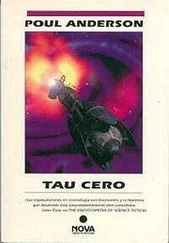
Poul Anderson - Tau Zero
Здесь есть возможность читать онлайн «Poul Anderson - Tau Zero» весь текст электронной книги совершенно бесплатно (целиком полную версию без сокращений). В некоторых случаях можно слушать аудио, скачать через торрент в формате fb2 и присутствует краткое содержание. Год выпуска: 1970, ISBN: 1970, Издательство: Doubleday, Жанр: Фантастика и фэнтези, на английском языке. Описание произведения, (предисловие) а так же отзывы посетителей доступны на портале библиотеки ЛибКат.
- Название:Tau Zero
- Автор:
- Издательство:Doubleday
- Жанр:
- Год:1970
- ISBN:1-568-65278-X
- Рейтинг книги:5 / 5. Голосов: 1
-
Избранное:Добавить в избранное
- Отзывы:
-
Ваша оценка:
Tau Zero: краткое содержание, описание и аннотация
Предлагаем к чтению аннотацию, описание, краткое содержание или предисловие (зависит от того, что написал сам автор книги «Tau Zero»). Если вы не нашли необходимую информацию о книге — напишите в комментариях, мы постараемся отыскать её.
Nominated for Hugo Award for Best Novel in 1971.
Tau Zero — читать онлайн бесплатно полную книгу (весь текст) целиком
Ниже представлен текст книги, разбитый по страницам. Система сохранения места последней прочитанной страницы, позволяет с удобством читать онлайн бесплатно книгу «Tau Zero», без необходимости каждый раз заново искать на чём Вы остановились. Поставьте закладку, и сможете в любой момент перейти на страницу, на которой закончили чтение.
Интервал:
Закладка:
“Quiet, you,” said Reymont. Unlike most of them, who stood with male and female hands clutched together, he held apart, near the stage. To a drab coverall he had pinned his badge of authority.
“You can’t—” Someone must have nudged Williams, for he spluttered into silence.
Telander’s frame grew visibly tenser. “Instruments have … have detected an obstacle. A small nebula. Extremely small, a clot of dust and gas, no more than a few billion kilometers across. It is traveling at an abnormal velocity. Maybe it’s a remnant of a larger thing cast out by a supernova, a remnant still held together by hydromagnetic forces. Or maybe it’s a protostar. I do not know.
“The fact is, we are going to strike it. In about twenty-four hours, ship’s time. What will happen then, I don’t know either. With luck, we can ride out the impact and not suffer serious damage. Otherwise … if the fields become too overloaded to protect us … well, we knew this journey would have its hazards.”
He heard indrawn breaths, like his own on the bridge, and saw eyes grow white-rimmed, lips flutter, fingers trace signs in the air. He persisted: “We cannot do much to prepare. A little battening down, yes; but in general, the ship is already as taut as can be. When the moment approaches, we will be in shock harness and space armor. So — The meeting is now open for discussion.” Williams’ hand rocketed past the shoulder of tall M’Botu. “Yes?” The chemist’s ruddiness showed indignation rather than fear. “Mister Captain! The robot probe observed no dangers on this route. At least, it beamed back no hint of them. Right? Who’s responsible for our blundering into this muck?”
Voices lifted toward a babble. “Quiet!” Charles Reymont called. Though he didn’t speak loud, he pushed the sound from his lungs in such a way that it struck. Several resentful glances were cast at him, but the talkers came to order.
“I thought I had explained,” Telander said. “The cloud is minute by cosmic standards, nonluminous, undetectable at any large distance. It has a high velocity, scores of KPS. Thus, supposing the probe had taken our identical path, the nebulina would have been well offside at the time — more than fifty years ago, remember. Furthermore … we can be certain the probe did not go exactly as we are going. Besides the relative motion of Sol and Beta Virginis, consider the distance between. Thirty-two light-years is more than our poor minds can picture. The slightest variation in the curves taken from star to star means a difference of many astronomical units in the middle.”
“This thing couldn’t have been predicted,” Reymont added. “The chances were big against our running into it. Still, somebody has to draw the long odds now and then.”
Telander stiffened. “I did not recognize you. Constable,” he said.
Reymont flushed. “Captain, I was trying to expedite matters, so some snotbrains won’t keep you here explaining the obvious till we smash.”
“No insults to shipmates. Constable. And kindly wait to be recognized before you speak.”
“I beg the captain’s pardon.” Reymont folded his arms and blanked his features.
Telander said with care: “Please do not be afraid to ask questions, however elementary they seem. You are all educated in the theory of interstellar astronautics. But I, whose profession this is, know how strange the paradoxes are, how hard to keep straight in one’s mind. Best if everyone understands exactly what we are meeting… Dr. Glassgold?”
The molecular biologist lowered her hand and said timidly: “Can’t we — I mean — nebular objects like mat, they would count as hard vacuums on Earth. Wouldn’t they? And we, we are just under the speed of light, gaining more every second. And so more mass. Our inverse tau is about fifteen at the moment, I believe. That means our mass is enormous. So how can a bit of dust and gas stop us?”
“A good point,” Telander replied. “If we are lucky, we will pass without too great hindrance. Not entirely. Remember, that dust and gas is moving equally fast with respect to us, with a corresponding increase of its mass.
“The force fields have to do work on it, directing the hydrogen into the ramjet system and diverting all matter from the hull. This action has its reaction on us. Moreover, it will take place extremely rapidly. What the fields can do in, say, an hour, they may not be able to do in a minute. We must hope that they can, and that the material components of the ship can endure the resultant stresses.
“I have spoken with Chief Engineer Fedoroff at his post. He thinks probably we will not suffer grave damage. He admits his opinion is a mere extrapolation. In a pioneering era, one learns chiefly by experience. Mr. Iwamoto?”
“ S-s-sst! I presume we have no possibility of avoidance? One day ship’s time is about two weeks cosmic time, no? We have not a chance to go around this nebu — nebulina?” “No, I fear not. In our own frame of reference, we are accelerating at approximately three gravities. In terms of the outside universe, however, that acceleration is not constant, but steadily decreasing. Therefore we cannot change course fast. Even a full vector normal to our velocity would not get us far enough aside before the encounter. Anyhow, we haven’t the time to make the preparations for such a drastic alteration of flight pattern. Ah, Second Engineer M’Botu?”
“Might it help if we decelerated? We must keep one or another mode operative at all times, forward or backward thrust, to be sure. But I should think that deceleration now would soften the collision.”
“The computer has not made any recommendations about that. Probably the information is insufficient. At best, the percentage difference in speed would be slight. I fear … I think we have no choice except to — ah—”
“Bull through,” Reymont said in English. Telander cast him a look of annoyance. Reymont didn’t seem to mind.
As discussion progressed, though, his glance darted from speaker to speaker and the lines between mouth and nostrils deepened in his face. When at last Telander pronounced, “Dismissed,” the constable did not return to Chi-Yuen. He pushed almost brutally through the uncertain milling of the rest and plucked the captain’s sleeve.
“I think we had better hold a private talk, sir,” he declared. The choppiness he had been losing was back in his accent.
Telander said with a chill, “Now is hardly the time to deny anyone access to facts. Constable.”
“Oh, call it politeness, that we go work by ourselves instead of bothering people,” Reymont answered impatiently.
Telander sighed. “Come with me to the bridge, then. I’m too busy for special conferences.”
A couple of others seemed to feel differently, but Reymont drove them off with a glare and a bark. Telander must perforce smile a bit as he went out the door. “You do have your uses,” he admitted.
“A parliamentary hatchet man?” Reymont said. “I fear there’ll be more call on me than that.”
“Conceivably on Beta Three. A specialist in rescue and disaster control might be welcome when we get there.”
“You’re the one who’s concealing facts. Captain. You’re pretty badly shaken by what we’re driving into. I suspect our chances are not quite as good as you pretended. Right?”
Telander looked around and did not reply until they were alone in the stairwell. He lowered his voice. “I simply don’t know. Nor does Fedoroff. No Bussard ship has been tested under conditions like those ahead of us. Obviously! We’ll either get by in reasonable shape or we’ll die. In the latter case, I don’t imagine it’ll be from radiation sickness. If any of that material penetrates the screens and hits us, it should wipe us out, a quick clean death. I saw no reason to make worse what hours remain for our people, by dwelling on that possibility.”
Читать дальшеИнтервал:
Закладка:
Похожие книги на «Tau Zero»
Представляем Вашему вниманию похожие книги на «Tau Zero» списком для выбора. Мы отобрали схожую по названию и смыслу литературу в надежде предоставить читателям больше вариантов отыскать новые, интересные, ещё непрочитанные произведения.

Обсуждение, отзывы о книге «Tau Zero» и просто собственные мнения читателей. Оставьте ваши комментарии, напишите, что Вы думаете о произведении, его смысле или главных героях. Укажите что конкретно понравилось, а что нет, и почему Вы так считаете.