Крис Бекетт - Spring Tide
Здесь есть возможность читать онлайн «Крис Бекетт - Spring Tide» весь текст электронной книги совершенно бесплатно (целиком полную версию без сокращений). В некоторых случаях можно слушать аудио, скачать через торрент в формате fb2 и присутствует краткое содержание. Город: London, Год выпуска: 2017, ISBN: 2017, Издательство: Corvus, Жанр: Фантастика и фэнтези, на английском языке. Описание произведения, (предисловие) а так же отзывы посетителей доступны на портале библиотеки ЛибКат.
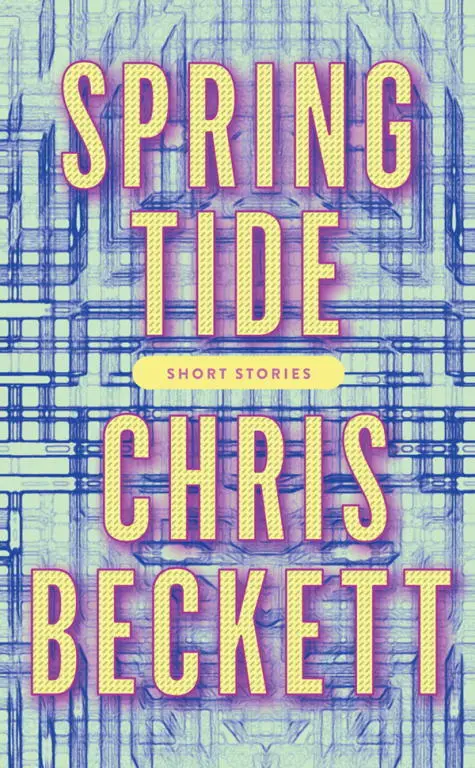
- Название:Spring Tide
- Автор:
- Издательство:Corvus
- Жанр:
- Год:2017
- Город:London
- ISBN:978-1-78-649-0506
- Рейтинг книги:4 / 5. Голосов: 1
-
Избранное:Добавить в избранное
- Отзывы:
-
Ваша оценка:
Spring Tide: краткое содержание, описание и аннотация
Предлагаем к чтению аннотацию, описание, краткое содержание или предисловие (зависит от того, что написал сам автор книги «Spring Tide»). Если вы не нашли необходимую информацию о книге — напишите в комментариях, мы постараемся отыскать её.
Chris Beckett’s thought-provoking and wide-ranging collection of contemporary short stories is a joy to read, rich in detail and texture. From stories about first love, to a man who discovers a labyrinth beneath his house, to an angel left alone at the end of the universe, Beckett displays both incredible range and extraordinary subtlety as a writer. Every story is a world unto itself – each one beautifully realized and brilliantly imagined.
Spring Tide — читать онлайн бесплатно полную книгу (весь текст) целиком
Ниже представлен текст книги, разбитый по страницам. Система сохранения места последней прочитанной страницы, позволяет с удобством читать онлайн бесплатно книгу «Spring Tide», без необходимости каждый раз заново искать на чём Вы остановились. Поставьте закладку, и сможете в любой момент перейти на страницу, на которой закончили чтение.
Интервал:
Закладка:
The same stimuli had been at work on all the others round her. They might be separate universes, islands of sensation in a void, but they were subject to the same basic laws, for each of them had ancestors every bit as distinguished as Ooze’s own, each was a member of the same tiny elite of the living. And so, as she spurted out eggs, they spurted too, until the water inside the wreck was thick and soupy with tiny gritty eggs and chlorine-tasting nebulae of creamy milt.
There was no plan on Ooze’s part, or on the part of any of the others, there was no strategy, but nevertheless an impeccable strategy was unfolding. Very soon millions of tiny fry were jiggling about in the clouded water, seeking out the dead flesh that they could already taste and recognise, though they as individuals had never encountered it before. They fastened themselves onto the ragged remnants of the soldiers and sailors, their tiny bodies forming great quivering sheets that pulsated in unison as they sucked and rasped at muscle and connecting tissue, skin and fat, guts and eyes and brains. Where bones had been broken by the explosion that had destroyed the ship, even the marrow was consumed, as the fry pressed through the jagged fractures and swarmed into the rich interior flesh, pulsing, quivering, jiggling, as they sucked and chewed and grew.
Ooze and her fellows might not be able to do justice to all that meat, but they could make copies of themselves who could.
And then quite suddenly the meat was gone. The ship was left with a crew of skeletons whose uniforms enclosed body-shaped masses of empty water, and whose bones tasted of nothing more appetising than chalk. The only taste in the water now was metal, and ash, and the drifting faeces of Ooze and all the others, the last remnants of the meat, which would spread out across the abyssal plain, settle onto the mud, and be processed in turn by the microscopic lifeforms out there that specialised in such things. From being a place of plenty the ship had all at once become exceptionally barren, a place that would yield no food at all, without even the usual meagre possibility of scraps descending from the surface. Ooze knew this, though the knowledge wasn’t encoded in her limited store of learned information, but in the wants and impulses that had been built into her brain over all those millions of generations of successful ancestors.
She didn’t want to be here any more: that was the form her knowledge took. She didn’t know why – she didn’t even know of the possibility of asking why – but she knew she didn’t want these tastes around her, and that she disliked the troubling vibrations that resulted from being enclosed. What was more, these tingling, wriggling presences all around her no longer provoked desire. She had no recollection of their ever having done so, nor any understanding that many thousands of them were her own sons and daughters. All she knew was that the proximity of all this touch and tingling once again provoked the feelings that it normally would: worry, irritation, fury, dread. And those feelings were a kind of knowledge too, not the temporary surface knowledge that is acquired in a single life, but a deep and ancient knowledge that was as much part of her make-up as her mouth or her senses or her spinal cord. Ooze could not reason, but the laws of her body, based on the experience of countless generations, were reasonable. One could say that Ooze’s body knew, even if she did not, that too many rivals in too small a space would very soon mean starvation.
She pushed the cold metal and the bone away from herself, pushed and turned, until taste and water flow and sound showed her which way she needed to face in order to find mud and open water which she could pull towards herself. And so, in due course, little wriggling Ooze emerged once again from the stripped and scoured wreck. All around her, thousands of tingling others were doing the same, wriggling over and under one another in their hurry to escape. Hunger would very soon build up. Even out there, in the open water around the wreck, there was nothing like enough nourishment descending from above to feed so many mouths. In this now hopelessly overcrowded part of the abyss, every tiny scrap of food that came down from the nothingness above would find a thousand hungry squirming rivals rushing to be the first to reach it.
And that meant that, out of every thousand, nine hundred and ninety-nine would soon be dead, their bodies fought over and torn apart by the still living, most of whom would die and be eaten in their turn. Nothing was wasted down there on the mud, nothing that could be eaten was left to lie.
But with her belly still full for the moment, Ooze pushed the useless metal and bone behind her with a firm rhythmic movement of her narrow body, and pulled the open mud steadily towards herself. Half a mile, a mile, she kept on moving, a tiny wriggling shape on a vast featureless expanse. It was chance, most probably, that sent her far enough away from the wreck to find a defendable territory that would be big enough to keep her going. It was probably just luck that she got away before being completely hemmed in by rivals who wouldn’t let her cross their mud. But chance or not, she got out in time.
And now she waits there again at the bottom of the abyss for the scraps and fragments that appear from above. She is always hungry, always anxious, always on the edge of murderous rage, but yet she is still alive. If she were like us, she’d look back fondly on the times of plenty, that happy interlude when there was more meat than she could eat, those precious moments when her body was so full of pleasure that her own substance burst out from inside her into the surrounding water. But old Ooze isn’t one for memories. Just as the point in space which she occupies is the centre of the universe, so each moment is the only moment she knows.
Yet she has learnt one thing from the time of the ship, learnt it in something like our own sense of that word, I mean: learnt it with her own brain in her own lifetime. She’s learnt that the taste of metal and oil and ash means meat. It means meat in abundance, still unchewed. And it means pleasure, ecstatic pleasure, pleasure of every kind.
Ooze doesn’t think about that taste again, because thinking isn’t a thing she does. She doesn’t play it over in her mind. She doesn’t revisit it. But if she ever encounters it again, she won’t wait this time for the taste of flesh to follow. No, if a lump of burnt metal descends again to her part of the abyss, clever Ooze will head towards it at once. She will drag it closer to herself, haul it out of nothingness, draw it into the tingling core of the universe, so that the universe may be transfigured once again by joy and exultation and rapturous pleasure.
To say Ooze hopes this will happen again would be to impose our kind of understanding on hers. And yet this new readiness, this new reflex, newly conditioned into her modest brain, is a kind of analogue or prototype of hope. She doesn’t know it, she doesn’t know it at all, but what Ooze hopes for in this prototypical and unconscious sense is that her strange-limbed cousins in the world above will sink more of their ships, or crash their planes, or have their great cities flooded by tidal waves of sufficient power to fling cars and buses and trains far out into the sea, so that little Ooze can gorge herself, down at the bottom of the world, and be happy once more before she dies.
15
Newmarket
This was their third date and Judy had suggested a walk not far from where she lived, followed by lunch in a local pub. It wasn’t the ideal day for it, Gerry privately thought, and he wasn’t so keen either on her choice of walk. Under a low grey sky, the country around them was flat not only in the sense of having no hills but also, so it seemed to him, in the sense of being 2D, as if not only colour but the third dimension had somehow been leached out of it. And, in this austere, minimalist landscape, Judy had chosen the most minimalist of landscape features to walk along. It was apparently once a defensive barrier, thrown up in the Dark Ages to protect the East Angles from enemies to the west, but that didn’t alter the fact that it was a dead straight bank of earth beside a dead straight ditch.
Читать дальшеИнтервал:
Закладка:
Похожие книги на «Spring Tide»
Представляем Вашему вниманию похожие книги на «Spring Tide» списком для выбора. Мы отобрали схожую по названию и смыслу литературу в надежде предоставить читателям больше вариантов отыскать новые, интересные, ещё непрочитанные произведения.









Обсуждение, отзывы о книге «Spring Tide» и просто собственные мнения читателей. Оставьте ваши комментарии, напишите, что Вы думаете о произведении, его смысле или главных героях. Укажите что конкретно понравилось, а что нет, и почему Вы так считаете.