Bruce Sterling - Distraction
Здесь есть возможность читать онлайн «Bruce Sterling - Distraction» весь текст электронной книги совершенно бесплатно (целиком полную версию без сокращений). В некоторых случаях можно слушать аудио, скачать через торрент в формате fb2 и присутствует краткое содержание. Год выпуска: 1998, ISBN: 1998, Издательство: Spectra, Жанр: Фантастика и фэнтези, на английском языке. Описание произведения, (предисловие) а так же отзывы посетителей доступны на портале библиотеки ЛибКат.
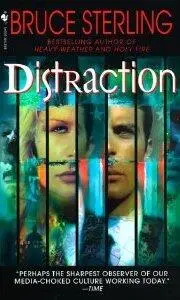
- Название:Distraction
- Автор:
- Издательство:Spectra
- Жанр:
- Год:1998
- ISBN:0-553-10484-5
- Рейтинг книги:4 / 5. Голосов: 1
-
Избранное:Добавить в избранное
- Отзывы:
-
Ваша оценка:
Distraction: краткое содержание, описание и аннотация
Предлагаем к чтению аннотацию, описание, краткое содержание или предисловие (зависит от того, что написал сам автор книги «Distraction»). Если вы не нашли необходимую информацию о книге — напишите в комментариях, мы постараемся отыскать её.
Won Clarke Award in 200.
Nominated for Hugo, Locus, and Nebula awards in 1999.
Distraction — читать онлайн бесплатно полную книгу (весь текст) целиком
Ниже представлен текст книги, разбитый по страницам. Система сохранения места последней прочитанной страницы, позволяет с удобством читать онлайн бесплатно книгу «Distraction», без необходимости каждый раз заново искать на чём Вы остановились. Поставьте закладку, и сможете в любой момент перейти на страницу, на которой закончили чтение.
Интервал:
Закладка:
Oscar canceled his public relations poster campaign. The Strike was well and truly over now, and the lab’s new regime required a new graphic look and a fresh media treatment. After a brainstorming ses-sion with his krewe, Oscar decided on the use of loudspeakers. The Emergency Committee’s continuing negotiations would be broadcast live on half a dozen loudspeakers, situated in various public areas within the dome.
This proved a wise design choice. The loudspeakers had a pleas-antly makeshift, grass-rootsy feeling. People could gently drift in and out of the flow of political agitation. The antiquated technology pro-vided a calming, peripheral media environment. People could become just as aware of the continuing crisis as they felt they needed to be.
Thanks to the use of loudspeakers, the Collaboratory personnel and their mongrelized invaders were placed on an equal informational plane. As an additional gambit, tasteful blue plastic “soapboxes” were set up here and there, where especially foolish and irate people could safely vent their discontents. Not only was this a safety valve and a useful check on popular sentiment, but it made the gimcrack Emer-gency Committee seem very adult and responsible by contrast.
This media campaign was especially useful in finessing the severe image problem presented by Captain (once General, once Corporal) Burningboy. In person or on video, the prole leader looked impossi-bly crazed and transgressive. However, he had a deep, fatherly speak-ing voice. Over the loudspeakers, Burningboy radiated the pious jollity of an arsonist Santa Claus.
It was a misconception to imagine that the Moderators were merely violent derelicts. The roads of America boasted a great many sadly desperate people, but the Moderators were not a mob of hobos. The Moderators were no longer even a “gang” or a “tribe.” Basically, the Moderators were best understood as a nongovernmental network organization. The Moderators deliberately dressed and talked like savages, but they didn’t lack sophistication. They were organized along new lines that were deeply orthogonal to those of conventional Amer-ican culture.
It had never occurred to the lords of the consumer society that consumerism as a political philosophy might one day manifest the grave systemic instabilities that Communism had. But as those instabil-ities multiplied, the country had cracked. Civil society shriveled in the pitiless reign of cash. As the last public spaces were privatized, it be-came harder and harder for American culture to breathe. Not only were people broke, but they were taunted to madness by commercials, and pitilessly surveilled by privacy-invading hucksters. An ever more aggressive consumer-outreach apparatus caused large numbers of peo-ple to simply abandon their official identities.
It was no longer any fun to be an American citizen. Bankruptcies multiplied beyond all reason, becoming a kind of commercial apostasy. Tax dodging became a spectator sport. The American people simply ceased to behave. They gathered to publicly burn their licenses, chop up their charge cards, and hit the road. The proles considered them-selves the only free Americans.
Nomadism had once been the linchpin of human existence; it was settled life that formed the technological novelty. Now technol-ogy had changed its nonexistent mind. Nomads were an entire alter-nate society for whom life by old-fashioned political and economic standards was simply no longer possible.
Or so Oscar reasoned. As a wealthy New Englander, he had never had much political reason to concern himself with proles. They rarely voted. But he had no prejudice against proles as a social group. They were certainly no stranger or more foreign to his sensibilities than scientists were. Now it was clear to him that the proles were a source of real power, and as far as he knew, there was only one Amer-ican politician who had made a deliberate effort to recruit and sustain them. That politician was Green Huey.
Having pacified the Moderators, Oscar’s second order of business was reconciling the Collaboratory’s scientists to their presence. Oscar’s key talking point here was their stark lack of choice in the matter.
The Collaboratory’s scientists had always had firm federal back-ing; they had never required any alternate means of support. Now there was no federal largesse left. That was bad, but the underlying reality was much, much worse. The lab’s bookkeeping had been ruined by a netwar attack. The Collaboratory was not only broke, its inhabitants were fiscally unable even to assess how broke they were. They couldn’t even accurately describe the circumstances under which they might be bailed out.
Morale at the lab had soared on the news that the President had taken notice of their plight. The President had even gone so far as to send a prepared speech for the lab’s Director, which was duly recited by Greta. However, the speech had a very conspicuous omission: money. The press release was basically a long grateful paean to the President’s talent for restoring law and order. Financing the Col-laboratory was not the President’s problem. The Congress was in charge of the nation’s purse strings, and despite frenzied effort, the Congress had still not managed to pass a budget.
For a federal science facility, this was a disaster of epic magni-tude, but for proles, it was business as usual.
So — as Oscar explained to the Emergency Committee — it was a question of symbiosis. And symbiosis was doable. Having boldly cut its ties to the conventional rules of political reality, the Collaboratory’s new hybrid population could float indefinitely within their glass bub-ble. They had no money, but they had warmth, power, air, food, shelter; they could all mind the business of living. They could wait out the turbulence beyond their borders, and since they were also ignoring federal oversight, they could all concentrate on their favorite pet proj-ects. They could get some genuine scientific work accomplished, for once. This was a formidable achievement, a Shangri-la almost, and it was there within their grasp. All they had to do was come to terms with their own contradictions.
There was a long silence after Oscar’s presentation. The Emer-gency Committee gazed at him in utter wonderment. At the moment, the Committee’s quorum consisted of Greta, her chief confidant and backer Albert Gazzaniga, Oscar himself, Yosh Pelicanos, Captain Burningboy, and a representative Moderator thug — a kid named Ombahway Tuddy Flagboy.
“Oscar, you’re amazing,” Greta said. “You have such talent for making impossible things sound plausible.”
“What’s so impossible about it?”
“Everything. This is a federal facility! These Moderator people invaded it by force. They’re occupying it. They are here illegally. We can’t aid and abet that! Once the President sends in troops, we’ll all be outed for collaboration. We’ll be arrested. We’ll be fired. No, it’s worse than that. We’ll be purged.”
“That never happened in Louisiana,” Oscar said. “Why should it happen here?”
Gazzaniga spoke up. “That’s because Congress and the Emer-gency committees never really wanted that air base in Louisiana in the first place. They never cared enough about it to take action.”
“They don’t care about you, either,” Oscar assured him. “It’s true that the President expressed an interest, but hey, it’s been a long week now. A week is forever during a military crisis. There aren’t any federal troops here. Because there isn’t any military crisis here. The President’s military crisis is in Holland, not East Texas. He’s not going to deploy troops domestically when the Dutch Cold War is heating up. If we had better sense, we’d realize that the Moderators are our troops. They’re better than federal troops. Real troops can’t feed us.”
Читать дальшеИнтервал:
Закладка:
Похожие книги на «Distraction»
Представляем Вашему вниманию похожие книги на «Distraction» списком для выбора. Мы отобрали схожую по названию и смыслу литературу в надежде предоставить читателям больше вариантов отыскать новые, интересные, ещё непрочитанные произведения.


Обсуждение, отзывы о книге «Distraction» и просто собственные мнения читателей. Оставьте ваши комментарии, напишите, что Вы думаете о произведении, его смысле или главных героях. Укажите что конкретно понравилось, а что нет, и почему Вы так считаете.