John Ringo - There Will Be Dragons
Здесь есть возможность читать онлайн «John Ringo - There Will Be Dragons» весь текст электронной книги совершенно бесплатно (целиком полную версию без сокращений). В некоторых случаях можно слушать аудио, скачать через торрент в формате fb2 и присутствует краткое содержание. Год выпуска: 2003, ISBN: 2003, Издательство: Baen Books, Жанр: Фантастика и фэнтези, Боевая фантастика, Фэнтези, на английском языке. Описание произведения, (предисловие) а так же отзывы посетителей доступны на портале библиотеки ЛибКат.
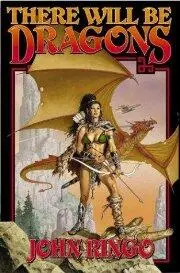
- Название:There Will Be Dragons
- Автор:
- Издательство:Baen Books
- Жанр:
- Год:2003
- ISBN:978-0-7434-7164-0
- Рейтинг книги:3 / 5. Голосов: 1
-
Избранное:Добавить в избранное
- Отзывы:
-
Ваша оценка:
There Will Be Dragons: краткое содержание, описание и аннотация
Предлагаем к чтению аннотацию, описание, краткое содержание или предисловие (зависит от того, что написал сам автор книги «There Will Be Dragons»). Если вы не нашли необходимую информацию о книге — напишите в комментариях, мы постараемся отыскать её.
There Will Be Dragons — читать онлайн бесплатно полную книгу (весь текст) целиком
Ниже представлен текст книги, разбитый по страницам. Система сохранения места последней прочитанной страницы, позволяет с удобством читать онлайн бесплатно книгу «There Will Be Dragons», без необходимости каждый раз заново искать на чём Вы остановились. Поставьте закладку, и сможете в любой момент перейти на страницу, на которой закончили чтение.
Интервал:
Закладка:
After the first meeting in the tavern, people had taken it as expected that he’d turn up at every such meeting. For the first week there had been one every other day until he pointed out that he had other things to be doing. At which point the term “dictator” had first been raised, initially by a few of the more loudmouthed of the new arrivals but later in mutterings even among some of the long-term residents of Raven’s Mill.
It had started with his “high-handed” decision to put Bethan Raeburn in charge of the treasury. She had taken up the handling of the commissary from the beginning and as food chits had quickly turned into currency, it had only made sense for her to continue applying her practical knowledge and increasing experience in handling them. Oh, but that did not sit well with some of the new arrivals. Brad Deshurt had been a researcher in preinformation technology economies and had made plain, with a large number of polysyllabic words, that the basis of Raeburn’s plans were inflationary and would otherwise cause the world to end. As if it hadn’t already. Deshurt was just about the only person Edmund had ever met who was frankly obese and he remained “fleshy” even after walking all the way from the region of Washan. Edmund was rather sure that the basis of Deshurt’s animus was that Bethan refused to let people have seconds.
Nonetheless, under fire and holding their positions with difficulty, Bethan hung on to the treasury and, remarkably, the sky had yet to fall. What was worse, Deshurt had somehow argued his way into a position of “expert on everything” and it had turned out to be impossible to shake him. Edmund was pretty sure that he was going to run in the next council election and since the world seemed to hate him, the loudmouth was probably going to win.
However, above and beyond Edmund’s decisions with regards to the treasury and who should run it, his cut-the-Gordian-knot approach to farm policy was considered even more evil. Edmund knew that he had, at most, a vague layman’s knowledge of period farming. To him the difference between, say, Republican Roman farming conditions and those of the Middle Ages existed only as a backdrop to the social, political and military climate of each age.
But in each of those periods the farming techniques influenced the military at least as much as the reverse. So he was well aware of what sort of farming he wanted to occur and what sort he didn’t. Fortunately he and Myron were in agreement, for similar reasons, and while Edmund knew next to nothing about farming, if there was anyone with more knowledge than Myron among the refugees, Edmund had yet to find them. So he put Myron in charge of making the decisions.
O! Woe was he! The screams had started almost immediately and they revealed a bitter undercurrent he’d only started to sense. Myron was very much the villain of the piece already. It was through his “stinginess” that food rations were so small. Edmund had never heard the term “bloated plutocrat” outside of an old novel until some yammerhead had stood up at the last meeting and shouted it at Myron.
Myron had no idea how to handle the pressure. He was, in his own mind, just a simple farmer. His previous experience with “public life” had been to give tours of his farm during Faire. Suddenly being at the center of a raging controversy was not his cup of tea. He’d tried to abdicate the responsibility but Edmund wouldn’t let him. Myron knew what needed to be done and how to do it and the various yammerheads, as their own proposals proved, did not.
Mostly the arguments boiled down to a few broad groups. One held that anyone who wanted to farm, knowledge or not, should be given everything that they felt was necessary and then given as much land as they could stake out. Generally “stake out” was based upon “blazing” trees to define their area. Edmund hadn’t been able to come up with all the reasons that was a stupid idea so he let others carry the ball. It was pointed out by several that there was a limit to the materials available, not to mention the people with the skill to make anything from them. Others pointed out the long-term arguments that would arise from such ephemeral markers as blazes.
The yammerhead that had called Myron a “bloated plutocrat” was at the head of the “all for one and one for all” group who felt that all materials should be held in common and used in common. They were in favor of putting all the resources of the town into a communal “usage storage” and letting people draw from it. All the land would be held in common and people would do what they could, giving material back into common holding.
Edmund had been the main one to put his foot down on that. He had dredged up dozens of half-remembered historical references, from the early Pilgrims in Norau, who had nearly starved before they gave up communal ownership, to the great debacles of the latter twentieth-century “communist” states and communal farms, which had starved most of a nation for fifty years.
The last group, and this one was the scariest, was led by Brad Deshurt. He had proposed that Myron’s farm simply be expanded and use the labor of the refugees to do the work. Despite his background in preinformation technology economics, the term “latifundia” was not part of his background nor was he willing to admit the resemblance to “slave plantations.” But since Myron wasn’t about to let a giant plantation be raised on bond labor, with the long-term implications that would raise, the argument was moot. In fact, the problem that Edmund was having with Myron was the exact opposite; he wanted regulations to prevent any one person from ever owning too much land. They had talked about it for hours the night before.
“Latifundia, either true latifundia with large numbers of semi-bond labor or corporate latifundia where the corporation owns the land and works it through hirelings, are eventually a given…” Edmund had explained.
“But… Edmund, the whole basis for a decent preindustrial democracy or republic is the small farmer. If you get latifundia, eventually you get feudalism, either implied or in fact. You either get the Middle Ages or the postslavery South. You don’t want that, I don’t want that. The only way to avoid it is to prevent any group from getting too much power.”
“Every law against monopolies, especially land-holding monopolies, has failed,” Edmund pointed out. “It’s like laws against ‘moral crimes.’ If you create a law that involves that much money, either people will flout it or the lawyers will find a loophole. It’s like the idiots who don’t want hemp planted because it can be used as a drug. Great, it’s also the best basis for making paper and rope, two things we need. People who want to get addicted to hemp can feel free. Trying to keep them from growing it, given that the seeds are available and the land is for the taking, is impossible. It’s a law designed to fail. And if you set up a law to fail, you set up the law to be ignored.
“No, avoidance of latifundi would be a good thing, but in all honesty there’s no way to do it. Initially, I’ll agree that individuals cannot prove and register more than five hundred hectares during their lifetimes. But after it is proved and registered, it’s open season. If someone wants to sell out, they can sell out. Assuming that there is any capital to sell it to.”
“I hate latifundi,” Myron grumped. “It was the corporate latifundia that put the stake in the heart of the small farmer. And you know where that led.”
“To a huge argument about which came first the chicken or the egg,” Edmund said with a grin. “Truthfully, so do I, but open-market democratic capitalism isn’t the best system of government in the world, it just works the best. Actually, there’s a real question whether it’s the best for this sort of society. Arguably, we should be setting up a centralized dictatorship or a feudalism. Those are generally the most stable in this sort of situation. But we’re not; we’re going for the long ball of republicanism. History will tell us if we were right or wrong. Hopefully, if we’re wrong, history will tell us after our grandchildren are dead.”
Читать дальшеИнтервал:
Закладка:
Похожие книги на «There Will Be Dragons»
Представляем Вашему вниманию похожие книги на «There Will Be Dragons» списком для выбора. Мы отобрали схожую по названию и смыслу литературу в надежде предоставить читателям больше вариантов отыскать новые, интересные, ещё непрочитанные произведения.








Обсуждение, отзывы о книге «There Will Be Dragons» и просто собственные мнения читателей. Оставьте ваши комментарии, напишите, что Вы думаете о произведении, его смысле или главных героях. Укажите что конкретно понравилось, а что нет, и почему Вы так считаете.