John Ringo - There Will Be Dragons
Здесь есть возможность читать онлайн «John Ringo - There Will Be Dragons» весь текст электронной книги совершенно бесплатно (целиком полную версию без сокращений). В некоторых случаях можно слушать аудио, скачать через торрент в формате fb2 и присутствует краткое содержание. Год выпуска: 2003, ISBN: 2003, Издательство: Baen Books, Жанр: Фантастика и фэнтези, Боевая фантастика, Фэнтези, на английском языке. Описание произведения, (предисловие) а так же отзывы посетителей доступны на портале библиотеки ЛибКат.
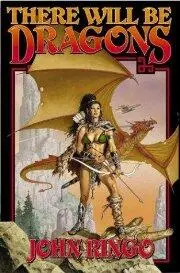
- Название:There Will Be Dragons
- Автор:
- Издательство:Baen Books
- Жанр:
- Год:2003
- ISBN:978-0-7434-7164-0
- Рейтинг книги:3 / 5. Голосов: 1
-
Избранное:Добавить в избранное
- Отзывы:
-
Ваша оценка:
There Will Be Dragons: краткое содержание, описание и аннотация
Предлагаем к чтению аннотацию, описание, краткое содержание или предисловие (зависит от того, что написал сам автор книги «There Will Be Dragons»). Если вы не нашли необходимую информацию о книге — напишите в комментариях, мы постараемся отыскать её.
There Will Be Dragons — читать онлайн бесплатно полную книгу (весь текст) целиком
Ниже представлен текст книги, разбитый по страницам. Система сохранения места последней прочитанной страницы, позволяет с удобством читать онлайн бесплатно книгу «There Will Be Dragons», без необходимости каждый раз заново искать на чём Вы остановились. Поставьте закладку, и сможете в любой момент перейти на страницу, на которой закончили чтение.
Интервал:
Закладка:
“How do you propose to spread them?” Ishtar asked. “And what does your little friend think of them?” she added, gesturing at the lizard wrapped around Sheida’s neck.
“He thinks they’re a prey species,” Sheida chuckled. “And they can be given a boost of energy and told to fly to specific places on earth. So they can be spread widely. But if you could start breeding them here, for example, and Ungphakorn in Soam, myself in Norau, etc.”
“Can New Destiny use the power?” Ishtar asked.
“No, it doesn’t dump in the Net,” Sheida said. “It can be restricted from it. But they might copy us. At some point I could see battles for solar territory, but that’s far off. We have to get the nannites spread first.”
“Hmmm,” Ishtar replied, closing her eyes. “Long term it might even be to Paul’s advantage. He has more land area than we do and more of it in high solar regions. Do these interfere with photosynthesis?”
“No,” Sheida assured her. “They absorb a completely different spectrum. And, of course, they cannot auto-replicate. So they’ll spread slowly no matter what. The last thing is that they are self-repelling; they won’t cover more than ten percent of any given square meter and that broadly distributed. I don’t want the whole world to look like a dust bowl.”
“Okay,” Ishtar said. “I’ll ken some of these creatures and get them distributed. I’ll start in the Southern Marshes; they should like it there.”
“Have you figured out who is supplying Paul with power?” Sheida asked.
“Not yet,” Ishtar admitted. “I’m having to send out biological scouts similar to that one to try to find each of the Wolf 359 board members. That means going to their last known location and then trying to track them. It is going slowly. So far I have determined that six of them died either just prior to or just after the Fall. Others I haven’t been able to find yet.”
“Well, keep me posted,” Sheida said. “I have the funny feeling it’s going to bite us in the ass.”
CHAPTER THIRTY-SIX
Herzer wasn’t too sure what being in a permanent station would be like, but it turned out to be not too different from training. They still drilled intensively every day, worked their weights and took regular road marches, not to mention a daily stroll up the Hill. In addition, they were put to work building a more permanent camp, making wooden barracks with planked wood walls and floors instead of the tents they had been occupying and making furniture for them. Herzer was fine at the construction but his inability to handle fine woodwork followed him to the furniture making. After seeing his first few disastrous attempts, Jeffcoat set him to other tasks.
The physical area of the camp was expanded and workers from the town extended the ditch and palisades under Herzer’s direction. He also found himself in charge of their maintenance and pay and discovered the horrors of paperwork. However, he turned out to be capable of that as well and Jeffcoat, who it turned out was on the near side of functionally illiterate, turned more and more of the administration of the camp over to him. Herzer soon found himself handling pay records, training plans, duty rosters and all the other minutiae that is necessary to a well run military operation. When he found himself generating paperwork he decided that he’d been at it too long and started working on expansion plans in his spare time.
At his suggestion, part of the triari’s training was to begin regular “simulated” battles with the town militia. This did two things. The first was that it gave the troops and the militia good training, more realistic than either group fighting decuri to decuri. The second thing was that the militia quickly discovered, and passed along the message, that there was a big difference between the two forces. At the first encounter Herzer, who was acting in the position of triari commander, had been surprised how easily the militia, many of whom had been reenactors before the Fall, had been routed. Part of it was the bowmen, who had set up in record time and “counterfired” the crossbowmen and short bows of the militia before the two infantry forces had even come to blows. The second was the difference in the disciplined shield line and “open formation” of the Blood Lords versus the more-or-less mob approach of the militia.
The militia formed in two lines with a solid line of basically unarmed shield wielders followed by spear and polearm wielders. The “sawtoothed” formation of the Blood Lords, and their superior discipline, permitted them to break up the shield formation and then rout the lighter armed interior groups. And this was without a pilum cast or even engaging the militia with the longbowmen. It went a long way to quelling an incipient war that was developing between the “civilians” and the military forces.
There still was a terrific lack of luxuries or free time in Raven’s Mill. Everyone was working nearly nonstop. So on the Saturday evenings when the “soldiers” were let free on pass, the fact that most of them had some money to spend, and the fact that the town so rarely saw the intensity of their daily drill, had caused a fair amount of resentment. There had been a few fights and one stabbing of a soldier, fortunately not fatal. But after the first militia battle, when the militia was so handily and speedily routed, and after it was pointed out that the Blood Lords would be the first to engage any enemy, and hopefully the last, some of the disturbance subsided. There were still a few hotheads, on both sides, but exercise had helped ease the tension. And the fact that it was Herzer’s idea brought him, again, to Edmund Talbot’s attention.
He was laying out the parameters for the next battle one evening when the door of the triari office opened to reveal Mayor Talbot.
“Herzer, it’s Saturday night,” Edmund said. “What the hell are you doing still working? When I saw the lamplight, I figured it was Gunny.”
“I’m trying to tighten up the scenario for the next battle, Mayor Edmund,” Herzer said defensively. “We’ve got a real problem with not being able to cover enough frontage and I think that the archers could be better employed. But that means making training arrows of some sort or coming up with a scoring system. And Kane’s going to argue the scoring system unless I’ve got good data.” He gestured to the books on the desk and shrugged. “I’ve been going over the accounts of Crecy, Poitiers and Agincourt to define how many arrows are going to do what damage to the opposing force.”
“Good God, son,” Edmund laughed. “You should have just asked me; I’ve got those numbers memorized. And the simple answer is that if the militia really fought your group, it would get slaughtered in the first couple of minutes. Even though, you’re right, you can’t cover enough frontage. Son, you need to take a break. Put down the quill, put away the sword and come on down to the tavern for a drink. I’ll buy the first round.”
“Well, sir,” Herzer said uneasily. “I don’t know. I don’t actually have much cash at the moment.”
“Come on,” Talbot said, grabbing his arm and hoisting him to his feet. “You’re leaving. All work and no play isn’t conducive to good personal development. For that matter, why don’t you have any cash? The big argument has been that you troops are overpaid.”
“Well, I haven’t been spending it,” Herzer replied, blowing out the lantern as they went out the door. “Actually… I’ve been saving it or investing it. Robert Usawe is starting a dredging operation and he’s taking investors. Given what the masons are paying for river sand and rock, it looks as if we can make back the investment on the dredges and barges in about five months. And the actual operations costs are relatively low. So I’ve poured most of my money lately into that. I also stood part value on a loan to John Miller for an expansion of the sawmill. So it’s not that I don’t have money, it’s just tied up.”
Читать дальшеИнтервал:
Закладка:
Похожие книги на «There Will Be Dragons»
Представляем Вашему вниманию похожие книги на «There Will Be Dragons» списком для выбора. Мы отобрали схожую по названию и смыслу литературу в надежде предоставить читателям больше вариантов отыскать новые, интересные, ещё непрочитанные произведения.


Обсуждение, отзывы о книге «There Will Be Dragons» и просто собственные мнения читателей. Оставьте ваши комментарии, напишите, что Вы думаете о произведении, его смысле или главных героях. Укажите что конкретно понравилось, а что нет, и почему Вы так считаете.