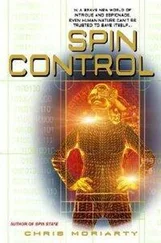
Chris Moriarty - Spin State
Здесь есть возможность читать онлайн «Chris Moriarty - Spin State» весь текст электронной книги совершенно бесплатно (целиком полную версию без сокращений). В некоторых случаях можно слушать аудио, скачать через торрент в формате fb2 и присутствует краткое содержание. Год выпуска: 2003, ISBN: 2003, Издательство: Bantam spectra, Жанр: Фантастика и фэнтези, на английском языке. Описание произведения, (предисловие) а так же отзывы посетителей доступны на портале библиотеки ЛибКат.
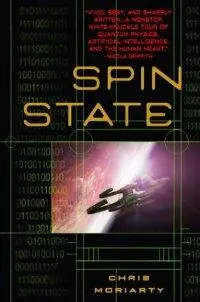
- Название:Spin State
- Автор:
- Издательство:Bantam spectra
- Жанр:
- Год:2003
- ISBN:978-0-553-38213-6
- Рейтинг книги:5 / 5. Голосов: 1
-
Избранное:Добавить в избранное
- Отзывы:
-
Ваша оценка:
Spin State: краткое содержание, описание и аннотация
Предлагаем к чтению аннотацию, описание, краткое содержание или предисловие (зависит от того, что написал сам автор книги «Spin State»). Если вы не нашли необходимую информацию о книге — напишите в комментариях, мы постараемся отыскать её.
UN Peacekeeper Major Catherine Li has made thirty-seven faster-than-light jumps in her lifetime—and has probably forgotten more than most people remember. But that’s what backup hard drives are for. And Li should know; she’s been hacking her memory for fifteen years in order to pass as human. But no memory upgrade can prepare Li for what she finds on Compson’s World: a mining colony she once called home and to which she is sent after a botched raid puts her on the bad side of the powers that be. A dead physicist who just happens to be her cloned twin. A missing dataset that could change the interstellar balance of power and turn a cold war hot. And a mining “accident” that is starting to look more and more like murder…
Suddenly Li is chasing a killer in an alien world miles underground where everyone has a secret. And one wrong turn in streamspace, one misstep in the dark alleys of blackmarket tech and interstellar espionage, one risky hookup with an AI could literally blow her mind.
Spin State — читать онлайн бесплатно полную книгу (весь текст) целиком
Ниже представлен текст книги, разбитый по страницам. Система сохранения места последней прочитанной страницы, позволяет с удобством читать онлайн бесплатно книгу «Spin State», без необходимости каждый раз заново искать на чём Вы остановились. Поставьте закладку, и сможете в любой момент перейти на страницу, на которой закончили чтение.
Интервал:
Закладка:
“Mmm. Sheer brute computing force. That and the fact that I’m eight times cleverer than anyone this charming has a right to be.”
Li smirked.
He stuck his tongue out at her, slipped his shoes off, and sank gracefully onto her bunk. “So. Where were we?”
She grabbed her desk chair and turned it around to sit backwards on it. She summarized her meeting with Daahl and Ramirez, telling Cohen about the exchange of information and the lockdown, but leaving out the personal talk.
“And this Daahl person just picked you out of thin air?” Cohen asked when she’d finished. “He thought you looked like a nice friendly person? You’ll forgive me if I confess to having suspicious thoughts about him.”
Li shrugged, trying to look unconcerned. “It didn’t come up.”
Cohen had sprawled across her bed while she was talking—he had to be doing this on purpose, didn’t he?—and now he stretched, sighing luxuriously, sending Chiara’s glossy curls cascading across Li’s pillow. He opened his eyes, gazed at her in wide-eyed and utterly insincere innocence, and said, “Sure it didn’t. Well, we’ll revisit that question later. Have you found the accident reports he wants?”
“I tried. Didn’t have time to really look.”
“Time is my middle name,” Cohen said with a grandly munificent gesture that Li was sure Chiara had never used in her life. “What’s your password?”
Li gave it to him, and he logged in and produced the missing accident reports within less than a minute.
“Where were they?” she asked.
He raised an eyebrow. “In Voyt’s files. Until a few days ago. Someone deleted them ten hours before you hit station.”
“Who?”
“Hush. I’m working on it. Go do something useful.”
Li scanned the reports, stopping here and there when a name or a word caught her eye:
02/01/47. Stokes, William. Age 32. ID No. 103479920. Subject fatally injured when he returned to Wilkes-Barre North 4 to check a missed shot. No autopsy. Cause of death: burns.
04/12/47. Pinzer, G. F. Age 26. ID No. 457347423. Subject discovered in lower gallery Wilkes-Barre South 14, crushed by roof fall. Rescuers unable to extract body because of gas seepage. Subject identified from personal effects, pit bottom logs. Cause of death: trauma.
04/19/47. Mafouz, Christina. Age 13. ID No. 764378534. Subject’s coal cart experienced brake failure in gangway west of Wilkes-Barre East 17. Subject suffered multiple compound fractures and dislocations with associated soft tissue trauma. Left leg amputated below knee, St. Johns hosp.
These entries were no news at all to Li. They recorded death and maiming by fire, explosives, roof falls, equipment failure. All the routine dangers of the miners’ world.
But scattered among the typical accident reports were other ones:
17/20/47. Carrig, Kevin. Age 37. ID No. 355607534. Subject found unconscious in Trinidad South 2. Pit inspector hypothesizes subject opened gas pocket, but rescuers found no gas at work site and autopsy revealed no signs of gas inhalation. Cause of death: unknown.
20/2/48. Cho, Kristyn. Age 34. ID No. 486739463. Subject collapsed during survey of Trinidad South 7. Witnesses describe complaints of head pain, bright lights, convulsions, loss of consciousness. Autopsy indicated extensive, nonlocalized damage to frontal lobe. Cause of death: brain seizure.
The troublesome reports had started about four months ago. Deaths attributed to electrical shock where repair crews had been unable to find stripped wires or standing water. Deaths attributed to gas where other miners working in the same vein had been mysteriously spared. Healthy miners dying of heart attacks, strokes, brain seizures. And two miners hadn’t died—were still lying in the Shantytown hospital in the grip of comas that no doctor could explain.
There had been a spate of these inexplicable accidents when the Trinidad opened. Then things had leveled off. Then there had been another significant bump three months ago: fourteen unexplained deaths in a single week.
Li didn’t have to cross-reference dates or check her files to know what had happened three months ago.
Sharifi had arrived.
“Guess where the reports were deleted from?” Cohen asked, arching a slender eyebrow and forwarding the still-legible remnant of an erased access log to her. “The station exec’s office.”
“So, Haas deep-sixed the accident reports the day before I arrived.”
“And he was embezzling crystal, or at least we suspect he was.”
“And,” Li said, feeling vaguely dirty, “we know Haas is not unfriendly to the Syndicates.”
They looked at each other.
“It all keeps coming back to Haas,” Li said. “Doesn’t it?”
Instead of answering her, Cohen vanished.
Li staggered to her feet, knocking her chair over. Her quarters looked wrong somehow. She checked her internals and realized that she was no longer in limited VR interaction mode, but in full two-way.
She tried to access realspace.
Nothing.
Code.
Nothing.
She’d been bagged, warehoused, shunted into virtual deadspace. She closed her eyes and rubbed her face, thinking. When she opened them again, she was no longer on-station.
She stood in a perfectly square, perfectly empty room. Blank white walls. Blank floors and ceilings. Nominal squares of windows opening on an eternity of white nothingness. Her heartbeat hammered in the silence like a kettledrum. She focused on a corner where floor met wall in order to stave off vertigo and waited, counting her heartbeats.
A door opened. One moment she was staring at a blank wall. The next someone had stepped into the room with her. But when she tried to recapture the moment of entry, it was missing, skipped over as if there had been a bad splice in her optical feed.
The new person in the room was small, dark, slender. It took Li a few heartbeats to focus on him after the long blank whiteness. When she did, she saw coltish, gangling legs below striped shorts. A red-and-black football jersey. Dark hair. Olive skin.
“Cohen?”
“Sshhhh!” he whispered.
He had nothing on his feet but tall striped socks with bulky shin guards poking out over their tops; his old-fashioned soccer cleats were tied together by the shoelaces and thrown over one bony shoulder. He circled the room, stopping several times to peer at sections of wall that looked, to Li’s eyes, completely unremarkable. He walked up one wall and sat down cross-legged a few feet below the ceiling. “Well, here we are,” he said.
“We? I don’t know who the hell you are, except that you look like Cohen. Which proves nothing.”
He grinned. “Looks don’t always deceive, my dear. Even mine.”
“Prove it.”
“How?”
“Tell me something.”
“Like what?” he said, sounding for all the world like the ten-year-old he appeared to be.
“Something no one else would know.”
He wrapped his arms around his legs and put his sharp little chin on his knees, thinking. “Right,” he said. “Well, you’re two centimeters shorter than you tell people you are.”
“You could pull that out of my transport files.”
“And you’re an evil-tempered beast in the morning.”
She snorted. “As opposed to the rest of the time?”
“Good point,” he said, and laughed.
He peered owlishly at her, rubbing at a fresh scab on his knee. “There’s always your deepest, darkest, awfulest secret.”
She froze. She tried for a laugh but couldn’t quite get there. “Which one?”
“That I love you.”
She looked up to find him watching her as if she were a suspicious package that might explode without warning. “Oh, for God’s sake,” he said after a brief awkward silence. “You don’t have to look like you’re ready to chew your leg off to get away from me every time I say it.”
Читать дальшеИнтервал:
Закладка:
Похожие книги на «Spin State»
Представляем Вашему вниманию похожие книги на «Spin State» списком для выбора. Мы отобрали схожую по названию и смыслу литературу в надежде предоставить читателям больше вариантов отыскать новые, интересные, ещё непрочитанные произведения.




Обсуждение, отзывы о книге «Spin State» и просто собственные мнения читателей. Оставьте ваши комментарии, напишите, что Вы думаете о произведении, его смысле или главных героях. Укажите что конкретно понравилось, а что нет, и почему Вы так считаете.