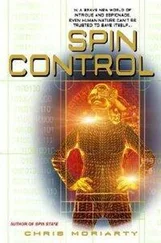
Chris Moriarty - Spin State
Здесь есть возможность читать онлайн «Chris Moriarty - Spin State» весь текст электронной книги совершенно бесплатно (целиком полную версию без сокращений). В некоторых случаях можно слушать аудио, скачать через торрент в формате fb2 и присутствует краткое содержание. Год выпуска: 2003, ISBN: 2003, Издательство: Bantam spectra, Жанр: Фантастика и фэнтези, на английском языке. Описание произведения, (предисловие) а так же отзывы посетителей доступны на портале библиотеки ЛибКат.
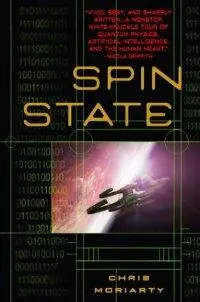
- Название:Spin State
- Автор:
- Издательство:Bantam spectra
- Жанр:
- Год:2003
- ISBN:978-0-553-38213-6
- Рейтинг книги:5 / 5. Голосов: 1
-
Избранное:Добавить в избранное
- Отзывы:
-
Ваша оценка:
Spin State: краткое содержание, описание и аннотация
Предлагаем к чтению аннотацию, описание, краткое содержание или предисловие (зависит от того, что написал сам автор книги «Spin State»). Если вы не нашли необходимую информацию о книге — напишите в комментариях, мы постараемся отыскать её.
UN Peacekeeper Major Catherine Li has made thirty-seven faster-than-light jumps in her lifetime—and has probably forgotten more than most people remember. But that’s what backup hard drives are for. And Li should know; she’s been hacking her memory for fifteen years in order to pass as human. But no memory upgrade can prepare Li for what she finds on Compson’s World: a mining colony she once called home and to which she is sent after a botched raid puts her on the bad side of the powers that be. A dead physicist who just happens to be her cloned twin. A missing dataset that could change the interstellar balance of power and turn a cold war hot. And a mining “accident” that is starting to look more and more like murder…
Suddenly Li is chasing a killer in an alien world miles underground where everyone has a secret. And one wrong turn in streamspace, one misstep in the dark alleys of blackmarket tech and interstellar espionage, one risky hookup with an AI could literally blow her mind.
Spin State — читать онлайн бесплатно полную книгу (весь текст) целиком
Ниже представлен текст книги, разбитый по страницам. Система сохранения места последней прочитанной страницы, позволяет с удобством читать онлайн бесплатно книгу «Spin State», без необходимости каждый раз заново искать на чём Вы остановились. Поставьте закладку, и сможете в любой момент перейти на страницу, на которой закончили чтение.
Интервал:
Закладка:
“But that’s just it. I don’t. I don’t remember anything.”
And then she started to cry.
She cried silently, tears sliding down her cheeks like rain running down the carved face of a statue. Li leaned her elbows on her knees and watched, feeling awkward and useless. She had never seen a grown woman cry like this. It was as if something had come unraveled inside her, as if she had lost whatever obscure sense of shame made people cover their faces when they cried. Lost it, or never had it in the first place.
Li cleared her throat. “What about before you went down? Or on the way down. You must have taken a shuttle. Maybe talked about going? Something.”
“No,” Bella said fiercely. “I told you. Nothing.”
She stood up so abruptly as she spoke that she knocked her coffee cup off the table.
Li reached for it without thinking. She got her hand under it just in time. The spoon fell to the floor. The saucer landed in her palm. The cup rattled but stayed upright. Nothing spilled. She set the cup back on the table and leaned down to pick up the teaspoon.
When she looked up, Bella was staring at her, slack-jawed. “How did you catch that?” she whispered.
Li held out her arm and showed Bella the network of filaments running just below the skin.
Bella looked at it like she’d never seen a wire job before. Worse than that, her face was filled with the fascinated revulsion of someone looking at a circus freak. “What—how do they put it inside you?”
“Viral surgery.”
“Like Voyt,” she said, and a shudder twisted through her slender body as she spoke the dead man’s name. “In the Syndicates, you’d be a monster.”
“Then I guess it’s a good thing we’re not in the Syndicates.”
Bella put her hand up to touch the cranial socket. “Even this is… a deviance.”
“Well, you need to access the spinstream if you’re going to work in the UN worlds. It’s how business is done here. How we communicate.”
“Communicate.” Clearly Bella had never thought of applying that word to what she did instream. “I grew up in a crèche of two thousand. I never looked in a mirror because my face—the crèche face—was all around. I never thought about who I was because I knew, every time I looked around me. I never thought about being alone because I knew I’d never have to be. And now I’m here. I don’t understand anything or anyone. I watch them talk at me, around me. I’m the deviant. And there’s no way out.”
“There’s always a way out,” Li said.
“Not for me. Not even the euth ward. I thought I was… all right. Before Hannah came. But when I meet someone like her, someone like you.” She wiped her face, pushed the heavy hair back from her forehead. “I can’t help wanting to talk to you. Wanting to feel that I’m not alone for a minute. And then you show me… that. And I don’t know what to think.”
“Sharifi was raised by humans,” Li said. “So was I.” It was as close as she’d come in fifteen years to admitting she wasn’t human.
“Does that make such a difference?”
“I guess it does.”
Bella wiped her eyes and spoke again. “I remember the day before the fire. I worked with Ha—with Sharifi. We talked about going down the next day, but we decided nothing. Not definitely. And the next thing I remember is waking up in the mine after the fire.”
Her hand crept to her neck again, and Li could see the pulse fluttering under her fingers like a bird in a hunter’s snare.
“It was dark. I—they were gone.”
“What do you mean, they were gone? Was there someone else with you before that?”
“No. Maybe.” She looked confused. “I don’t know.”
“Where were you when you woke up?”
“In the glory hole. It took me a long time to figure that out. The lights had gone out and I didn’t have a lamp. I… I crawled back and forth looking for the ladder. That’s what I was doing when I found Voyt.”
“Voyt?” Li asked, surprised. He should have been on the level above, at the foot of the stairs up to the Wilkes-Barre. “Are you sure it was Voyt?”
“I felt his mustache,” Bella said, and again Li saw that shudder of… what? Fear? Revulsion? “I never found a light though. And… there was another body.”
“At the foot of the stairs.” That would have been Sharifi.
“No. At the ladder. With Voyt. In the glory hole.” Bella put a hand to her mouth. “It was Hannah, wasn’t it?”
Li nodded. It had to have been Sharifi; no one else had died down there. But assuming Bella was telling the truth, someone had moved both Voyt and Sharifi up to the level above and left them at the bottom of the main stairs into the Trinidad for the rescue crews to find. Why? And who had done it?
“I stepped on her.” Bella looked sick. “I didn’t even stop.”
“She’d been dead a long time by then,” Li lied. “There was nothing you could have done for her.”
Bella started to speak, but as she opened her mouth Haas’s voice rang out in the front office.
“I should go,” Li said.
“No! Wait.”
Li had stood up to leave, but now she crouched in front of the woman, looking up into those impossible eyes, searching the perfect oval of her face for a clue, an answer, anything.
“They got away with it, didn’t they?” Bella said, still speaking in a harsh whisper. “They killed her. And no one’s going to punish them.”
Li was close enough to smell her now. Close enough to see the bitter lines around her lovely mouth, the bruised pallor of the flesh stretched across her cheekbones. Bella looked like a fighter who had taken a knockout punch and was waiting for gravity to catch up with her. And in the violet depths of her eyes Li saw the same black emptiness she’d seen down at the cutting face.
Only this time she could put a name to it.
It was hate. Hate that had been tended and fed and watered until it was big enough to burst through her skin and swallow universes.
Shantytown: 19.10.48.
Compson’s sun shed a smeary bottle green light on Shantytown and played halfheartedly over the awkward sprawl of mold-fuzzed rooftops. The miscalibrated atmospheric processors produced a sooty drizzle that made all of Shantytown look like it was underwater, and the mud that sucked at Li’s boots gave off a faint whiff of sewage.
She followed McCuen past pawnshops, tattoo parlors, storefronts advertising bail bonds and cash loans on paychecks. They were off the grid here; the signs flashed with neon and halogen, not spinfeed. THE PIT, she read, and PAYDAY PAWN and MINER’S EASE, and GIRLSGIRLSGIRLS.
First shift was on; it showed in the waiting silence of the bars, the absence of able-bodied men on the streets. Still, as they left the commercial strip and dove into the back streets, they drew increasing notice. A clot of pale, ragged children stopped their stickball game and stared. A woman on her way home from picking pea coal off the tailings piles turned clear around to watch them pass. When Li looked back, she saw that the woman’s body was bent into a sharp letter L under her load.
McCuen picked his way through the unmarked intersections as surely as if he had a map. Each turn took them farther from daylight and deeper into Shantytown’s poorest quarter. Modular housing units began to be replaced by the virusteel and decaying ceramic tiles of settlement-era habitat pods. Occasionally they passed a still-functional airlock, status lights blinking to indicate the operational status of long-idle life-support systems. More often, the remnants of the original colony were mere deadware, the bottom layer in a sedimentary accretion of obsolete technology and home-brewed or scavenged building materials.
Читать дальшеИнтервал:
Закладка:
Похожие книги на «Spin State»
Представляем Вашему вниманию похожие книги на «Spin State» списком для выбора. Мы отобрали схожую по названию и смыслу литературу в надежде предоставить читателям больше вариантов отыскать новые, интересные, ещё непрочитанные произведения.




Обсуждение, отзывы о книге «Spin State» и просто собственные мнения читателей. Оставьте ваши комментарии, напишите, что Вы думаете о произведении, его смысле или главных героях. Укажите что конкретно понравилось, а что нет, и почему Вы так считаете.