Chris Moriarty - Spin State
Здесь есть возможность читать онлайн «Chris Moriarty - Spin State» весь текст электронной книги совершенно бесплатно (целиком полную версию без сокращений). В некоторых случаях можно слушать аудио, скачать через торрент в формате fb2 и присутствует краткое содержание. Год выпуска: 2003, ISBN: 2003, Издательство: Bantam spectra, Жанр: Фантастика и фэнтези, на английском языке. Описание произведения, (предисловие) а так же отзывы посетителей доступны на портале библиотеки ЛибКат.
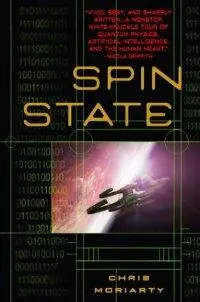
- Название:Spin State
- Автор:
- Издательство:Bantam spectra
- Жанр:
- Год:2003
- ISBN:978-0-553-38213-6
- Рейтинг книги:5 / 5. Голосов: 1
-
Избранное:Добавить в избранное
- Отзывы:
-
Ваша оценка:
Spin State: краткое содержание, описание и аннотация
Предлагаем к чтению аннотацию, описание, краткое содержание или предисловие (зависит от того, что написал сам автор книги «Spin State»). Если вы не нашли необходимую информацию о книге — напишите в комментариях, мы постараемся отыскать её.
UN Peacekeeper Major Catherine Li has made thirty-seven faster-than-light jumps in her lifetime—and has probably forgotten more than most people remember. But that’s what backup hard drives are for. And Li should know; she’s been hacking her memory for fifteen years in order to pass as human. But no memory upgrade can prepare Li for what she finds on Compson’s World: a mining colony she once called home and to which she is sent after a botched raid puts her on the bad side of the powers that be. A dead physicist who just happens to be her cloned twin. A missing dataset that could change the interstellar balance of power and turn a cold war hot. And a mining “accident” that is starting to look more and more like murder…
Suddenly Li is chasing a killer in an alien world miles underground where everyone has a secret. And one wrong turn in streamspace, one misstep in the dark alleys of blackmarket tech and interstellar espionage, one risky hookup with an AI could literally blow her mind.
Spin State — читать онлайн бесплатно полную книгу (весь текст) целиком
Ниже представлен текст книги, разбитый по страницам. Система сохранения места последней прочитанной страницы, позволяет с удобством читать онлайн бесплатно книгу «Spin State», без необходимости каждый раз заново искать на чём Вы остановились. Поставьте закладку, и сможете в любой момент перейти на страницу, на которой закончили чтение.
Интервал:
Закладка:
“According to Everett, each point on the Schrödinger wave function that you use to calculate the possible locations of an electron around the nucleus or the possible spin orientations of a photon has a real, physical existence. Just not in this world. In another world. One of an infinite number of worlds that branch off from each other every time a thermodynamically irreversible measurement event takes place.
“So—textbook example—you come to a crossroads, and you have to decide whether to turn left or right. Or so it seems. But actually you take both forks in the road. You just take them in different worlds. Or, depending on your terminology, in different constituent universes of the multiverse.”
“Then… what’s the point? I mean, everything happens no matter what you do, or what path you choose? It’s crazy.”
“Well, yes, that’s certainly the majority view of things. Or at least it was for several centuries. The Many-Worlds interpretation was one of those theories that was so absurd that Everett either had to be insane or right. And like a lot of crazy theories it took a long time to get off the ground. It got nowhere with most of Everett’s colleagues, in fact, and he left academia and eventually smoked himself to death, ignored and ridiculed.”
“What a surprise,” Li said caustically.
“Right. Well, Everett’s idea sat around gathering dust for the next few centuries while experimental physicists went on with their experiments. Experiments that over time, and without anyone really stopping to notice, gradually made the Many-Worlds theory look less and less crazy and more and more like it might just be a small but important piece of the truth.
“That’s where Hannah Sharifi comes into the story. Hannah was obsessed with Everett’s work. She basically spent two decades trying to prove that the Many-Worlds interpretation of quantum mechanics was right, and that Everett just hadn’t had the experimental data or the computational tools to prove it.”
“But she didn’t prove it, did she?” Li said. “She failed. The most famous failure in the history of physics, right? The biggest mistake since Columbus ran into America and called it India.”
“Yes. She failed. Which is to say that she didn’t prove the multiverse was physically real in the way she believed it was. But—and this is important—a theory doesn’t have to be experimentally verifiable to be valuable. And what she did with Coherence Theory was in some ways far more significant than pinning down an experimental result. She gave us a new theoretical framework for thinking about quantum-level events. In essence, she proved that even if the Many-Worlds interpretation of quantum mechanics doesn’t actually describe the universe, it’s still the most effective way to think about the universe. Or at least the most effective way to think about the universe for now.”
“And what does interference have to do with it? Why do you think she was looking at interference patterns in the Anaconda?”
Cohen shook out a cigarette and lit it, smiling. “Interference is central. It’s the hat trick at the center of Coherence Theory. Basically what Sharifi saw—and this takes us into the realm of quantum information theory—is that interference is really the flip side of coherence. If you really take the concept of the multiverse seriously, then entanglement, decoherence, and interference all become interdependent. In essence, they emerge as the same phenomenon occurring in different dimensions of the multiverse.”
“This is giving me a headache, Cohen.”
“Quantum mechanics gives everyone a headache. That’s just how it is. But my point is you don’t have to believe Sharifi’s idea or even be able to visualize it, really. Because it works, like a lot of the watershed ideas in quantum mechanics, whether or not you believe in it. The Everett-Sharifi Equations accurately predict a whole range of quantum behavior that prior theories couldn’t make sense of. Which goes back to what I was saying about how theories don’t have to be true to be useful.
“And Coherence Theory is beautiful, of course.” His cigarette described a delicate arc in mid-air. “Sharifi’s early papers on it were some of the most elegant pieces of reasoning in the history of modern physics. And being beautiful is almost as important as being useful.” He grinned. “More important, Sharifi would have said.”
“So you think she was looking at live fields in the Bose-Einstein beds because there was something about the relationship between entanglement, interference, and decoherence in those fields that she thought would… what? Prove her theories?”
“Maybe. Or she might just have hoped she could refine some aspect of Coherence Theory. But whatever she was after, it would have been primarily theoretical. A fresh direction. A big answer. A new problem. Something that meant something.”
“Well she found something,” Li said. “We know that. But then she erased her data. So whatever she found, it was something she didn’t want people to know about.”
Cohen shook his head decisively. “I don’t think that can be right. I don’t think Sharifi would have destroyed data. I don’t think any committed scientist could bring herself to do that.”
“Even if she realized that the data would prove Coherence Theory was wrong? Even if she thought it would destroy her life’s work, make her a laughingstock like Everett?”
“Even then, Catherine. Sharifi believed in knowledge. In truth. It was about being right for her, not just having people think she was right.”
“Maybe,” Li said. “Or maybe you just didn’t know her as well as you thought you did.”
Cohen didn’t answer for a moment, and when he spoke he was looking past the Ring-side skyline at the vast glittering curve of Earth. “You’ve never been there, have you?” he asked.
“To Earth? No. Of course not.” No one could go back anymore unless they fell under one of the religious exemptions. And constructs couldn’t go back even then; they were controlled technology, banned by the Embargo.
“I’ve been there,” Cohen said. “I was born there.”
“I know,” Li said, and shivered.
She had seen old noninteractive video footage of Cohen’s programming—or rather of the development of the affective loop cognitive program that eventually grew into the Emergent phenomenon that called itself Cohen. The programmers had described their work with a frankness that was shocking to modern ears. They had talked about calling behaviors, well-being-enhancement drives, emotive manipulation. Those words mocked Li every time she began to imagine that she knew anything about what happened on the other side of the interface.
“What was Earth like?” she asked, shaking off the memory of Chiara’s slender fingers brushing hers, of Roland standing alone in the middle of a crowded room, watching her.
“Beautiful,” Cohen said, and his voice trembled with something the human ear could only interpret as desire. “There will never be anything as beautiful in the universe again.”
“There’s Compson’s World,” Li said. “It’s beautiful. In its own way. What’s left of it.”
Cohen laughed softly, as if a pleasant memory had come back to haunt him. “You’re the second person who’s told me that.”
“Oh?”
“Can’t you guess who the first person was?”
“Who?” she asked.
“Hannah Sharifi.”
“Christ!” Li burst out. “I’m starting to wish I’d never heard of the woman! Gould’s going to hit Freetown in twenty-three days to do who knows what. I have to be there before her. I have to know what Sharifi did, what she found. What she was hiding from us.”
And I have to know how far I can trust you, Cohen .
Читать дальшеИнтервал:
Закладка:
Похожие книги на «Spin State»
Представляем Вашему вниманию похожие книги на «Spin State» списком для выбора. Мы отобрали схожую по названию и смыслу литературу в надежде предоставить читателям больше вариантов отыскать новые, интересные, ещё непрочитанные произведения.









Обсуждение, отзывы о книге «Spin State» и просто собственные мнения читателей. Оставьте ваши комментарии, напишите, что Вы думаете о произведении, его смысле или главных героях. Укажите что конкретно понравилось, а что нет, и почему Вы так считаете.